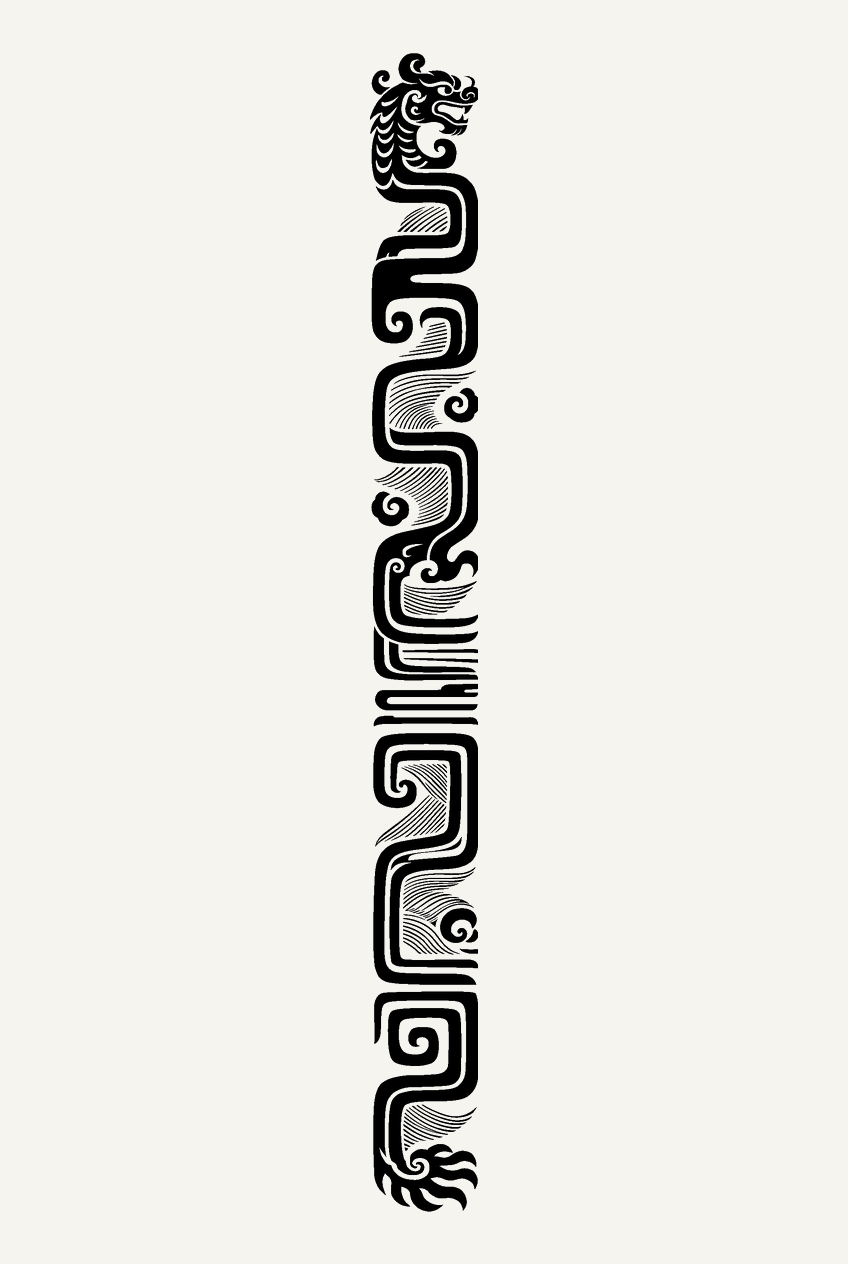
螭龙带 · Chī Lóng Dài
The Coiled Whelp
系列: 符号纹样 · Design #23
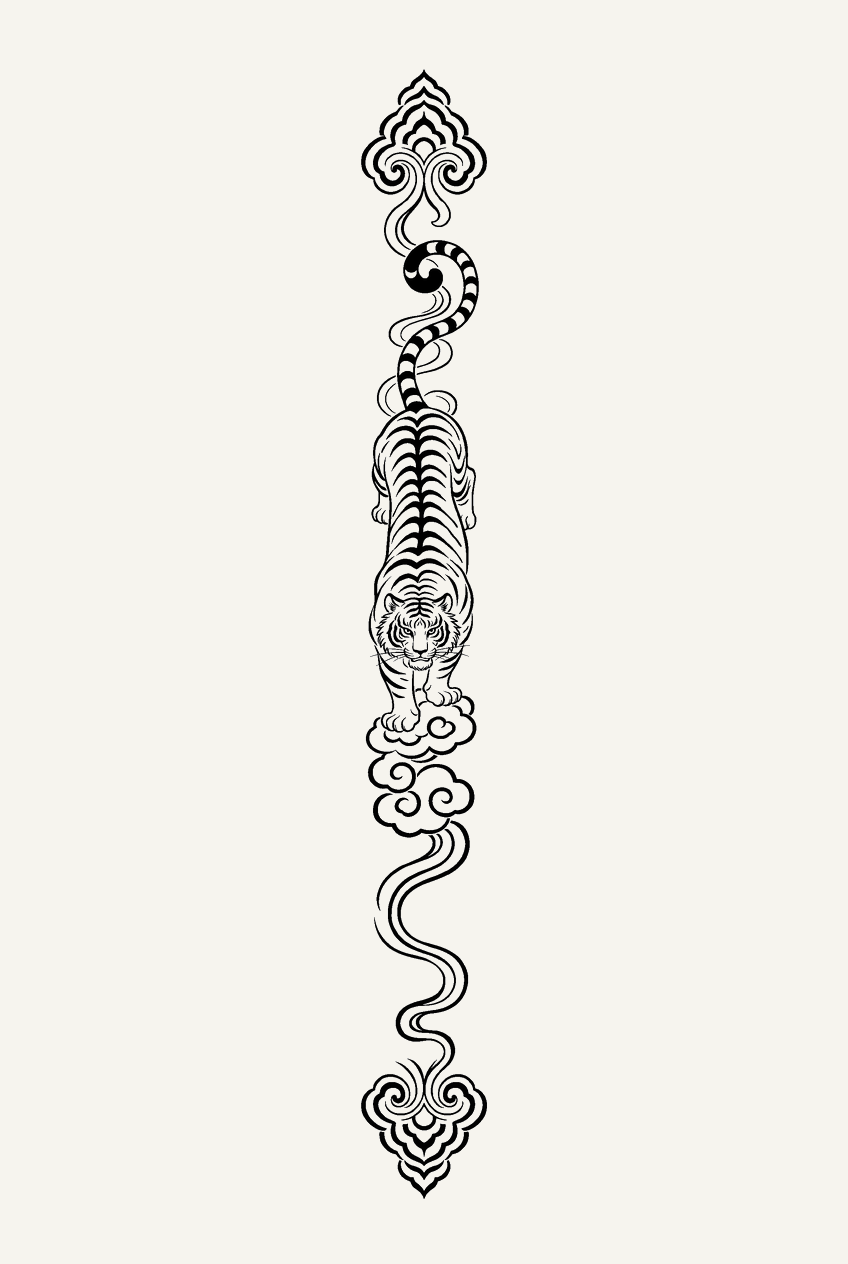
笔法: Hornless dragon vertical band · the chi-dragon's sinuous body coiling down the strip through geometric registers · black-and-white block contrast · full arm-band or leg-band wrap · scalable 12–18 cm
形态: 螭龙几何竖带,无角龙身盘曲贯带,回纹几何地纹相接,作臂环或腿环整圈佩戴
名字
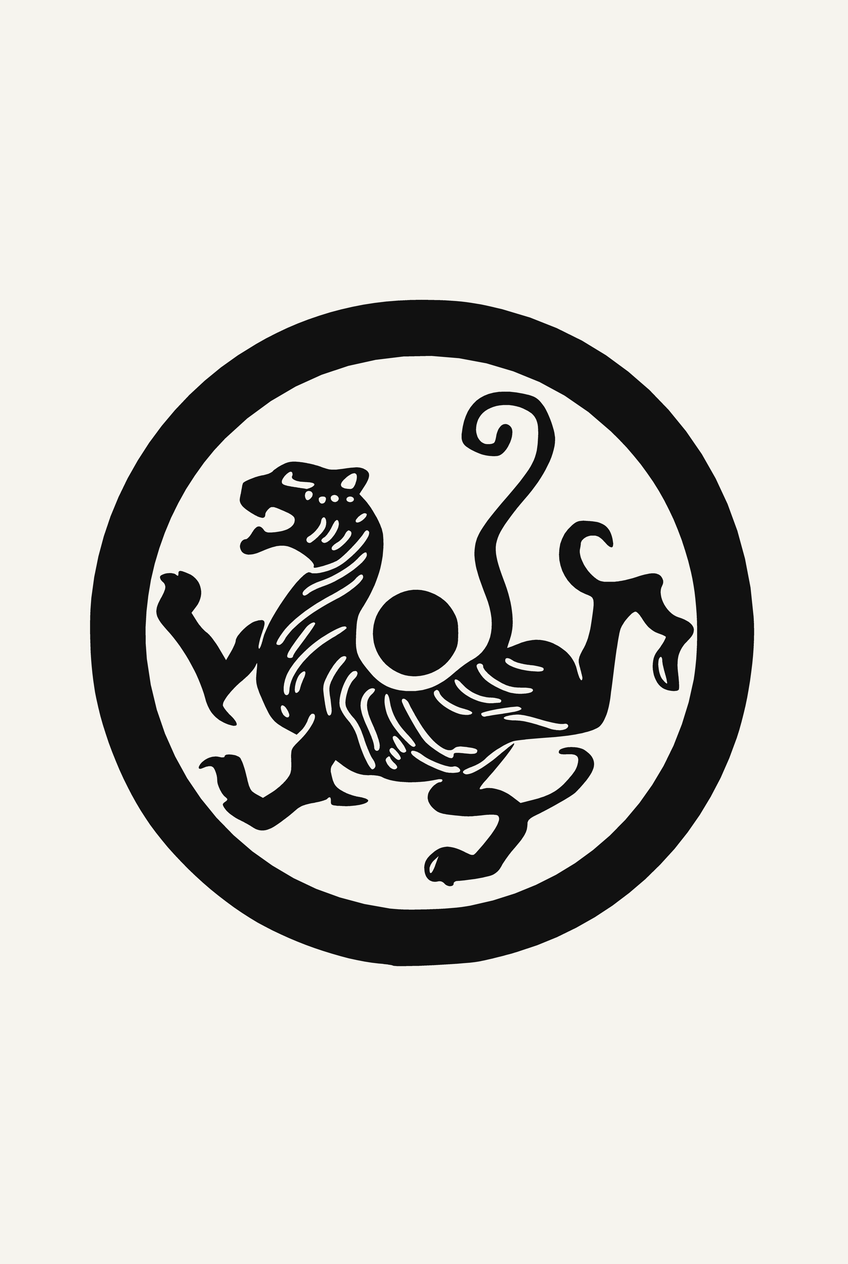
螭龙带(chī lóng dài)——「语法书里的龙」。螭龙是龙最抽象也最古老的自相:无角、无翼,一条盘曲的肌肉线,纹样需要它绕到哪里,它就绕到哪里。辞书早早定下了它的定义:「无角曰螭」(《说文解字》)。在春秋战国的铜器与玉器上,螭龙干脆不再当生物,成了互相咬合的几何——一条被解析成纹样的龙,如同河被解析成涟漪。这条带保留的正是这种解析:先读出结构,后认出动物。
chī lóng dài — the dragon of the grammars. The chilong is the dragon reduced to its most abstract and most ancient self: hornless, wingless, a sinuous line of muscle that coils wherever the pattern needs it. The dictionaries fixed its definition early: 「无角曰螭」 — "the hornless one is called chi" (*Shuowen*). On Spring-and-Autumn and Warring States bronzes and jades, chilong stopped being creatures at all and became interlocking geometry — a dragon resolved into pattern, the way a river is resolved into ripples. This band keeps that resolution: a dragon you read as structure first and animal second.
出处
蟠螭的传统:春秋战国铜器与玉佩上无角龙的互相咬合,小小的蜿蜒龙身打结成连绵的几何场。《说文解字》定下解剖:「无角曰螭」。这一风格传到汉代玉器与建筑,成为中国装饰里标准「龙族」之一,与有角的蛟、帝王的龙并列。形制参考:东周铜器与玉器上的蟠螭纹。墨线转写:本设计以传统母题的经典线条造型为底,转写为纹身墨线。
The pan-chi (coiled chi) tradition: hornless dragon interlace on Spring-and-Autumn and Warring States bronze vessels and jade pendants, where small sinuous dragons knot into continuous geometric fields. The *Shuowen Jiezi* fixes the anatomy: 「无角曰螭」. The style spread to Han jade and architecture and became one of the standard "dragon families" of Chinese ornament, alongside the horned jiao and the imperial lung. Historical form reference: pan-chi interlace on Eastern Zhou bronzes and jades. Inking note: this design adapts the classic line construction of the traditional motif and re-inks it as tattoo linework.
设计灵感
本版每一处形制决定都有出处可查,逐条对账。① 蜿蜒无角身——一根连续的 S 长线,周代玉器里螭的解剖。② 咬合——龙穿过自己的盘曲再打回来,蟠螭的编织逻辑。③ 几何纹段——龙身过场之间的方折回纹地,青铜底纹体系。④ 块面反转——上一段黑龙白地、下一段白龙黑地,如交织纹换前景。
Every form decision on this design points to a recorded source, element by element. ① The sinuous hornless body — one continuous S-running line, the chi's anatomy from the Zhou jades. ② The interlock — the dragon knotting back through its own coils, the pan-chi weaving logic. ③ The geometric registers — square-folded fret fields between the dragon passes, the bronze ground system. ④ The black-mass reversal — the dragon reads black-on-white in one register and white-on-black in the next, as interlace shifts foreground.
来历
每个朝代都照自己的样子重塑龙。帝王的龙长出角、爪与朝廷礼制;佛家的龙长出宝珠与雨。螭龙留在最老的层位里——无角的线、盘曲的肌,还是那条没被提拔上宝座之前的龙。周代工匠用它就像后世用文字:一种活的「书法」,能填进任何形状、拼出的仍是同一个词——运动中的力量,盘着,随时就绪。
螭龙的独特美德是它没有脸可读。无角可宣告等级,无爪可用来威胁,无表情可供解读。它是纯矢量:一根绷紧的线,去向某处,又折回自身,让「某处」永不枯竭。古人觉得这好用至极,把几十条螭打进同一片纹饰场里,图案从不打结——因为一根不与自己争论的线,也轮不到邻居把它缠乱。
这条带让一条螭龙占满整条长度,穿过几何纹段盘行而下,一如它的祖先穿行铜器的地纹。绕在臂上,它像所有好龙一样合拢——合进自己。它承诺的是龙最古老、最不装饰的美德:可以循环的动量,能弯折而不断线的力量。
Every dynasty remade the dragon in its own image. The imperial lung grew horns, claws, and a court protocol; the Buddhist naga grew beads and rain. The chilong stayed behind in the oldest layers — the hornless line, the coiled muscle, the dragon before it was promoted to a throne. Zhou craftsmen used it the way later eras used lettering: as a living script that could fill any shape and still spell the same word — power in motion, coiled and ready.
The chilong's particular virtue is that it has no face to read. No horns to announce rank, no claws to threaten with, no expression to interpret. It is pure vector: a line under tension, going somewhere, doubled back on itself so the "somewhere" never runs out. The ancients found this so useful they knotted dozens of them into single fields of ornament, and the pattern never tangled — because a line that has no argument with itself cannot be tangled by its neighbors.
This band gives one chilong the full length of the strip, coiling through geometric registers the way its ancestors coiled through bronze grounds. Around the arm it closes like all good dragons do — into itself. What it promises is the dragon's oldest and least ornamental virtue: momentum that recycles, strength that bends without breaking the line.
释义
可以循环的力。螭是用几何句法陈述的耐力:盘起来而非一次性花掉的力量,能把一段人生绕起来的动量。也是「不炫之力」——不需要角的龙。给造慢东西的人,这就是徽记。
Force that recycles. The chi is endurance stated as geometry: power that coils instead of spending itself, momentum you can wrap a life around. Also the strength of the unspectacular — the dragon that needs no horns. For builders of slow things, this is the emblem.
位置
上臂或前臂整圈臂环,宽 3–5 厘米,龙线无接续环。小腿腿环上,盘曲顺着小腿线走。缝口落在几何纹段内,绝不许跨龙脊。
Full arm band on the upper arm or forearm, 3–5 cm wide, the dragon's line wrapping continuously. As a leg band the coils follow the calf's line naturally. The seam should fall inside a geometric register, never across the dragon's spine.
纹之前
脊线就是设计:一根长曲线必须贯穿整条不抖——这是线稿师的活。② 至少 3 厘米宽;龙身内部的白细线命薄。③ 纹段极性交替必须干净——翻转一半的纹段读作失误。④ 只宜墨线:交织对比就是全部系统。⑤ 龙身回穿处是白线最紧的点——提前向纹身师标注,用略重的线重。
The spine line is the design: one long curve must run the whole band without wobble — this is a linework-artist piece. ② Keep 3 cm minimum width; the dragon's white interior lines are fine. ③ Registers must alternate polarity cleanly — a half-flipped register reads as an error. ④ Ink-only by design: the interlace contrast is the whole system. ⑤ The dragon's return-through-coil points are the tightest whites — flag them to your artist for slightly heavier line weight.
本卡每一个汉字都由中文母语者选定并逐笔核对。