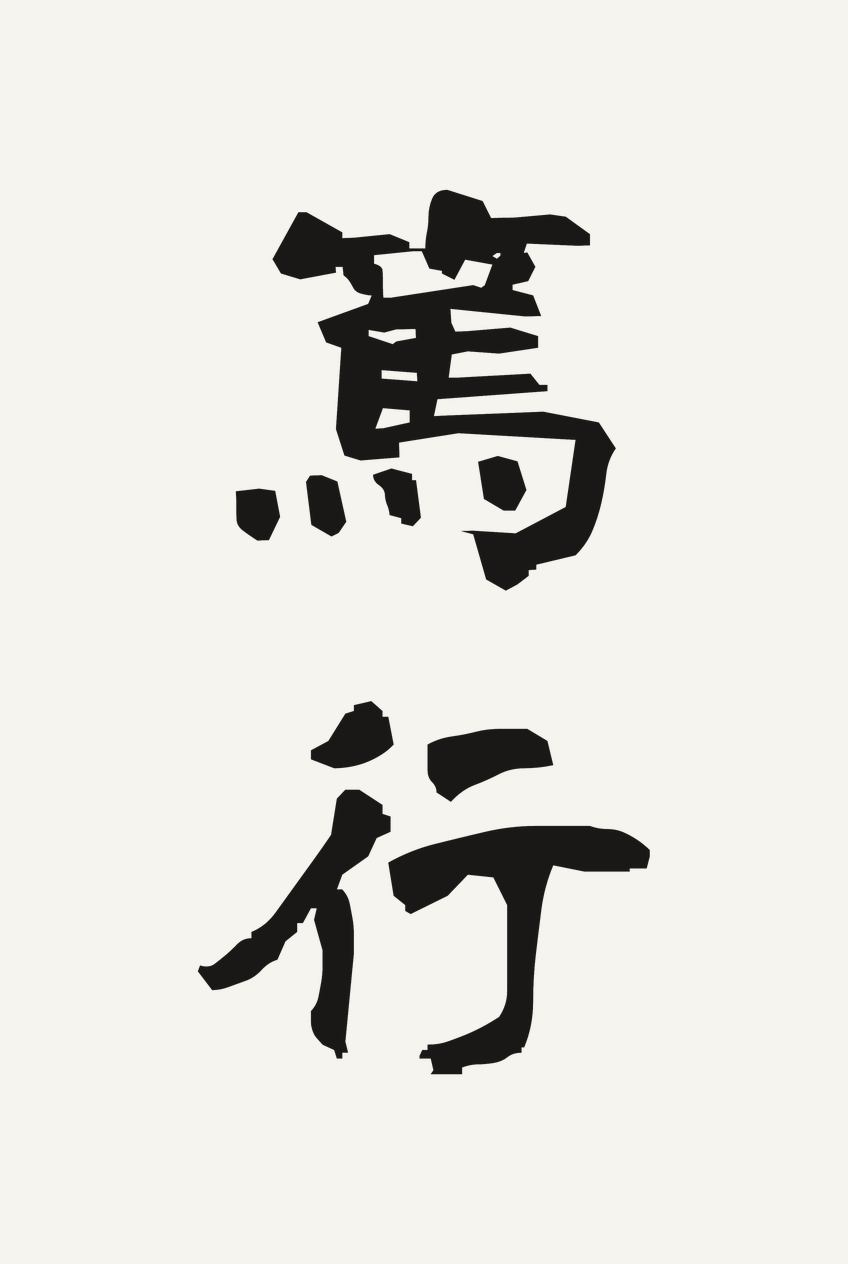
笃行 · Dǔ Xíng
Walk It Home
系列: 单字禅意 · Design #41
笔法: two characters, vertical column · clerical script (lishu, traditional form 篤行) · small-to-medium
形态: 二字竖列,隶书
名字
《礼记》把学习排成五步,最后一步是唯一在光天化日之下算数的:博學之,審問之,慎思之,明辨之,篤行之——广泛地学、使劲地问、仔细地想、清楚地辨,然后——笃行——把它落地,厚厚地,用脚。笃是拴马桩:打进地里,让牲口跑不散。笃行,就是被拴在桩上的知识,散不成观点。
The Ritual Text lays out learning in five steps and ends with the only one that counts in daylight: 博學之,審問之,慎思之,明辨之,篤行之 — study broadly, question hard, think carefully, sort clearly, then — 笃行 — carry it out, thickly, on foot. 笃 is the horse-tightener: the stake driven into the ground that keeps an animal from drifting. 笃行 is knowledge tied to a stake, so it cannot wander off into opinion.
出处
《礼记·中庸》五步法:博學之……篤行之——原文实录;笃行是第五步、最后一步,不是脱离前四步的口号。墨线转写:本设计以传统母题的经典线条造型为底,转写为纹身墨线。
"Liji," Zhongyong, the five-step method: 博學之……篤行之 — original text; 篤行 is the fifth and final step, not a slogan detached from the other four. Inking note: this design adapts the classic line construction of the traditional motif and re-inks it as tattoo linework.
设计灵感
本设计的每一处形制决定都有出处可查,逐条对账。① 二字竖列——方法的最后一步放在最低的位置,因为脚在那里。② 隶书、繁形「篤行」——「篤」的竹字头像路标立在顶上;「行」在底下走。③ 小到中尺寸——6–10 厘米。④ 只用墨——地面只有一种墨,走路各有各的走法。
Every form decision points to a recorded source, element by element. ① Two characters, one vertical column — the method's last step gets the lowest position, because that is where feet are. ② Clerical script, traditional form 篤行 — 篤's bamboo top sits like a signpost; 行 walks at the bottom. ③ Small-to-medium scale — 6–10 cm. ④ Black ink only — the ground is one ink; the walking varies.
来历
五步法是古代世界对囤积式知识最安静的驳斥:每一步都带一个之——它——因为没有一步在拿到对象并搬动它之前算完成。次序也是仁慈的:不要求你在理解之前行动,也不要求你在学习之前理解。笃行的存在,是因为古代的编者见过失败的样子:前四步才华横溢,第五步薄得像百科全书。桩才是智慧,马不是。
The five steps are the ancient world's quiet rebuttal to hoarded knowledge: each step has an 之 — it — because none of them is complete until it takes an object and moves it. The sequence is also merciful in its order: you are not asked to act before you understand, nor to understand before you study. 篤行 exists because the ancient compilers had seen the failure mode: people brilliantly through step four, encyclopedia-thin at step five. The stake, not the horse, is the wisdom.
释义
给「知道」与「照做」之间那段缝:上完的课、没开工的手艺。它是打在地里的桩,由穿戴者亲手打,为穿戴者打。
For the gap between what you know and what you do about it: the course finished, the craft unstarted. It is a stake in the ground, driven by the wearer, for the wearer.
位置
二字竖列:腕内侧、后颈、胸骨;6–8 厘米私人,10 厘米公开;5 厘米起。
Two characters, one column: inner wrist, nape, sternum; 6–8 cm private, 10 cm stated; minimum 5 cm.
纹之前
两个字就是全部设计。 ② 繁形「篤行」。 ③ 5 厘米起。 ④ 它与知行合一是对偶——店里备着这套哲学嗓门大的表亲;这一件是安静施工的日常版。⑤ 五步是小字条款——没学就走的,不叫笃行;那只是走路。
Two characters are the whole design. ② Traditional form 篤行. ③ Minimum 5 cm. ④ It pairs with 知行合一 — the shop carries the philosophy's louder cousin; this one is the quiet daily build. ⑤ The five steps are the fine print — walking before studying is not 笃行; it is just walking.
本卡每一个汉字都由中文母语者选定并逐笔核对。



