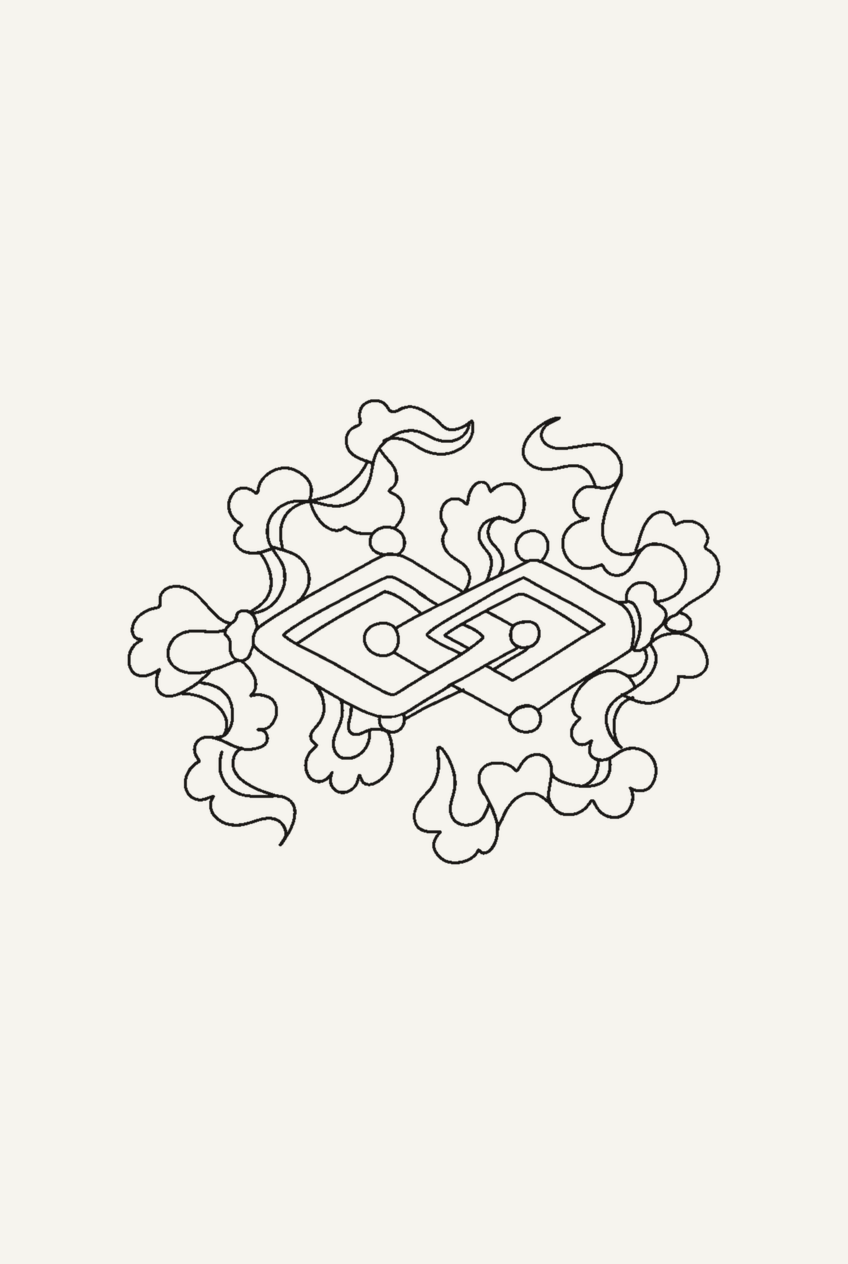
方胜纹 · Fāng Shèng Wén
Two Hearts, One Win
系列: 符号纹样 · Design #07
笔法: Two interlocking diamond lozenges with nested outlines and a central boss, ringed by auspicious cloud curls · fine-line · landscape composition · scalable 6–12 cm
形态: 两菱相叠中现小菱,外环祥云卷带,横构图
名字
方胜纹(fāng shèng wén)——相叠的「胜」。胜本是一件首饰:王后与女神的头饰,最古老的文本里西王母戴的就是它。把两个放在一起——方胜——几何替你把话说完:两个一模一样的菱形,交叠到刚好在中间生成第三个更小的菱形。这是中国人早了几个世纪的集合论图解:两个完整相遇的地方,长出新的东西。
*fāng shèng wén* — the "joined sheng." A 胜 was an ornament: the headdress of queens and goddesses, the thing the Queen Mother of the West wears in the oldest texts. Put two together — 方胜, the paired sheng — and the geometry says the rest: two identical diamonds overlapping just enough to create a third, smaller diamond where they meet. The Chinese answer, centuries early, to a set-theory diagram: where two wholes meet, something new appears.
出处
《山海经·西山经》(约成书于前 4—前 2 世纪)记西王母:「西王母其状如人,豹尾虎齿而善啸,蓬发戴胜」——散乱的头发上束着「胜」。胜起于礼制首饰;到汉代,它的菱形轮廓脱离器物成为纹样,而相叠的形式——两菱相合、交叠处再生一菱——成了「相遇且相守」的图记:婚俗同心,首推方胜。汉代画像石与明清窗棂、喜笺上,处处是这对相叠的菱形。形制参考:传统装饰艺术中的双菱(方胜)构图。墨线转写:本设计以传统母题的经典线条造型为底,转写为纹身墨线。
The *Shanhaijing*, *Xi Shan Jing* chapter (compiled c. 4th–2nd century BC), on the Queen Mother of the West: 「西王母其状如人,豹尾虎齿而善啸,蓬发戴胜」 — "her loose hair bound by the sheng." The sheng began as ceremonial hair-ornament; by Han times its lozenge silhouette had detached into pattern, and the paired form — two lozenges joined, their overlap forming a third — became the emblem of things that meet and hold: married hearts above all. Han stone reliefs and Ming-Qing lattice windows and wedding stationery all carry the paired diamonds. Historical form reference: paired-lozenge (fangsheng) compositions in traditional decorative art. Inking note: this design adapts the classic line construction of the traditional motif and re-inks it as tattoo linework.
设计灵感
本版每一处形制决定都有出处可查,逐条对账。① 双菱套线——方胜的标准相合式,每只菱形都以双线勾描。② 中央小珠——交叠所生的第三只菱,几何许诺的那个「新的东西」。③ 四周祥云卷带——围绕这一对的祥瑞云气,把几何托举成祝福。④ 横幅构图——云布四方、主图横陈,一如明清窗棂与织绣上的原始排布。
Every form decision on this design points to a recorded source, element by element. ① The two nested lozenges — the canonical fangsheng join, each diamond drawn as a doubled outline. ② The small central boss — the third diamond born of the overlap, the "something new" the geometry promises. ③ The cloud curls surrounding them — the auspicious vapor that breathes on the pair, lifting geometry into blessing. ④ The landscape composition — the horizontal reading, clouds on all sides, as the motif appears on Ming-Qing lattice and textiles.
来历
从女神发间的一件首饰讲起。在中国神话最古老的地理书里,胜出现在西王母头上——散发、虎齿,而唯一一件秩序井然的几何物把它束住。不论原物为何,它的轮廓——菱形、相合之形——早已被读作「荒野之中有秩序」的标记。
然后这形状离开头发、进入纹样的世界,中国人对它做了一件极聪明的事:把它翻倍。两只一模一样的菱形,交叠到恰好让交集处生出第三只更小的菱形——完整、居中、自成一形。算术上你可以说 1 + 1 = 3。文化把它读作婚姻:两个完整的人,谁也没有溶掉谁,而两人之间生出一件因双方而在、却不单独属于任何一方的东西。喜礼上印它,窗棂上框它,这对相叠的菱形成了「同心」的公认画符——两颗心,一个方向。
今天纹在身上,这张图解多出最后一位读者:你。交叠的部分刻意收得很小——约占每只菱形的五分之一——因为这几何是诚实的:真实的结合并不把两个人融成一团模糊;它让双方都保持完整,再在中间生出第三样东西。方胜是「我们」的几何学——不是你,不是我,也不是合并——是第三只菱形。
Begin with an ornament worn in the hair of a goddess. The sheng appears in the oldest geography of Chinese myth on the head of the Queen Mother of the West — wild hair, tiger teeth, and this one piece of disciplined geometry holding it together. Whatever the original object was, its silhouette — a diamond, a held-together shape — was already understood as the mark of something ordered amid the wild.
Then the shape leaves the hair and enters the pattern world, and the Chinese do something very smart with it: they double it. Two identical lozenges, overlapped so precisely that their intersection is a third, smaller lozenge — complete, centered, its own shape. You could read it as arithmetic: 1 + 1 = 3. The culture read it as marriage: two whole people, neither dissolved, and between them something that exists because of both and belongs to neither alone. Wedding gifts bore it; window lattices framed it; the paired diamonds became the accepted pictogram for 同心 — two hearts, one direction.
Worn now, the diagram gets one final reader: you. The overlap is small by design — about a fifth of each lozenge — because the geometry is honest: real unions do not merge two people into one blur; they leave both whole and generate the third thing between them. 方胜是「我们」的几何学:not you, not me, and not a merger — the third diamond.
释义
两个完整,一道交集,中间生出新物。最古老的「同心」几何图解——两心相类,同向而行。适合一切形式的结伴:婚姻、手足、隔洋的知己。
Two wholes, one overlap, something new in between. The oldest geometric diagram of 同心 — kindred hearts, one direction. For partnerships of every kind: the marriage, the sibling, the friend across an ocean.
位置
相叠的菱形要一块平坦易读的地皮:6–8 厘米置小臂内侧或颈后(镜子能看、旁人能看),8–12 厘米横陈锁骨或肩外侧,让云环舒口气。天生横构图——长轴顺着肢体线条走。
The paired lozenges want a flat, readable field: 6–8 cm on the inner forearm or the back of the neck, 8–12 cm across the collarbone or the outer shoulder where the cloud ring breathes. Horizontal by birth — keep the long axis parallel to the limb's line.
纹之前
交叠即信息:中央的第三菱必须保持锋利——手懒的师傅把相接处揉成一团「熔合」,寓意就被抹掉了。② 对称不可妥协;两只菱形按定义完全相同——让纹身师拿尺规,别靠目测。③ 只宜墨线:几何即画面;传统上可在中央珠心点一粒朱砂红(见本站色彩规则)。④ 留够尺寸。 最小 6 厘米:再小套线焊死,第三只菱就淹了。平坦部位(小臂内侧、肩帽)让菱形不变形;弧度过大的区域会扭歪角度。
The overlap is the message: the central third-diamond must stay crisp — a lazy artist rounding the join into a "fused" blob has erased the meaning. ② Symmetry is not optional; the two lozenges are identical by definition — ask your artist to measure, not eyeball. ③ Ink-only by design: the geometry is the drawing; a single red dot at the central boss is the one traditional option (see the collection's color rule). ④ Respect the scale. Minimum 6 cm: under that the nested outlines weld and the third diamond drowns. Flat placements (inner forearm, shoulder cap) keep the diamonds true; curved zones distort the angles.
本卡每一个汉字都由中文母语者选定并逐笔核对。