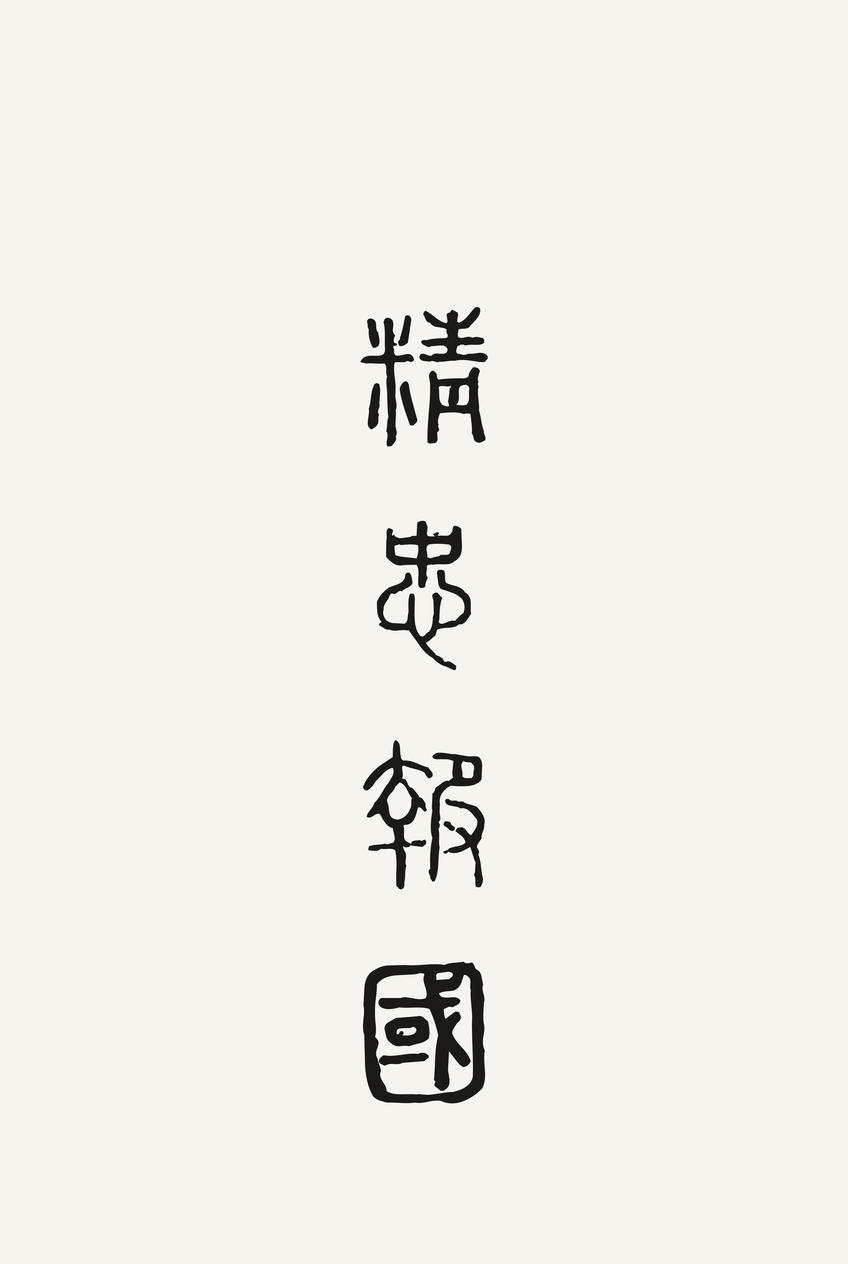
精忠报国 · Jīng Zhōng Bào Guó
Serve the Country with Unwavering Loyalty
系列: 吉语成语 · Design #01
笔法: 4-character idiom · small-seal script · single vertical column
名字
精忠报国。四个字,中国人一眼扫过去,不需要思考。但坑恰恰藏在第一个字里:「精」是"纯粹",不是"完全"。一字之差,这句耳熟能详的话就悄悄变了味——而这正是最不容易被外人察觉的那种错。
Four characters, and every Chinese reader takes them in at a glance: *jīng zhōng bào guó* — serve the country with a loyalty that has been refined until nothing else is left. The trap hides in the first character: 精 means "undiluted," not "complete." Get that one character wrong and your tattoo quietly stops being the phrase everyone knows.
出处
语出《宋史·岳飞传》(元朝官修,1345 年成书)。最早的记载写作「尽忠报国」——"拿全部的自己报效国家"。而人人挂在嘴边的「精忠」,是后起的版本——从岳庙的匾额、戏文的唱段、到刺字的故事本身。两个写法都站得住,但意味不同:一个是正史的重量,一个是传说的温度。你选哪个,我们都给你准确排版,并告诉你这个选择在懂行的人眼里意味着什么。
*History of Song, Biography of Yue Fei* (compiled 1345). The earliest written form is 尽忠报国 — "repay the country with the whole of one's loyalty." The version everyone actually says, 精忠, comes later — from temple plaques, from opera, from the story of the needle itself. Both are defensible; they are not interchangeable. We set either, and we will tell you exactly what each choice signals.
设计灵感
设计灵感
本版每一处形制决定都有出处可查,逐条对账。① 正史原文——《宋史·岳飞传》(1345 年成书),刺字作「尽忠报国」。② 流传写法——「精忠」出自岳庙匾额与戏文传统;两版各有来历,排版时绝不混用。③ 背部位置——两肩胛骨之间,即当年落针之地。④ 篆书字形——依《说文解字》小篆(经 CNS11643 全字庫开放授权字体渲染),与岳飞之孙岳珂所铸祭爵腹内镌「精忠報國」篆书相印证(《两浙金石志》著录)。
Every form decision on this design points to a recorded source, element by element. ① The source text — *History of Song, Biography of Yue Fei* (compiled 1345), where the needle writes 尽忠报国. ② The transmitted form — 精 in 精忠, from temple plaques and opera tradition; both versions are honored, and never silently mixed. ③ The back placement — between the shoulder blades, the ground the historical needle covered. ④ The seal-script glyphs — small-seal forms per *Shuowen Jiezi* (rendered from the CNS11643 government open-data seal font), echoing the Southern Song bronze libation vessel cast by Yue Ke, Yue Fei's grandson, whose belly bears the four characters in seal script (*Liang-Zhe Jin Shi Zhi*, Qing dynasty).
来历
来历
公元 1128 年,靖康之变后的第二个冬天。北宋的北方已经丢了——故都化为焦土,官道上尽是南逃的流民。相州汤阴的一间农舍里,油灯如豆。一位母亲让第二天就要投军的儿子跪坐下来,此去生死未卜。史书没记她说什么,只记下了那件事本身:她拿起绣花针,在儿子背上刺下四个字——尽忠报国。针针见血,入骨三分。
这个少年叫岳飞。后面的故事,每个中国孩子都是听着长大的:农家子弟成了那个时代最令敌人胆寒的统帅,背嵬军击溃了无人能挡的金军铁骑,连对手都留下了那句著名的哀叹——"撼山易,撼岳家军难"。北伐眼看功成,一天之内十二道金牌到军前,命他班师。他回去了——因为他背上那四个字,容不下第二种结局。狱中,面对一个连主审官都只能含糊其辞的罪名"莫须有",他死于三十九岁。二十年后朝廷为他平反,葬于西湖之畔,庙至今犹在。八百年过去,中国的孩子对"忠诚"二字最初的理解,几乎都始于他背上这四个字。
The winter of 1128. The Song dynasty has lost its north — the old capital is ash, and columns of refugees walk the roads south. In a farmhouse in Tangyin county, a mother sits her son down the night before he leaves for the army. She is, history tells us, almost silent. One question — *with the country in this state, what do you still owe?* — and then a needle: four characters pressed into the skin of his back, one drop of ink at a time. The boy's name was Yue Fei.
What follows is the stuff every Chinese schoolchild grows up with. The farm boy becomes the most feared general of his age; his cavalry breaks the Jurchen armies nobody else could touch, and the enemy concedes, famously, that it is "easier to shake a mountain than to shake Yue's army." Then, with the north within reach, twelve gold plaques arrive in a single day, ordering him home. He goes — because the words on his back allow no other ending. In prison, on a charge his own judge can only stammer as *"perhaps it exists,"* he dies at thirty-nine. The dynasty apologizes a generation too late and buries him by West Lake, where his temple still stands. Eight hundred years on, Chinese children learn the four characters on his back before they learn almost any other idea of what loyalty is.
释义
释义
字面之下,这四个字在中国文化里是一把尺子:老师坚守讲台、医生坚守岗位、军人坚守阵地——凡是本可以走、却留下来的人,人们都用它来形容。所以把它纹在身上,不是表态,而是自持:我知道自己认什么,而且这份认,不是随手给的。
Unconditional devotion to something larger than yourself — that is the surface. Underneath, in Chinese culture, this phrase is the *measuring stick*: it is what people invoke for the teacher who stays, the doctor who stays, the soldier who stays — for anyone who could leave and doesn't. As a tattoo it makes a quiet, heavy statement: *I know exactly what I stand for, and I did not choose it cheaply.*
位置
位置
最讲究的部位是上背、两块肩胛骨之间——正是当年那一针落下的地方,四字横排或两两成方。想每天看见它,现代的经典做法是小臂内侧竖排一列,细线风格,8–12 厘米;更大的竖排(12–15 厘米)放在小腿外侧或大腿也很自然。
The historically faithful spot is the upper back, between the shoulder blades — the exact ground the needle covered, laid out as four characters in a row or a 2×2 square. If you'd rather see it every day, the modern classic is a single vertical column down the inner forearm, fine-line, 8–12 cm; larger vertical work (12–15 cm) sits naturally on the outer calf or thigh.
纹之前
纹之前
首字是「精」,不是「金」,也不是「惊」——网上错版流传很广,都过不了母语这一关。② 如果你在意考据胜过一眼可识,选正史版「尽忠报国」——以后一定会有人问你为什么这么写,而你可以讲出一个好故事。③ 四个字笔画密集,尺寸小于 10 厘米时密集笔画最先糊掉,对书法干净度的要求必须苛刻。④ 只宜墨线:书法即画面本身。⑤ 锁定排版。 逐字转印定字距,列沿身体线取直(脊柱、小臂缘)——排布不靠徒手。
The first character is 精 (jīng) — not 金 (gold), not 惊 (fright). Both miswritings circulate widely online; neither survives a native check. ② If provenance matters to you more than instant recognition, take the source version 尽忠报国 — and enjoy explaining the difference, because people will ask. ③ Four dense characters need room: below ~10 cm, clustered strokes blur first, so the calligraphy must be impeccably clean. ④ Ink-only by design: the calligraphy is the drawing. ⑤ Lock the layout. Transfer per-character stencils to set the spacing, and align the column to a body line (spine, forearm edge) — never freehand the arrangement.
本卡每一个汉字都由中文母语者选定并逐笔核对。