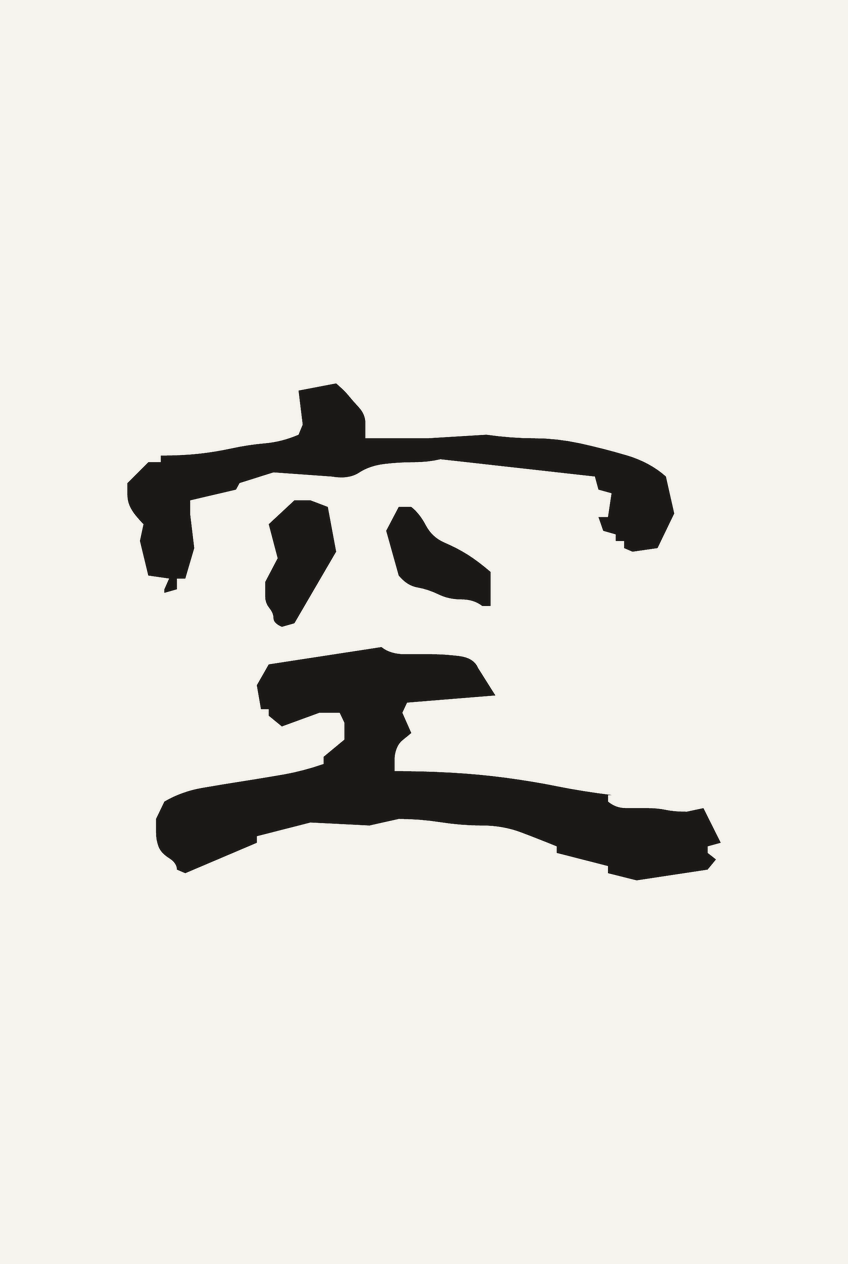
空 · Kōng
Emptiness
系列: 单字禅意 · Design #34
笔法: single character · clerical script (lishu) · traditional form 空 · small-to-medium
形态: 单字,隶书
名字
空——佛教里被误译最多的词,也是最值得译对的词。空不是说什么都不存在;它是说什么都不是*独立*存在的。《心经》的引擎:色即是空,空即是色——杯子不「独立存在」,却装满了雨、黏土、火与手。作为皮肤上的单字,空是一个被造出来的悖论——「空」这个字被实实地画出,屋顶上却留着一个洞,让天空露出来。
Emptiness — the most mistranslated word in Buddhism, and the most valuable to translate correctly. 空 does not mean nothing exists; it means nothing exists *separately*. The Heart Sutra's engine: 色即是空,空即是色 — form is emptiness, emptiness is form: the cup is empty of independent existence and full of rain, clay, fire, hands. As a single character on skin, 空 is a built paradox — the character for empty is drawn solid, and holds a hole in its roof for the sky to show through.
出处
《般若波罗蜜多心经》原文:色不異空,空不異色;色即是空,空即是色。字源:穴字头下一个「工」——一个挖出来、且有用的空间。龙树中观(汉译《中论》)提供义理:空是缘起,不是虚无主义。墨线转写:本设计以传统母题的经典线条造型为底,转写为纹身墨线。
Heart Sutra (《般若波羅蜜多心經》), original text: 色不異空,空不異色;色即是空,空即是色. The character's own etymology: cave-radical (穴) over work (工) — a dug space that does something. Nāgārjuna's Madhyamaka (translated as 中論) supplies the doctrine: emptiness is dependent arising, not nihilism. Inking note: this design adapts the classic line construction of the traditional motif and re-inks it as tattoo linework.
设计灵感
本设计的每一处形制决定都有出处可查,逐条对账。① 单字居中——设计就是字形本身:穴字头罩着一个有用的空腔。② 隶书、繁形「空」——「穴」的双翼庇护下面的「工」;空的东西被画成正在工作的样子。③ 小到中尺寸——5–7 厘米;空不做广告。④ 只用墨——墨在演示义理:笔画是实的,意思是空的,毫无矛盾。
Every form decision points to a recorded source, element by element. ① One character, centered — the design is the glyph: cave-roof over a working hollow. ② Clerical script, traditional form 空 — the 穴 roof's two wings shelter the 工 below; the empty thing is drawn working. ③ Small-to-medium scale — 5–7 cm; emptiness advertises nothing. ④ Black ink only — the ink demonstrates the doctrine: solid strokes, hollow meaning, no contradiction.
来历
龙树,二世纪中观学派的创始人,把哲学建在一个技术细节上:世界上没有任何东西独自拥有自己的存在。陶轮转是因为棍,棍动是因为手,手是因为整个的人——顺着任何东西追下去,它都消失进万物里。他把这种消失命名为空,并且补了一个锋利的点:空本身也是空的——它不是值得崇拜的东西,不是宇宙的虚空,只是「互相依赖」这个朴素的事实。空,就是你停止给万物多记一笔「自性」时它露出的样子。
这个纹身的日常功能是诊断。每一种恐惧、每一种骄傲都是一张「独立存在」的主张:这次失败定义我;这个成功全归我。空是那张读小字的橡皮——你的一切都是借来的、合著的、看天气的。作为侮辱它很毁灭;作为练习它很自由。让失败不再属于你的那个事实,同样让羞耻不再属于你。
Nāgārjuna, second-century founder of the Madhyamaka, built his philosophy on a technological detail: nothing in the world owns its own existence. A potter's wheel spins because of the stick, the stick because of the hand, the hand because of the whole human — trace anything and it vanishes into everything else. He named this vanishing 空, emptiness, and made the sharp point that emptiness itself is also empty: it is not a thing to worship, not cosmic void, just the plain fact of interdependence. Emptiness is what it looks like when you stop over-crediting things with selfhood.
The tattoo's daily work is diagnosis. Every fear and every pride is a claim of independent existence: this failure defines me; this success is mine alone. 空 is the eraser that reads the fine print — everything you are is borrowed, co-authored, weather-dependent. Devastating as an insult; liberating as a practice. The same fact that un-owns your failures un-owns your shame.
释义
给过度认领的人——认领过去的失败、未来的结果、别人的眼光。它不是对生活的疏离;它是正确的记账。
For the over-owners — of past failures, future outcomes, other people's opinions. It is not detachment from life; it is correct accounting.
位置
一个字:胸骨(字面的凹陷处)、后颈、腕内侧。5–7 厘米私人,8 厘米公开;「穴」的双翼要打开需 4 厘米起。
One character: sternum (the literal hollow), nape, inner wrist. 5–7 cm private, 8 cm stated; minimum 4 cm for the 穴 roof's wings to stay open.
纹之前
一个字就是全部设计。 ② 繁形「空」。 ③ 隶书、笔画实——悖论就是设计:画得实,意思是空的。④ 4 厘米起。 ⑤ 空,不是虚无。 如果纹身开始给「不在乎」当理由,它丢掉了经文的后半句:空*即是*色。在乎,论证才闭合。
One character is the whole design. ② Traditional form 空. ③ Clerical script, solid strokes — the paradox is the design: drawn solid, meaning hollow. ④ Minimum 4 cm. ⑤ Empty, not nihilistic. If the tattoo starts justifying not caring, it has dropped the second half of the sutra: emptiness *is* form. Care completes the argument.
本卡每一个汉字都由中文母语者选定并逐笔核对。



