莲台纹 · Lián Tái Wén
The Lotus Seat
系列: 符号纹样 · Design #29
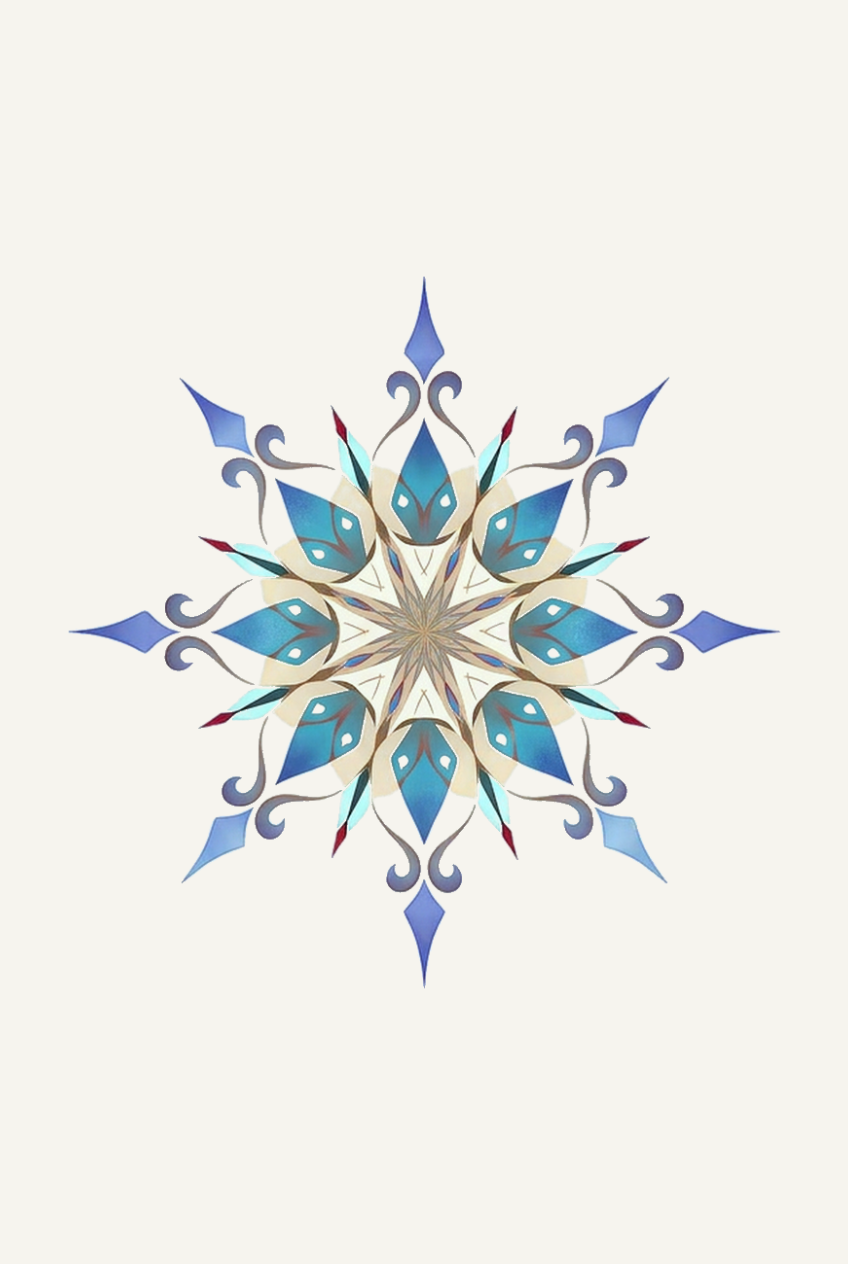
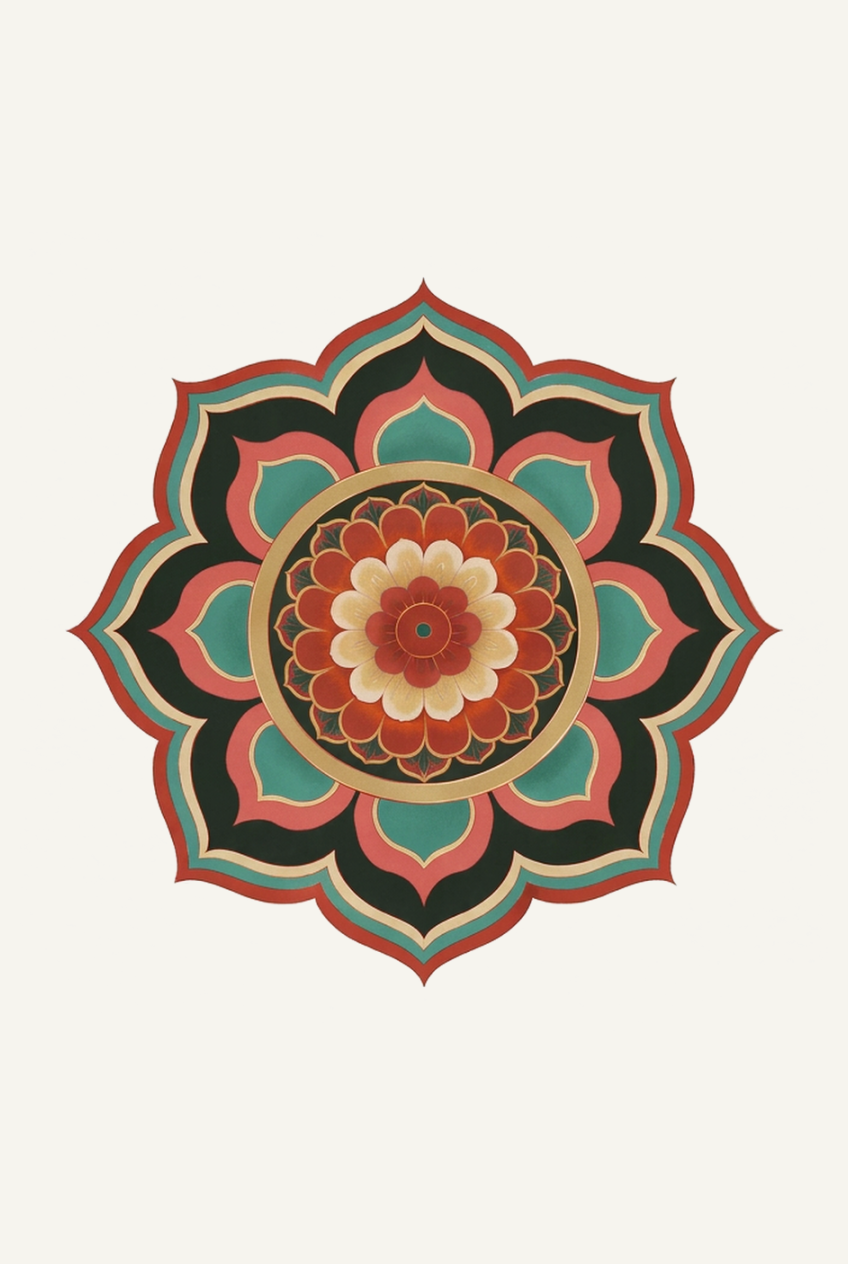
笔法: A circular lotus rosette — a layered bloom at the center inside a gold ring, ringed by eight stacked petals in celadon, cinnabar and ink · ornamental fill · centered round composition · scalable 10–16 cm
形态: 圆形莲台团花,中心叠瓣莲花配金环,外圈八瓣青绿砖红墨黑层叠
名字
莲台纹(lián tái wén)——不是侧看的一朵莲,而是从正上方看下去、收成一团圆整的莲:花成了一个可以落座的地方。「台」字把花变成了门槛。不倾斜,不拖曳,整幅守住一个中心。
*lián tái wén* — the "lotus seat." Not a lotus caught in profile but a lotus seen straight down, folded into a perfect round: the flower become a place to sit. The word *tái* — seat, terrace, platform — is what turns a bloom into a threshold. Nothing leans, nothing trails; the whole thing holds its center.
出处
莲台是一张借来的宝座。佛教艺术里,佛与菩萨坐于莲上——那朵从泥里升起、开而不染的花——于是「台」成了一种象征:清明被安放在它的来处之上。周敦颐《爱莲说》把这份品格写定在中文里:出淤泥而不染,濯清涟而不妖。从正上方看下去、收成一团圆花,这朵莲就成了石窟与古典装饰里的莲花藻井、团花宝相:一处被单独划出来、平而完整的位置。形制参考:中国传统佛教装饰中的莲花藻井与叠瓣团花。墨线转写:本设计以传统母题的经典线条造型为底,转写为纹身墨线。
The lotus seat is a borrowed throne. In Buddhist art the Buddha and the bodhisattvas are seated on a lotus — the flower that rises from mud and opens unstained — so the *tái* (seat, terrace) becomes an emblem of clarity held above its origin. Zhou Dunyi's *Ài Lián Shuō* (On the Love of the Lotus) fixed the flower's meaning in Chinese letters: 出淤泥而不染,濯清涟而不妖 — unstained by the mud, not flamboyant above the water. Seen from straight above and folded into a round rosette, that same bloom becomes the lotus medallions and ceiling lotuses (莲花藻井) of cave temples and classical ornament: a center set apart, level and complete. Historical form reference: the lotus medallions and stacked-petal rosettes of traditional Chinese Buddhist decoration. Inking note: this design adapts the classic line construction of the traditional motif and re-inks it as tattoo linework.
设计灵感
这里每一处形制都有可对的谱系。① 中心——一朵收在朱砂点上的小叠瓣莲:莲心,是所有莲花团花里眼睛歇脚的地方。② 金环——把花变成台的边界,呼应传统团花的环形外框。③ 外圈八瓣——青绿、砖红、墨黑三色叠层,即古典装饰里的叠瓣莲瓣,每瓣勾边,颜色读起来像镶嵌,不是阴影。④ 完全对称——圆自己合拢、找不到起点,这是藻井团花的纪律:每一瓣都相等,每一处间隙都有数。
Every form decision here answers to a recorded type. ① The center — a small stacked bloom closing on a cinnabar dot: the lotus heart (莲心), the resting point of the eye in every lotus medallion. ② The gold ring — the boundary that turns a flower into a seat, echoing the ringed frame of the traditional 团花 medallion. ③ The eight outer petals — celadon, cinnabar and ink in three stacked bands: the layered 莲瓣 of classical ornament, each petal outlined so the color reads as inlay, not shadow. ④ The perfect symmetry — the round closes on itself with no beginning to find, the discipline of the ceiling medallion, where every petal is equal and every gap is counted.
来历
侧看的莲向上生长。从上方看的莲成了圆——而圆是唯一没有薄弱转角、没有图案松懈之处的形状。这个纹样做的正是一个安静的转换:把「生长」的东西折成「安住」的东西。
放到皮肤上,道理不变。中心给眼睛一个落点;金环说「这里自成一处」;八瓣把同一个承诺绕了一圈又一圈。这是一个关于守中的图案——不是靠把外界关在外面,而是把一切都排布在一个点周围,让它保持平稳。
对任何不得不在自己没选过的环境里保持清白的人来说,莲从不需要解释。这一张,只是把那句话用圆形说了出来。
A lotus seen from the side reaches upward. A lotus seen from above becomes a circle — and a circle is the one shape with no weak corner, no place where the design gives out. That is the quiet move this motif makes: it takes something that grows and folds it into something that holds.
Set it on skin and the logic stays. The center gives the eye somewhere to land; the ring says "this is its own place"; the eight petals repeat the same promise around and around. It is a design about keeping a center — not by shutting the world out, but by arranging everything around a point and letting it stay level.
For anyone who has had to stay clear in surroundings they did not choose, the lotus never needed an explanation. This one just says it in a circle.
释义
清升,与守中。莲不被它的根染污,圆没有薄弱环节。给自己一个清明的定位,也给自己一处始终属于自己的位置。
Clean rise, and a center that holds. The lotus unstained by its roots; the round with no weak point. Wear it for clarity you intend to keep, and for a place that stays your own.
位置
居中的团花需要一块平整、看得全的地方:上臂或大腿 10–13 厘米,肩胛或后背正中 13–16 厘米,胸口正中 10–12 厘米。别破这个圆——它要靠完整的圆才立得住。
A centered rosette wants a flat, readable field: upper arm or thigh at 10–13 cm, shoulder blade or center of the back at 13–16 cm, and the center of the chest at 10–12 cm. Keep the round unbroken — it needs its full circle to hold.
纹之前
颜色可选,墨线不可省。 参考图用青绿、砖红与墨黑分层填瓣;转印线稿本身就能撑起整个图案,很多人只留墨线。若要上色,让金环保留为唯一亮色。② 在身体上找准中心。 在肢体或后背,先定中线——这么对称的圆,偏一点立刻看得出来。③ 留够尺寸。 最小 10 厘米;再小中心花瓣和金环会焊在一起,莲就堵了。④ 避开高摩擦部位。 肘、膝和躯干两侧最快把细同心线磨糊。
Color is optional, ink is not. The reference shows celadon, cinnabar and ink in layered petals; the transfer linework alone carries the design, and many people keep it ink-only. If you add color, keep the gold ring as the one bright accent. ② Center it on the body. On a limb or the back, mark the midline first — a round this symmetrical shows any offset immediately. ③ Respect the scale. Minimum 10 cm; below that the center petals and the ring weld together and the lotus clogs. ④ Avoid high-friction spots. Elbows, kneecaps and the sides of the torso blur fine concentric lines fastest.
本卡每一个汉字都由中文母语者选定并逐笔核对。