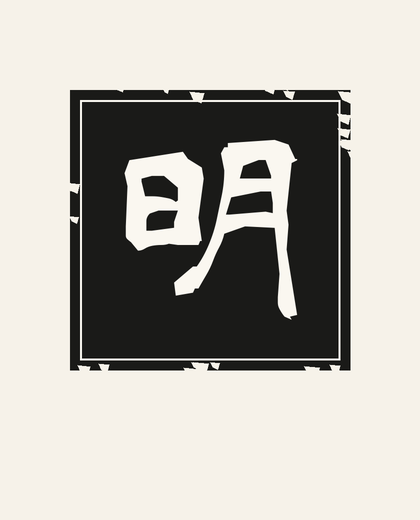
明 · Míng
Brightness / Clarity
系列: 单字禅意 · Design #60
笔法: Single character · Han-seal filled-white (bǎiwén) stamp — black ground, reversed white glyph, weathered border · clerical script (lishu) · medium scale
形态: 单字大字;汉印满白文,黑底白字、残边;青柳隶繁形
名字
明(míng)——明亮、清楚,以及看透事物的那种明白。这个字把太阳(日)和月亮(月)并排放在一起:中国天空里的两个光源,站在一起。这幅图直白得几乎不用解释——两道光都在,就是明。
*Míng* — bright, clear, and the kind of understanding that sees through things. The character puts the sun (日) next to the moon (月): the two sources of light in the Chinese sky, side by side. It is a picture so obvious it barely needs explaining — brightness is what you get when both lights are present.
出处
字源与出处:甲骨文的「明」由日、月合成;部分早期字形是月亮对着一扇打开的窗。《说文解字》(东汉):明,照也。《道德经》(老子):知人者智,自知者明。《大学》开篇:大学之道,在明明德。本设计未使用任何第三方源图像。墨线转写:本设计以传统母题的经典线条造型为底,转写为纹身墨线。
Etymology and text: the oracle-bone form of 明 joins 日 (sun) and 月 (moon); some early forms show a moon beside an open window. *Shuōwén Jiězì* (Eastern Han): 明,照也 — "ming is to illuminate." The *Dao De Jing* (Laozi): 知人者智,自知者明 — "to know others is wisdom; to know oneself is clarity." The *University* (*Dàxué*) opens: 大学之道,在明明德 — "the Way of great learning lies in illuminating luminous virtue." No third-party source image was used for this design. Inking note: this design adapts the classic line construction of the traditional motif and re-inks it as tattoo linework.
设计灵感
本设计每一处形制决定都有出处可查,逐条对账。① 满白文印——日月从暗里被刻出来,两道光留下来。② 隶书——汉石经的语域,取它匀称的重量,让日与月读成平等的。③ 左日收窄、右月留开——白文印里两半要平衡而不并拢,它们的分开*就是*"两道光并排"。④ 残边——手工盖出的印,像透过一扇不完美的人窗看到的光。
Every form decision points to a recorded source, element by element. ① The filled-white seal — sun and moon cut out of the dark, the two lights left visible. ② Clerical script — the Han-stone register, chosen for the even weight that keeps 日 and 月 reading as equals. ③ The left 日 kept narrow and the right 月 kept open — in white-negative the two halves must balance without merging; their separation *is* the "two lights side by side." ④ Weathered border — a hand-set seal, like light seen through an imperfect human window.
来历
中国人用两盏灯造出了"明"这个字:一个太阳、一个月亮并排站着。这是整个汉字里最好懂的意念之一——几乎不用人讲。正因为这幅图太直白,这个词才一路上行,进了最难的那种知道。
《道德经》把「明」留给最稀有的东西:自知者明。知道别人是「智」,知道自己才是「明」。《大学》把它当动词用:明明德——把自己身上光明的德性照出来。两种用法里,明都不是关于世界的信息,是你向自己打开的那束光。
日月这个根让它不至于变得太肃穆。这个字从来没停止是一幅"两道光"的简单图画——所以哲学家拿它讲自知时,借的是语言里最普通的图像,请你把它转向里面。
纹「明」,是用最简单的形式带着那句提醒:两道光并排,而最需要被你照见的,是你自己。
The Chinese made clarity out of two lamps: a sun and a moon standing next to each other. It is one of the most legible ideas in the whole script — you almost do not need to be told. And precisely because the picture is so plain, the word was able to travel upward into the hardest kind of knowing.
In the *Dao De Jing*, 明 is reserved for the rarest thing: 自知者明 — seeing yourself clearly. Knowing other people is 智 (wisdom); knowing yourself is 明. The *Great Learning* makes it a verb: 明明德, to bring one's own luminous virtue out into the light. Clarity, in both cases, is not information about the world. It is the light you turn on yourself.
The sun-and-moon root keeps that from getting solemn. The character never stopped being a simple picture of two lights — so when the philosophers use it for self-knowledge, they are borrowing the most ordinary image in the language and asking you to point it inward.
To wear 明 is to carry that instruction in the simplest possible form: two lights, side by side, and the suggestion that the one you most need to see is yourself.
释义
明是看见自己,用最朴素的图造出来:一个太阳、一个月亮。这个字是你向自己打开的光——是《道德经》放在"知人"之上的"自知"。给那些宁可看清自己、而不是被看好的人。
Clarity as self-seeing, built from the plainest possible picture: a sun and a moon. 明 is the light you turn on yourself — the "knowing yourself" that the *Dao De Jing* puts above knowing others. For people who value seeing themselves accurately over being seen well.
位置
左右匀称的两部件字。小臂外侧与上背 5–8 厘米能让日月分明;后颈 4–6 厘米适合小号;锁骨下 5–7 厘米也干净。避开收细处,免得两半被挤在一起。
A balanced, two-part character. Outer forearm and upper back at 5–8 cm keep 日 and 月 distinct; back of the neck at 4–6 cm suits a smaller seal; below the collarbone at 5–7 cm is also clean. Avoid tapering spots that squeeze the two halves.
纹之前
负形印——用随卡附的白底黑线转印页。② 日与月要分开、要平衡——两半一并,日月的图像就没了。③ 切勿徒手画汉字。 ④ 只用墨。 ⑤ 最小 4 厘米。 ⑥ 只纹一体——本款隶书,勿与篆书「明」混纹。
Negative-form seal — use the supplied white-ground black-line transfer sheet. ② Keep 日 and 月 separate and balanced — merging the two halves destroys the sun-and-moon image. ③ No freehand Chinese characters. ④ Ink only. ⑤ Minimum 4 cm. ⑥ One script only — clerical version; never mix with seal-script 明.
本卡每一个汉字都由中文母语者选定并逐笔核对。



