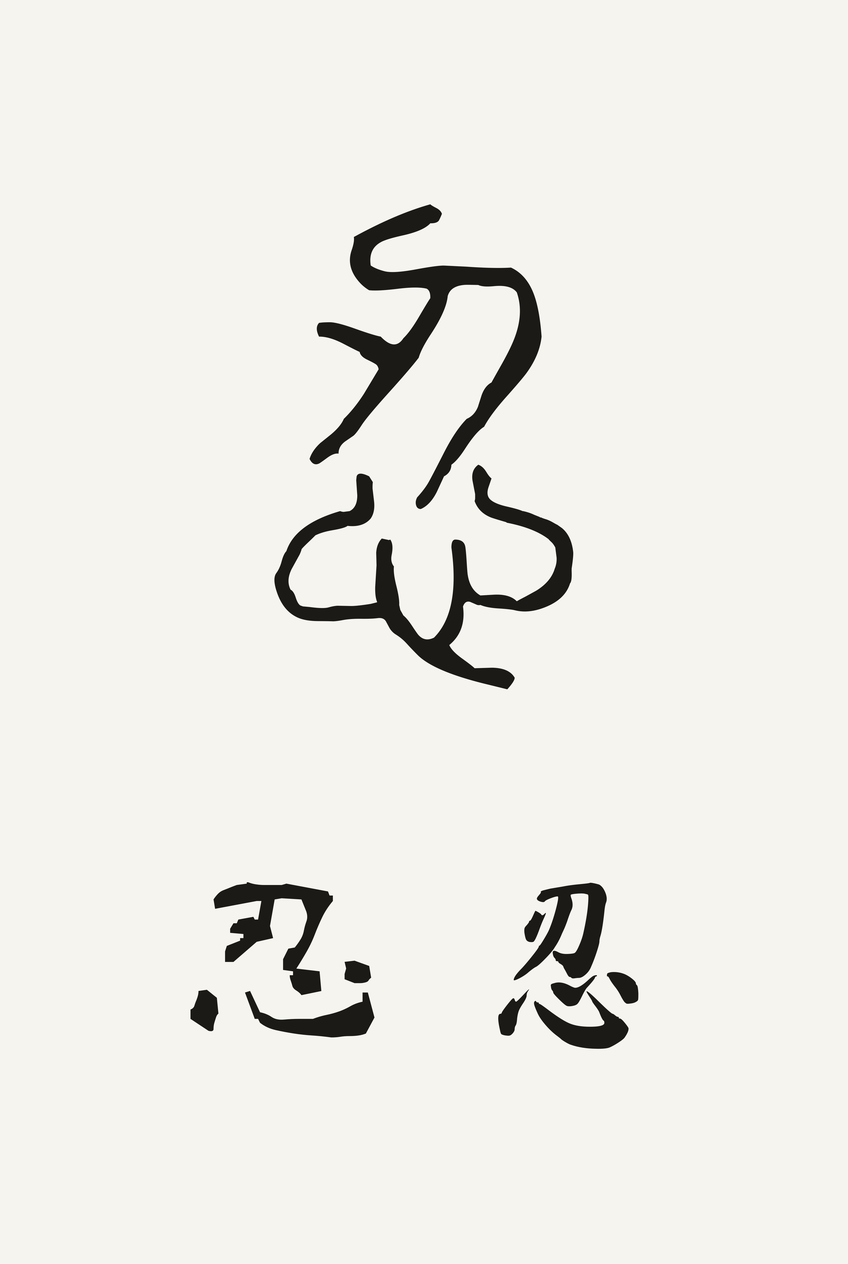
忍 · Rěn
Endure
系列: 单字禅意 · Design #02
笔法: Single character · one sheet, three scripts: small-seal large on top, clerical & regular smaller below · optional fine-line blade motif
形态: 单字大字,可配刀刃意象细线插图
名字
忍(rěn)。看这个字的构造:心字头上一把刀。这是汉字造法里罕见的"精神命题直接画成图形"。
*rěn* — endure. Look at how the character is built: a blade (刃) suspended over a heart (心). It is one of the rare characters in the language that draws a spiritual proposition as a picture.
出处
字形解析:「刃」在「心」上——心字头上一把刀。《论语·卫灵公》(春秋,前 5 世纪):小不忍则乱大谋。《史记·淮阴侯列传》(西汉·司马迁):韩信胯下之辱本事。形制参考:「忍」字「刃在心上」的构形,见于后世篆书与隶书写法。 本设计未使用任何第三方源图像。
Glyph: 刀-blade pressed onto 心-heart — the blade hovers, it has not fallen. *Analects, Duke Ling of Wei* (Confucius, c. 5th century BC): "A small failure of endurance ruins a great plan." *Records of the Grand Historian, Biography of the Marquis of Huaiyin* — the source account of Han Xin crawling between another man's legs. Historical form reference: The blade-over-heart construction of 忍 is attested in later seal and clerical script forms. No third-party source image was used for this design.
设计灵感
设计灵感
本版每一处形制决定都有出处可查,逐条对账。① 刃在心上的构形——见于「忍」字后世篆书与隶书写法。② 箴言出处——《论语·卫灵公》(约前 5 世纪):「小不忍则乱大谋。」③ 故事锚点——《史记·淮阴侯列传》:韩信胯下之辱,后建四百年帝业。
Every form decision on this design points to a recorded source, element by element. ① The blade-over-heart construction — 刃 over 心, attested in the character's later seal and clerical script forms. ② The maxim — *Analects, Duke Ling of Wei* (c. 5th century BC): "A small failure of endurance ruins a great plan." ③ The story anchor — *Records of the Grand Historian, Biography of the Marquis of Huaiyin*: Han Xin crawling through the market, later building a four-hundred-year empire.
来历
来历
先看这个字的构造:心字头上一把刀。
不是刀插入心,是刀悬在心上。刃口向下,贴着皮肉,但还没落下。这个字画出的不是受伤,而是受伤前一瞬间的高度清醒——你知道刀在那里,你感受着它的冷,而你选择不动。
为什么要造这样的字?看看它背后那个故事。
秦朝末年,淮阴有个叫韩信的年轻人,穷得讨饭,腰间却总挂着一把剑。城里的屠户少年当街拦住他:"你要是有种,拿剑刺我;要是有种没胆,就从我裤裆底下钻过去。"
整条街的人都在笑。韩信盯着他看了很久——然后趴下去,从对方胯下钻了过去。满街哄笑,他起身拍拍土,走了。
后来的事写进了教科书:这个钻裤裆的年轻人,成为汉初三杰之一,统兵百万,战必胜、攻必取,垓下一战灭掉项羽,帮刘邦建立了四百年汉朝。史书记下他封楚王后回到淮阴的处理方式——找到那个屠户少年,没有杀他,封了他一个官。韩信说:他是壮士。当年我不是怕他,我只是觉得,杀他的理由不值得赔上我的未来。
这就是"忍"——它从来不是懦弱,是战略性的耐心:刀悬在心上的时候不躁动,为的是在真正值得的时刻出刀。孔子早把这个道理说透:"小不忍则乱大谋。"
中国人的处世智慧里,忍是被反复锤炼的核心品质:忍不是终点,忍是为了"不忍"那一刻的分量。字挂在墙上容易,刻在心上很难——所以有人选择把它刻在皮肤上,让那把刀永远悬在看得见的地方,提醒自己:现在还不到时候。
Look at how the character is built: a blade (刃) suspended over a heart (心).
Not stabbed into the heart — hovering. Edge down, close enough to feel the cold, but not yet falling. This character does not depict injury. It depicts perfect clarity in the moment before injury — you know the blade is there, you feel it, and you choose not to move.
Why would a language invent such a word? Look at the story behind it.
At the end of the Qin dynasty, a destitute young man named Han Xin — thin, hungry, but always wearing a sword at his waist — was stopped in the street by a butcher's apprentice. "If you've got the guts, stab me. If not, crawl between my legs."
The whole street was laughing. Han Xin stared at him for a long time — then got down and crawled through. He stood, brushed off the dirt, and walked away.
What happened next is in every history book: the young man who crawled between a butcher's legs became one of the three great generals of the Han dynasty, undefeated in a hundred battles, the man who crushed Xiang Yu at Gaixia and built a four-hundred-year empire. And the record preserves what he did when he returned home as a king — he found the butcher and made him an officer. "He was a man of courage," Han Xin said. "I didn't fear him that day. I simply judged that killing him was not worth my future."
That is 忍 — endurance not as weakness but as strategic patience: refusing to flinch while the blade hangs over your heart, so that when the moment worth striking arrives, your strike carries full weight. Confucius said it first: "A small failure of endurance ruins a great plan."
In Chinese wisdom this quality is hammered and re-forged like steel: endurance is never the end; it is the weight behind the moment you choose to stop enduring. A character like this is easy to hang on a wall and very hard to carry in the chest — which is why some people choose to carry it on their skin instead: the blade, always visible, always suspended. *Not yet. Not yet.*
释义
释义
心字头上一把刀,悬而不落,是为忍。忍 = 清醒的自制力 + 对未来时机的笃信。它不是压抑,是把情绪变成弹药。适合正在熬难关、长期被质疑、需要"卧薪尝胆"期的人。
A blade over the heart — held, not fallen. That is endurance. 忍 is clear-eyed self-control plus absolute faith in a future moment: not suppression, but turning emotion into ammunition. For anyone deep in a hard season — building, studying, recovering, doubted too long.
位置
位置
经典位是手背/虎口——一抬手就看见刀悬在心上,自我提醒感最强;其次前臂内侧、颈后。小中幅:单字 3–6 厘米;配刀刃细线插图可至 8–10 厘米。
The classic spot is the back of the hand / the web of the thumb — one glance down and you see the blade hanging over the heart, the strongest self-reminder there is. Inner forearm and behind the neck follow. Small-to-medium: 3–6 cm for the bare character; 8–10 cm with the fine-line blade motif.
纹之前
纹之前
「忍」与日文汉字同形,日本忍者文化(ninja)联想强烈——介意者可选篆书强调来源,本图上方大字即篆书;或加中文印章元素。任选一体、只纹一体——同一字的多体绝不并纹。② 若纹它纪念的是"熬过至暗时刻",请在状态好的时候纹——仪式感能强化正向意义。③ 此字上下结构重心极难排,纹身师手写极易把"刃"写歪——务必用校验字形。④ 只宜墨线:字形即画面本身。⑤ 尺寸与部位。 字面不小于 4 厘米、落在平整肌面(小臂外侧、肩部);曲面会放大上下结构的歪斜。
The character is identical to the Japanese 忍 (nin / shinobi) — the ninja association is loud in the West; if provenance matters, the large glyph on this sheet already ships in seal script, or add a Chinese seal element to anchor it. One script only — never wear two script versions of the same character together. ② If this marks surviving a darkest hour, get it in a good season, not a bad one — ritual should reinforce the meaning that carried you through. ③ The character's vertical balance is brutally hard to draw freehand — tattooists most often tilt the blade component. Use a verified glyph, always. ④ Ink-only by design: the glyph is the drawing. ⑤ Scale and surface. At least 4 cm on a flat plane (outer forearm, shoulder); curved skin exaggerates any lean in the vertical stack.
本卡每一个汉字都由中文母语者选定并逐笔核对。