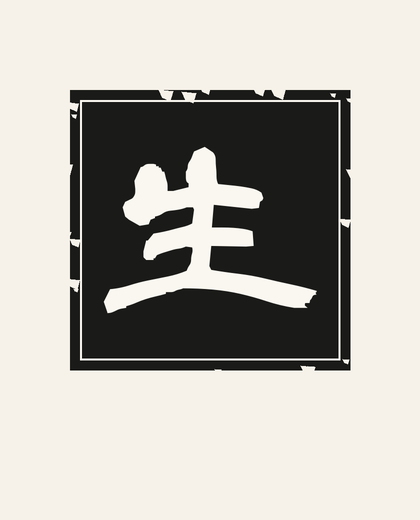
生 · Shēng
Life / To Be Born
系列: 单字禅意 · Design #59
笔法: Single character · Han-seal filled-white (bǎiwén) stamp — black ground, reversed white glyph, weathered border · clerical script (lishu) · medium scale
形态: 单字大字;汉印满白文,黑底白字、残边;青柳隶繁形
名字
生(shēng)——生命、出生、生长。最古的字形是一株苗从土里顶出来:上面是芽,下面是根。一点也不抽象——这个字就是画"有东西从地里长出来"。后来它扛起了中文里"生"的全部范围:出生、活着、一辈子、一个人的整个段落。
*Shēng* — life, to be born, to grow. The oldest shape is a seedling pushing out of the soil: a sprout above, a root line below. Nothing abstract about it — the character simply draws something coming up out of the ground. It went on to carry the whole range of "life" in Chinese: birth, living, a lifetime, a person's whole span.
出处
字源与出处:《说文解字》(东汉):生,进也,象草木生出土上。甲骨、金文是芽从地平线冒出来的样子。《道德经》(老子):道生一,一生二,二生三,三生万物。《论语》用「生」指活着:未知生,焉知死。本设计未使用任何第三方源图像。墨线转写:本设计以传统母题的经典线条造型为底,转写为纹身墨线。
Etymology and text: *Shuōwén Jiězì* (Eastern Han): 生,进也。象草木生出土上 — "sheng is advancing; it pictures grass and trees growing out of the earth." Oracle-bone and bronze forms show the sprout emerging from a ground line. The *Dao De Jing* (Laozi): 道生一,一生二,二生三,三生万物 — "the Way gives birth to one; one to two; two to three; three to the ten thousand things." The *Analects* uses 生 for being alive: 未知生,焉知死 — "if you do not yet know life, how can you know death?" No third-party source image was used for this design. Inking note: this design adapts the classic line construction of the traditional motif and re-inks it as tattoo linework.
设计灵感
本设计每一处形制决定都有出处可查,逐条对账。① 满白文印——芽从暗里被刻出来:生命在地的对照下留下来。② 隶书——汉石经的语域;「生」是隶笔还保着象形根源的字之一。③ 三横要分明——「生」的三横(土加两层生长)在白文印里不能并拢,间距就是它"往上长"的样子。④ 残边——手工盖出的印;芽破土也不会破得整齐。
Every form decision points to a recorded source, element by element. ① The filled-white seal — a sprout cut out of the dark: life left visible against the ground. ② Clerical script — the Han-stone register; 生 is one of the characters whose pictographic root the clerical stroke still preserves. ③ The three horizontals kept distinct — 生's three bars (soil plus two growth levels) must not merge in white-negative; their spacing is the character's "growing upward." ④ Weathered border — a hand-set seal; even the seedling breaks ground unevenly.
来历
中国思想把这个字放在土里起步。「生」是东西往上出来——芽、地平线、冒出来这件最简单的事实。整套哲学从这幅图长出来:《道德经》让「生」成为道自己的动作,是让万物充满天地的那个生;《论语》让它成为你谈死之前必须先弄懂的东西。
这个字里有一个不太声张的激进处:"生命"和"生长"不是两个意思,是同一幅图。你不是先有生命、再长大;你是*以生长的方式*活着——和芽破土那天、以及之后每一天,是同一股向上的顶。
所以「生」适合一个已经在进行中的开始:一次复原、一个孩子、一段新的活、一个已经做了、正在活进去的决定。它不许诺容易,它只给方向——向上,从土里出来。
纹「生」,是把最古的那幅图带近:你有一样东西正在往上出来,而它是从土里出来的。
Chinese thought starts this character in dirt. 生 is a thing coming up — the sprout, the ground line, the simple fact of emergence. From that picture the whole philosophy grew: the *Dao De Jing* makes 生 the Way's own action, the giving-birth that fills the world with ten thousand things; the *Analects* makes it the thing you must understand before you can say anything about death.
What is quietly radical in the character is that "life" and "to grow" are not two meanings. They are one picture. You do not have life and then grow; you have life *as* growing — the same upward push the seedling makes on the day it breaks soil and on every day after.
That makes 生 a good character for a beginning that is already underway: a recovery, a child, a new stretch of work, a decision you have made and are now living into. It does not promise ease. It promises the direction — up, out of the ground.
To wear 生 is to keep the oldest picture close: something of yours is coming up, and it came up through soil.
释义
生是"冒出来"——芽破土,是道自己的生。这个字不是静止状态,是方向:向上、出土。给已经开始了的开始,给那些把生长理解为活着的形状、而不是活着中某个阶段的人。
Life as emergence — the sprout breaking ground, the Way's own giving-birth. 生 is not a static state but a direction: up and out of the soil. For beginnings already underway, and for anyone who understands growth as the shape of being alive rather than a phase of it.
位置
简单、直立的字,几乎任何平面都好看。小臂外侧与上背 5–8 厘米能让三横间距清楚;后颈 4–6 厘米是单字经典位;锁骨下 5–7 厘米也成立。避开高摩擦边缘,免得横画糊在一起。
A simple, upright character that reads well almost anywhere flat. Outer forearm and upper back at 5–8 cm give the three horizontals clear spacing; back of the neck at 4–6 cm is the classic single-character spot; below the collarbone at 5–7 cm works too. Avoid high-friction edges where the bars might blur together.
纹之前
负形印——用随卡附的白底黑线转印页。② 三横要分开、间距要匀。 ③ 切勿徒手写汉字——一横不平,"往上长"就没了。④ 只用墨。 ⑤ 最小 4 厘米。 ⑥ 只纹一体——本款隶书,勿与篆书「生」混纹。
Negative-form seal — use the supplied white-ground black-line transfer sheet. ② Keep the three horizontals separate and evenly spaced. ③ No freehand Chinese characters — a single uneven bar flattens the "growing upward" effect. ④ Ink only. ⑤ Minimum 4 cm. ⑥ One script only — clerical version; do not combine with a seal-script 生.
本卡每一个汉字都由中文母语者选定并逐笔核对。



