唐狮 · Táng Shī
the Lion That Guards the Door
系列: 中国人在纹 · Design #02
笔法: symmetrical front-facing lion head · cloud-mane, mirrored eyes, brow mirror · medium-to-large
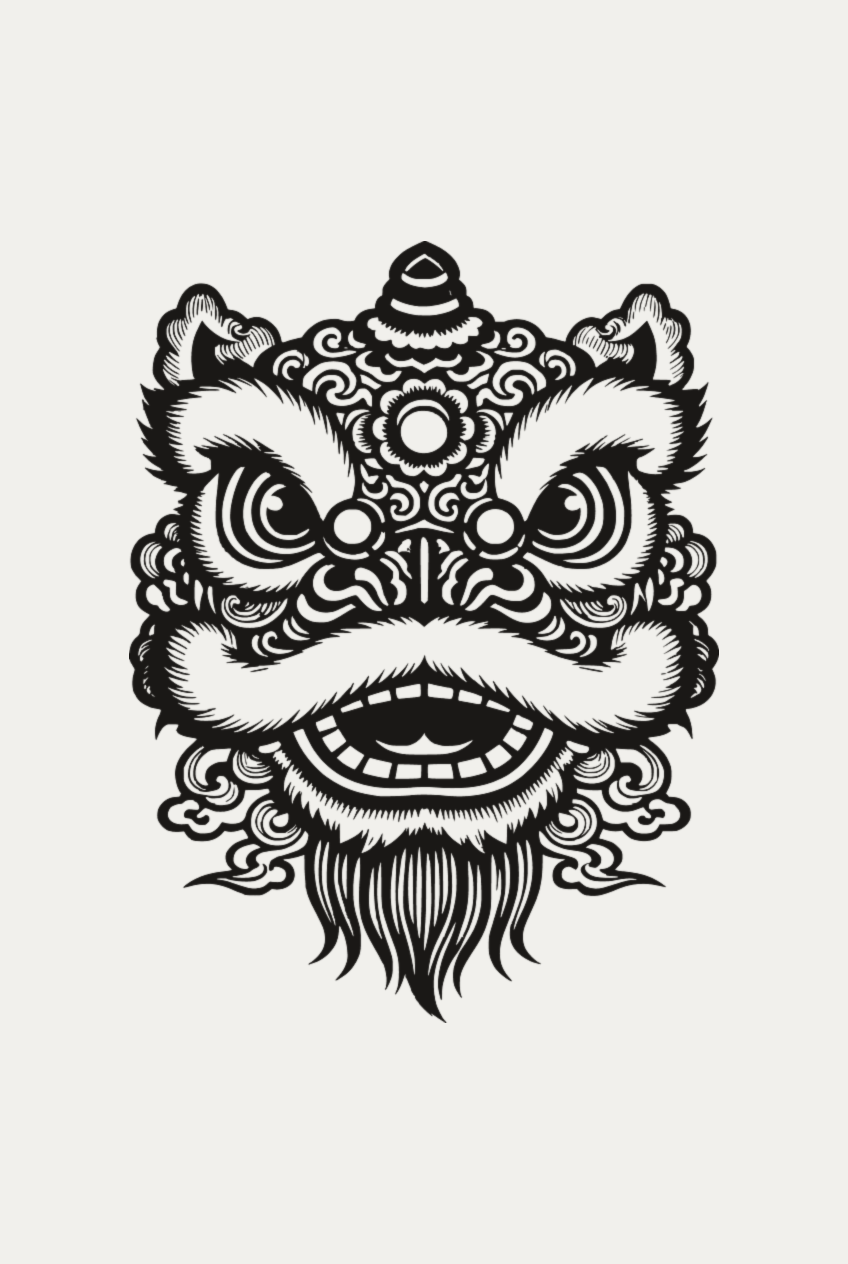
形态: 对称正面狮头:卷云鬃团,火眉双环眼,花环额镜,莲座宝顶,下颌垂须
名字
唐狮——中国人没见过的兽。中国不产狮子;这兽是跟着使节进来的。东汉章和元年(公元 87 年),安息国遣使献师子,正史把它当作一件珍奇异闻记下。见过活狮的汉人没有几个——而这正是开始:中国的画工与匠人,凭传闻、凭零星的记载,造出了自己的狮子——鬃毛卷成云团,眼睛圆如铜铃,额头上装一面镜子。守在中国门口的这只狮子,不是波斯的狮子,是中国人自己想出来的那一只。
*Táng shī* — the Tang lion. China never had native lions; the beast arrived by ambassador. In the first year of the Zhanghe era of the Eastern Han (87 CE), the Parthians sent a lion as tribute, and the court gazetteers recorded the event as they recorded the arrival of any rare thing. Few Han ever saw the living animal — and that was the beginning. Chinese artists, working from rumor, travelers' descriptions and a few caged specimens, invented their own lion: mane rolled like storm-cloud, eyes round as temple bells, a forehead set with a mirror. The lion that guards doorways across China is not the lion of Persia. It is what China made of it.
出处
出处在正史里有定案:《后汉书》记章和元年安息贡狮,自此汉家门阙与陵墓前开始蹲石狮——守门狮成了中国每一道门槛的语法。卷云状的鬃毛,承唐代狮子绘画与狮舞幡旗一脉:外来的卷毛在中国人的笔下长成了云团。额头正中的圆镜,是岭南醒狮狮头的标准构件——舞狮人额上装镜,照回靠近的邪祟。头顶的莲座宝珠、下颌一束束梳齐的垂须,是守门石狮与年画狮头的头部构件。墨线转写:本设计以传统母题的经典线条造型为底,转写为纹身墨线。
The tribute is fixed in the official record: the *Hou Han Shu* chronicles the Parthian gift of lions in 87 CE, and from the Han onward the beast was carved in stone at gates and tombs — the door-guarding lion that became the grammar of every Chinese threshold. The mane as rolling cloud-coils descends from the lion imagery of Tang painting and lion-dance banners, where the imported curls of the foreign beast grew into the storm-cloud tufts every Chinese lion wears. The round mirror on the forehead is the lion-head standard of the waking-lion (醒狮) dance of Lingnan: the mirror set into the dancer's forehead to turn back what approaches. The crown of lotus pedestal and pearl above it, and the beard falling in combed strands below the jaw, are the head-furniture of the guardian lion as carved at gates and printed in New Year woodcuts. Inking note: this design adapts the classic line construction of the traditional motif and re-inks it as tattoo linework.
设计灵感
本设计的每一处形制决定都有出处可查,逐条对账。① 卷云鬃团——唐代狮子画的鬃,外来的卷毛转写成带钩的云团,从眉到耳层层叠起。② 火眉双环眼——醒狮狮头的眼窗:睫毛立成火纹,瞳仁两重环套住一点黑。③ 花环额镜——舞狮人额上的镜,正安在狮子「天眼」的位置,外圈花瓣如门铺首。④ 莲座宝顶与梳齐的垂须——守门狮头的头部构件:上为莲座承珠,下为咧开的口颌之下垂落的长须。
Every form decision points to a recorded source, element by element. ① The cloud-coil mane — the Tang-painting mane, its imported curls re-inked as hooked storm-cloud tufts layered from brow to ear. ② The flame-browed double-ring eyes — the waking-lion head's eye windows: lashes standing in fire-strokes, the iris built of two rings around a dark pupil. ③ The mirror in a ring of petals — the dancer's forehead mirror, centered where a lion's third eye would sit, ringed like the boss of a temple door. ④ The lotus crown and combed beard — the head-furniture of the gate-guarding lion: pearl on lotus pedestal above, the beard falling in long combed strands below the open jaw.
来历
关于中国的狮子,最奇怪的一件事是:真狮子没过几百年就没了——贡狮生在伊朗高原,死在中国的宫苑里——可雕出来的狮子越生越多。每道门前蹲一对,每座桥、每家银库、每场喜事都有狮子。中国的狮子长成了人们需要它长成的样子:不是草原上的猎手,是门口的看守——凶到邪祟不敢来试,稳到一蹲一千年。卷云鬃就是这场「发明」的证据:没有哪只真狮子长那样的鬃。那是云,是香烟绕过香炉的样子。狮子就这样变成了中国的兽——像词语进入一门语言一样:被使用,被改造,最后被当成理所当然。
而这只狮子从未过时。在岭南,醒狮年年新年起舞,额镜照着光;从广州到成都的纹身店里,狮头是全国点单率最高的题材之一——纹它的人,要的是不带庙宇的守护者、不带残忍的凶。这张脸背后蹲着一千年的门槛。它守的东西变了——如今那道「门」是一个人——狮子照样适应,像它一贯的那样:你把它安在哪里,它就蹲在哪里,纹丝不动。
Here is the strangest thing about the Chinese lion: the real animal was gone within a few centuries — tribute lions were palace curiosities, they were born in the Iranian plateau and they died in northern courtyards — and yet the carved ones multiplied. Every gate grew a pair. Every bridge, every bank vault, every wedding got its lions. The Chinese lion became what the people needed it to be: not the hunter of the savanna but the keeper of the door — fierce enough that nothing wicked would test it, calm enough to sit for a thousand years. The cloud mane is the proof of the invention: no lion ever had a mane like that. It is weather. It is the way smoke curls over an altar. The lion became a Chinese animal the way a word becomes part of a language — by being used, reshaped, and finally taken for granted.
And the lion never stopped being contemporary. In Lingnan, the waking lion dances every New Year with the mirror flashing on its forehead; in tattoo shops from Guangzhou to Chengdu, the lion head is one of the most-inked subjects in the country — worn by people who want the guardian without the temple, the fierceness without the cruelty. A thousand years of doorways sit behind this face. The thing it guards has changed — the door is now a person — and the lion has adapted to that too, the way it always has: by sitting exactly where you put it and refusing to move.
释义
你自己选的守护者,而不是你害怕的那一个。门上的狮子说的是:这条线有人看着——看着它的东西有一头卷云鬃、一面额镜,不追人,也挪不动。在醒狮的传统里,它还带着舞蹈给它的第二层意思:「醒」本身——狮从睡中被一炷香、一点朱砂逐点唤醒才起舞,额镜安在额头正中,正是要把佩戴者自己的清醒照向外头。纹它的人,纹在自己要护的东西上:家人、一门手艺、一条画定了就打算守住的线。凶是表面,意思是稳稳蹲住。
The guardian you choose, not the one you fear. The lion at the door says: this line is watched — by something with a cloud mane and a mirror for a forehead, something that does not chase and cannot be moved. In the waking-lion tradition it carries a second layer the dance gave it: the waking itself — the lion starts the dance asleep, and is woken dot by dot, which is why the mirror sits where it does, turning the wearer's own awareness outward. People wear it over what they protect: family, a craft, a line they have drawn and mean to keep. Fierce is the surface. The meaning is the sitting still.
位置
正面构图生来属于平面:肩头、胸口、上背——身体能「摊平」的地方。它是一扇门,门是正对你开的。避开环形部位(臂环、脚环):镜面狮脸要整张被看见,两只眼同时迎着世界的两边。中到大;额镜、双环眼与梳齐的垂须都需要余地才能读清。
The front-facing symmetry is built for flat ground: the shoulder cap, the chest, the upper back — anywhere the body presents a plane. It is a door, and doors face you. Avoid wrapping placements (forearm rings, ankle bands): the mirrored face wants to be seen whole, one eye meeting each side of the world at once. Medium-to-large; the mirror, the double-ring eyes and the combed beard each need room to read.
纹之前
只放平面。 对称正面狮脸是门神式构图——肩头、胸口、上背或小腿正面;不做环绕。② 额镜不能省。 花环套圆的额镜是醒狮的身份——去掉它,这张脸就空了。③ 双眼对称,两眼都留。 整件设计的神气在那一对互为镜像的眼睛里;破了对称,就破了守护。④ 只用墨。 实黑与白色雕线是剪纸的两色——不必上色。⑤ 细刻线要留量。 鬃毛与垂须里的短刻线,至少要 10 厘米的成品尺寸才撑得住。
Flat placements only. The symmetric front face is a door-god composition — shoulder, chest, upper back or calf front; it does not wrap. ② The forehead mirror stays. The petal-ringed boss is the waking lion's identity — removing it empties the face. ③ Two eyes, mirrored, both kept. The design's whole temperament lives in the doubled gaze; breaking the symmetry breaks the guardian. ④ Only ink. Solid black with carved white detail is the paper-cut's two tones — no color needed. ⑤ Mind the fine hatching. The short carved strokes in mane and beard need at least 10 cm of finished size to hold.
本卡每一个汉字都由中文母语者选定并逐笔核对。