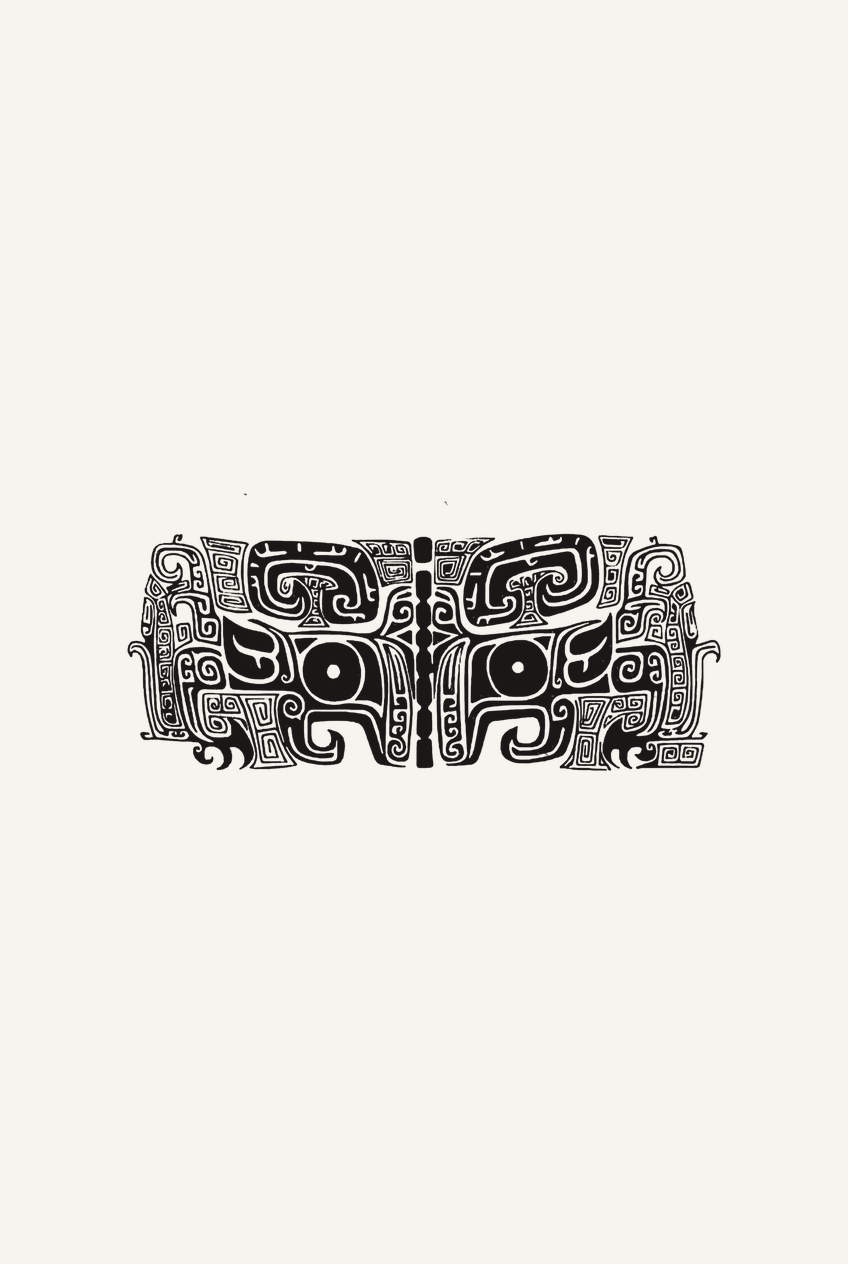
饕餮纹 · Tāo Tiè Wén
The Guardian Mask
系列: 符号纹样 · Design #02
笔法: Frontal symmetrical beast mask · bold brushwork · cloud-thunder spiral ground · scalable 8–18 cm
形态: 青铜兽面纹主体,对称正面构图,可配云雷纹地
名字
饕餮纹(tāo tiè wén)——中国青铜时代的面孔,也是中文里唯一一个把「吃」写了两遍的词:两个字都带食字旁。现代考古学叫它「兽面纹」,但民间记住的始终是那个上古凶兽的名字——饕餮。
*tāo tiè wén* — the taotie pattern, the animal-mask motif of Chinese bronze. The only word in Chinese that writes "eating" twice: both characters carry the 食 radical. Three thousand years ago it stared out from every ritual vessel that mattered. Modern archaeology calls it 兽面纹, the animal-face pattern — but the old name, the glutton's name, is the one that stuck.
出处
商与西周青铜礼器(约前 1600—前 771 年)——鼎、簋的正中都是它。《吕氏春秋》已有名目:「周鼎著饕餮,有首无身。」宋代金石学家定下称呼,沿用两千年。更深的根在良渚文化玉琮(约前 3300—前 2300 年)上的神人兽面——「琮王」今藏浙江省博物馆。现存最重的古代青铜器后母戊鼎(中国国家博物馆藏)腹部即是完整的兽面。形制参考:商周礼器上的铸铜兽面。墨线转写:本设计以传统母题的经典线条造型为底,转写为纹身墨线。
Shang and Western Zhou ritual bronzes, c. 1600–771 BC — ding tripods and gui food vessels cast with the mask as their central face. The name is attested in the *Lüshi Chunqiu* (3rd century BC): 「周鼎著饕餮,有首无身」 — "the Zhou ding bears a taotie: a head with no body." Song-dynasty antiquarians fixed the usage; the name has run for two thousand years since. Deeper roots: the animal-mask face on Liangzhu culture jade cong, c. 3300–2300 BC — the "king of cong" is held at Zhejiang Provincial Museum. The Houmuwu ding, the heaviest ancient bronze surviving, National Museum of China, carries the full-face version. Historical form reference: bronze-cast animal masks from Shang-Zhou ritual vessels. Inking note: this design adapts the classic line construction of the traditional motif and re-inks it as tattoo linework.
设计灵感
本版每一处形制决定都有出处可查,逐条对账。① 正面对称兽面——青铜器标准构图,沿中轴鼻线左右镜像,与铸工的布局一致。② 巨目——青铜兽面最具辨识度的目纹,隔着一个大厅也能认出来的那一双。③ 云雷纹地——兽面四周的螺旋填地纹,青铜器标配底纹。④ C 形角与卷鼻——商代兽面共有的角与下颚结构。
Every form decision on this design points to a recorded source, element by element. ① The frontal symmetric mask — the canonical bronze composition, mirrored around a central nose line exactly as the casters laid it out. ② The bulging eyes — the 目 boss-eyes that dominate every bronze face, the part you read from across a room. ③ The cloud-thunder ground — leiwen spirals filling the space around the face, the standard bronze backdrop. ④ The C-shaped horns and curled snout — the horn-and-jaw architecture shared by Shang mask faces.
来历
中国人还没有用文字讲故事的时候,先在青铜上铸故事。而每一件铜器的故事都从一张脸开始:两只凸目,双角如枝,巨口张着,没有身子。三千年,从黄河一路铺到四川盆地。这就是饕餮纹。
名字来自一只怪兽。《吕氏春秋》记:「周鼎著饕餮,有首无身,食人未咽,害及其身。」——一口没吞完人,反害了自己。纯然的贪欲之兽,在更早的名单里位列四凶。于是青铜时代最庄严的器物上,那张脸被冠以典籍里最出名的贪兽之名。
但要告诉你一句实话:名字是后来的故事,不是最早的。考古学如今更常用平实的「兽面纹」,而这张脸本身比任何文字都古老——良渚的玉琮上早就有它,比第一件商鼎还早一千年,一双眼睛占掉画面一半。这张脸守着献给祖先与神明的食物,它是那条界线:凶到足以守住生与死之间的那道门。它到底是辟邪的门神,还是「必须被喂养」的脸,学界至今在争——诚实的答案是,一张三千岁的脸,总会留几个秘密。
中国人处理「贪」这个字的方式很妙:苏东坡写《老饕赋》,把这个词抢了回来。今天说某人是「老饕」,是夸他懂吃。贪欲之兽,成了认真对待吃的人的徽章。
纹在身上,它和铸在鼎上做的是同一件事:正面对称、无法忽视。在胸口是甲,在后背是门。这是中国视觉谱系里最古老的一张脸——比笔墨早,比纸早,比「中国」这个词还早——而它至今仍在工作:与它对视的人,它也在看你。
Before Chinese writing told stories, it cast them in bronze. And the story every vessel tells starts with a face: two bulging eyes, horns spreading like antlers, jaws wide, no body. Three thousand years old, found from the Yellow River to Sichuan. The face with no body — the taotie.
The name comes from a monster. The *Lüshi Chunqiu* records the saying: "the Zhou ding bears a taotie — a head with no body; it swallowed a man before finishing, and the harm fell on its own frame." A creature of pure appetite, devouring everything, including itself. In the older lists it counts among the four fiends banished by Shun. So the mask on the most sacred vessels of the Bronze Age got labeled with the most notorious glutton in the corpus.
But here is what a native would tell you: the name is the later story, not the first. Modern archaeology prefers the plain name 兽面纹, the animal-face pattern, and the face itself goes back further than any text — to Liangzhu jade carved a thousand years before the first Shang ding, a face whose eyes alone take up half the design. The mask watched over the vessels that carried food to ancestors and gods. It was the boundary: the thing fierce enough to hold the door between the living and the dead. Whether it wards off evil or *is* the face of what must be fed, scholars still argue — the honest answer is that a three-thousand-year-old face keeps some secrets.
Chinese handled the greed of it with a shrug and a smile: Su Shi, the Song dynasty's great eater-poet, wrote the *Laotao Fu*, the "Glutton's Rhapsody," and reclaimed the word. Today 老饕 means a serious gourmet — someone who takes eating as seriously as the bronze casters took sacrifice. The beast of appetite became the badge of the person who refuses bad food.
As a tattoo it works the way it worked on the vessel: a face forward, symmetric, unignorable. On the chest it is armor. On the back it is a gate. The oldest face in the Chinese visual canon — cast in bronze before ink, before paper, before the word "China" existed — and it still does its job: it watches back.
释义
有牙齿的守护。饕餮是靠威慑完成的保护——中国纹样里的守门者;纹上它,也是对欲望的表态:认识你的饥饿,承认它,但绝不被它吞掉。同时它也是「资历」的最强表达:中国纹样谱系里,没有比它更老的。
Guardianship with teeth. The taotie face is protection by intimidation — the boundary-keeper of Chinese motifs — and, worn by choice, a statement about appetite: know your hunger, own it, never be devoured by it. Also the strongest possible claim of old money in tattoo form: nothing in the Chinese canon is older.
位置
正面对称的脸要正面舞台:胸口中线与后背肩胛之间是正位,12–18 厘米,眼睛的气场才压得住。缩小到 8–10 厘米可以放在大臂外侧或小腿线,读作一枚印。不适合环绕式布局——镜像对称的脸需要一个完整的平面。
The frontal symmetry wants a frontal stage: the center of the chest or the upper back between the shoulder blades are the canonical positions, 12–18 cm so the eyes hold their power. A reduced version, 8–10 cm, sits on the outer shoulder or the calf line, reading as a seal. Not designed for wrap-around placement — a mirror-symmetric face needs one flat plane.
纹之前
名字之争本身就是故事的一部分:纹身师叫它兽面纹或饕餮都对——图案比名字古老。② 对称的脸要求对称的皮肤:兽面需要一块完整、相对平坦的平面(胸、上背),否则那双眼睛会变形。③ 云雷纹地是它「读作青铜」而不是「怪兽海报」的关键——不要让纹身师把它简化掉。④ 只宜墨线:青铜兽面从来不是彩色的,目内可以做灰面晕染,上彩则不对。⑤ 留够尺寸。 胸背全脸不小于 12 厘米(肩部缩印不小于 8 厘米)——再小眼睛就失去压迫感,而眼睛才是重点。
The name debate is part of the story: if a tattooist calls it 兽面纹 and another calls it 饕餮, both are right — the pattern is older than its name. ② Symmetric faces demand symmetric skin: the mask needs an unbroken, relatively flat plane (chest, upper back), or the eyes will distort. ③ The leiwen ground is what makes it read "bronze" instead of "monster poster" — don't let anyone thin it out. ④ Ink-only by design: the bronze mask was never painted; greywash shading inside the eyes is welcome, color is not. ⑤ Respect the size. Keep the full mask at least 12 cm on chest or back (8 cm minimum for a shoulder reduction) — below that the eyes lose their dominance, and the eyes are the point.
本卡每一个汉字都由中文母语者选定并逐笔核对。