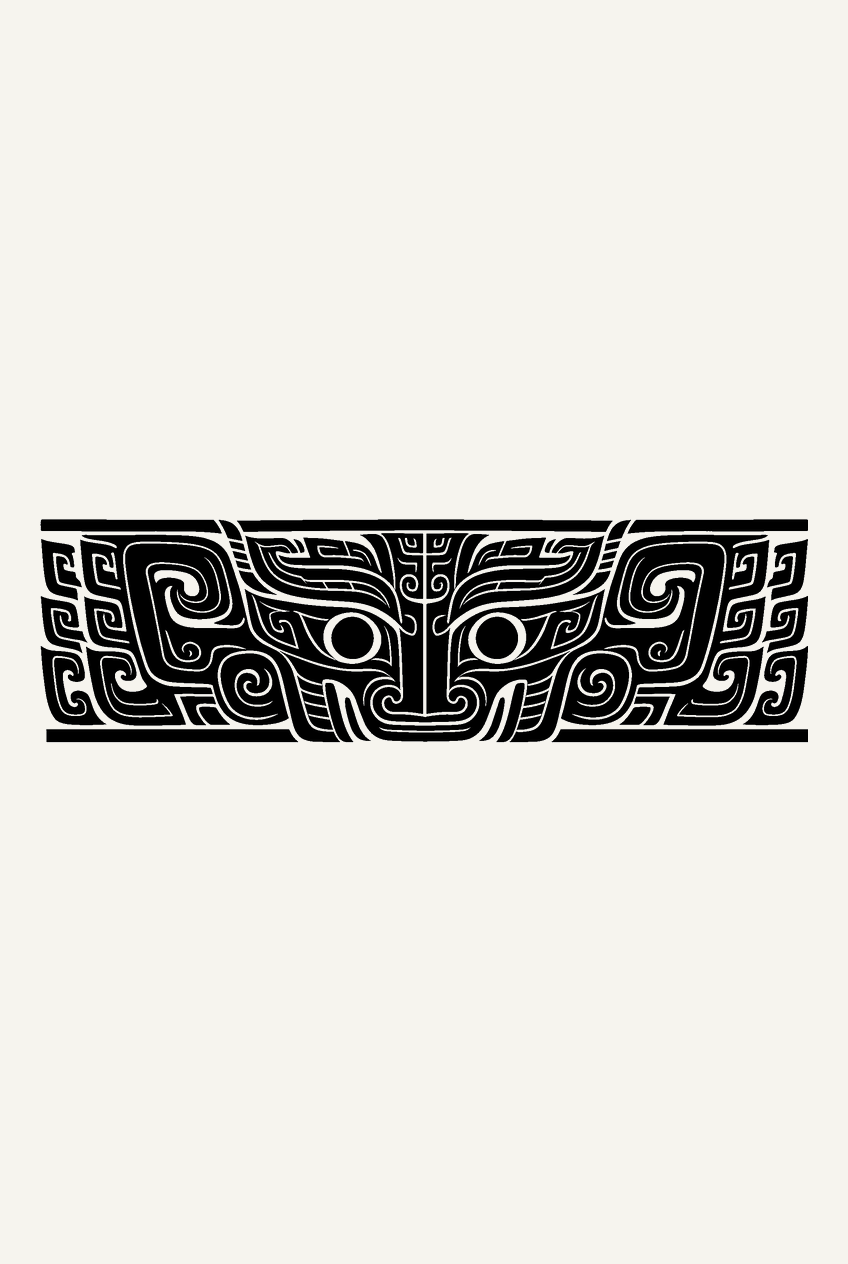
饕餮角带 · Tāo Tiè Jiǎo Dài
The Horned Face
系列: 符号纹样 · Design #20
笔法: Horned-mask horizontal band · C-scroll horns and curled snout centered, meander borders closing the strip · black ground with white pattern lines · arm-band wrap · scalable 16–22 cm
形态: 饕餮角纹横带,C形巨角兽面居中,回纹边带两侧收口,作臂环横排佩戴
名字
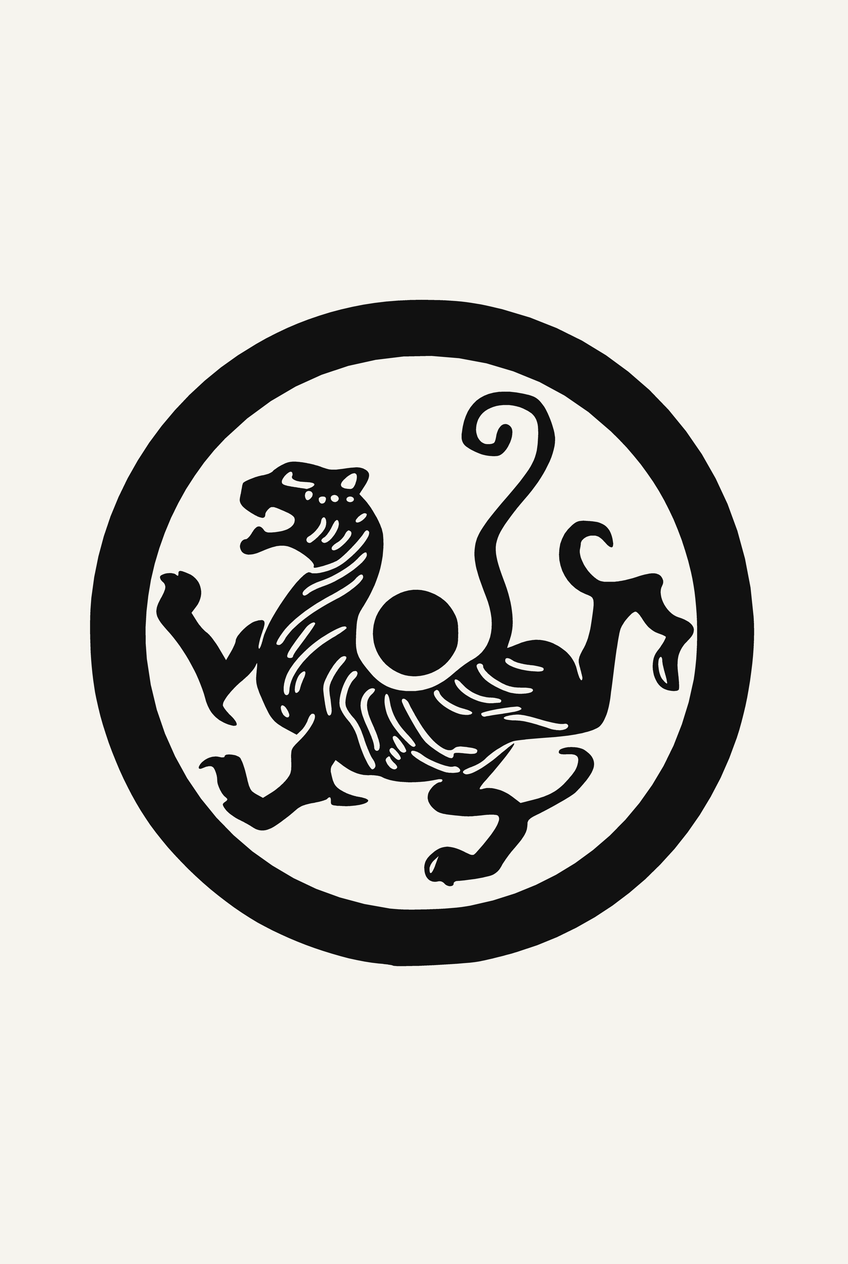
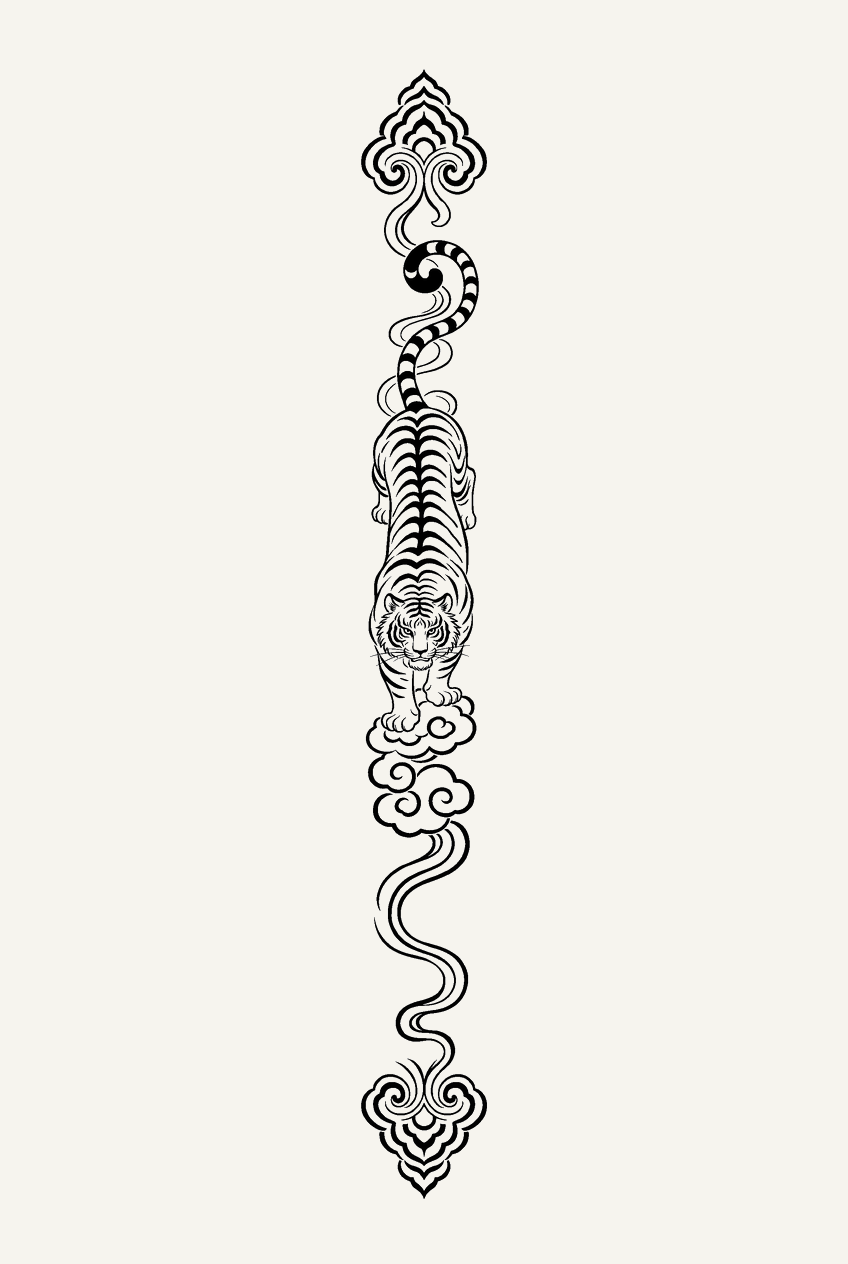
饕餮角带(tāo tiè jiǎo dāi)——从「冠部」读出的兽面。青铜器专家给兽面体系里的上千张脸分类,依据就是角:C 形卷、鹿角形、瓶形角,以及角下的卷鼻。角是面具的语法——它告诉你面对的是哪一族生物、铸于哪个世纪。这条带把带角的脸上部放在正中:巨大的 C 形卷从眉部升起,卷鼻在下方,回纹边带在两端收口。它是饕餮的建筑学,而不是它的注视。
tāo tiè jiǎo dài — the mask read by its crown. Bronzes specialists sort the thousand faces of the animal-mask tradition by their horns: the C-scroll, the antler, the bottle-horn, the curled snout beneath. The horns are the mask's grammar — they tell you which family of creature you are dealing with and which century cast it. This band centers the horned upper face: great C-shaped scrolls rising from the brow, the curled snout beneath, meander borders closing the strip at both edges. It is the taotie's architecture rather than its stare.
出处
商周兽面体系的角部类型学:C 形卷与卷鼻的角形,加冕于礼器的兽面段——青铜学者用来断代与分类的判别特征。两侧的回纹边带承自同一套青铜边饰体系。兽面传统的名字注脚仍是《吕氏春秋》那句「有首无身」——头就是全部,而角是头的开场白。形制参考:商周礼器带回纹边的带角上部兽面段。墨线转写:本设计以传统母题的经典线条造型为底,转写为纹身墨线。
Horn typology of the Shang-Zhou animal-mask tradition: the C-scroll and curled-snout horn forms that crown the mask registers on ritual bronzes — the diagnostic features bronze scholars use to date and classify faces. The flanking meander (huiwen) borders descend from the same bronze border system. The mask tradition's name gloss remains the *Lüshi Chunqiu*'s 「有首无身」 — the head is the whole of it, and the horns are the head's announcement. Historical form reference: horned upper-face registers on Shang-Zhou ritual bronzes with meander borders. Inking note: this design adapts the classic line construction of the traditional motif and re-inks it as tattoo linework.
设计灵感
本版每一处形制决定都有出处可查,逐条对账。① C 形巨角——从眉部对称升起的巨大钩卷,青铜角形的经典式。② 下方卷鼻——向下回卷的颌卷,与上方的角配重。③ 回纹边带——方折回纹条在带的上下收口。④ 黑地极性——实黑里刻出的白色角线,拓片对铸面的读法。
Every form decision on this design points to a recorded source, element by element. ① The C-scroll horns — great hooked volutes rising symmetrically from the brow, the classic bronze horn form. ② The curled snout beneath — the down-curling jaw scroll balancing the horns above. ③ The meander edge borders — square-folded fret strips closing the band top and bottom. ④ The black-ground polarity — white horn lines carved from solid black, the rubbing's read of a cast face.
来历
问一个青铜器专家如何给一张脸断代,答案是:看角。角是面具的签名和指纹——一族一族,逐个世纪变着形状,像碑刻上的大写字母在朝代间漂移。那头兽从未存在过;角始终是一种形式语言,只是被无比认真地「说」着。
这就是这条带奇异的力量。它展示的是一张「没有原物」的脸的上半部——角、眉带、卷鼻——而眼睛会条件反射地把其余的部分拼装出来。你看到的不是一个残件;你看到一个刻意未完成的存在,像一道在走进去之前永远算不上完成的大门。
绕在臂上,这张带角的脸继续它古老的职务。在铜器上,脸的上半部是高出纹段线的那部分——面向仪式的天空,而非地面。在臂上,它面对房间。声索与铜器当年的声索一样:有冠之物,立于此处。
Ask a bronze specialist how they date a face and the answer is: by the horns. The horns are the mask's signature and its fingerprint — families of them, changing shape century by century, the way capital letters drift across a dynasty of stone inscriptions. The beast itself never existed; the horns were always a formal language, spoken with total seriousness.
That is the strange power of this band. It shows the top of a face that has no original — the horns, the brow band, the curled snout — and the eye assembles the rest of the creature by reflex. You do not see a fragment; you see a presence that is deliberately unfinished, the way a great doorway is unfinished until you walk through it.
Around the arm, the horned face keeps its ancient job description. On the vessels, the upper face was the part that rose above the register line — the part that faced the sky of the ritual, not the floor. On the arm it faces the room. The claim is the same one the bronze made: something crowned stands here.
释义
有冠的权威。角是中国艺术说「等级」的最古老方式:不是眼睛的警觉,而是眉骨的结构。给那些承担着「先于自己开始、并将比自己更久」的责任的人——一个家族、一个机构、一门手艺——带角的脸是诚实的徽记。
Crowned authority. The horn is the oldest way Chinese art says "rank": not the eyes' watchfulness but the brow's structure. For someone carrying responsibility that predates them and will outlast them — a family line, an institution, a craft — the horned face is the honest emblem.
位置
上臂横排臂环,宽 5–7 厘米,双角在臂外侧居中。前臂可作宽环;小腿腿环双角朝外。回纹边带能干净地消化弧面。
Horizontal arm band on the upper arm, 5–7 cm wide, horns centered on the outer face. On the forearm it works as a wide band; as a leg band the horns wrap the calf outward. The meander borders handle curvature cleanly.
纹之前
C 形巨角是全件的考题:两条卷线必须沿臂轴镜像——上线前转印并核对两次。② 带宽至少 5 厘米;角卷内部的白线很快就会并死。③ 缝口落在回纹边带内,绝不许在角尖。④ 只宜墨线:黑地白线,别的什么都不要。⑤ 黑地随岁月扩张——线条从一开始就应比参考图略重。
The C-scroll horns are the test of the piece: their two curves must mirror across the arm's axis — template and check twice before lining. ② Keep 5 cm minimum band width; the horn scroll's white interior lines close up fast. ③ The seam falls inside a meander border, never at the horn tips. ④ Ink-only by design: black ground, white line, nothing else. ⑤ Black fields expand with age — line weights should run slightly heavier than the reference from the start.
本卡每一个汉字都由中文母语者选定并逐笔核对。