仙女 · Xiān Nǚ
The Fairy on His Left Arm
系列: 历史名纹 · Design #03
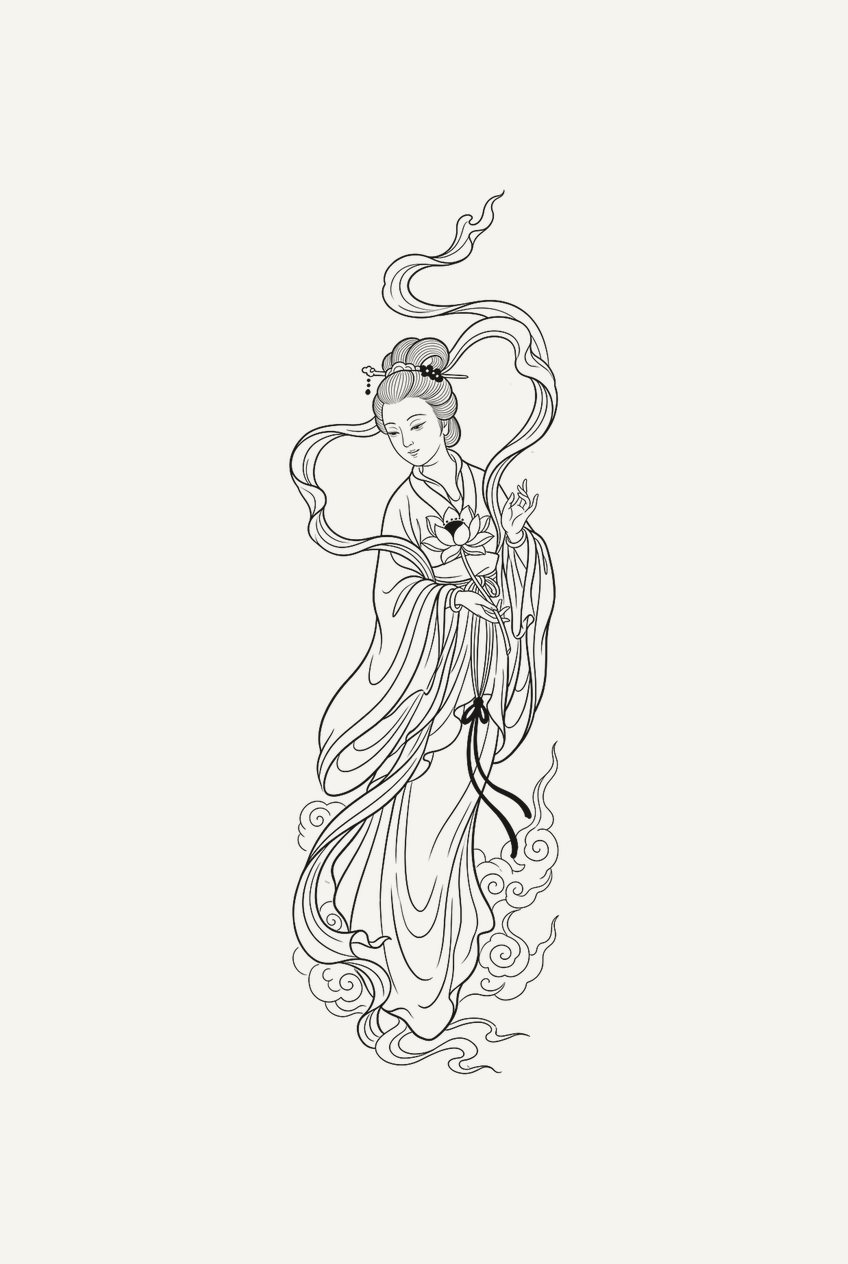
笔法: standing celestial figure on clouds · flowing ribbon · fine-line black with soft wash
形态: 仙女立像踏云,衣带当风
名字
仙女——长生者的少女相。一个叫刘知远的少年把他义父的耐心花光的那一年,他把生活费拿去找刺青匠,左臂刺了位仙女,右手一条龙,背上一个夜叉。这句话是中国小说史上第一条完整的刺青记录:宋人说话人的底本《新编五代史平话》,一句话点了三处刺青——然后跟着这个少年一路走向后汉的御座。本设计里的仙女,就是那条手臂上的那一位。
*Xiān nǚ* — the immortal maiden. In the year a boy named Liu Zhiyuan ran out of ways to disappoint his foster father, he took his allowance to a tattooist and had a fairy inked on his left arm, a dragon on his right hand, and a storm spirit on his back. The story is fiction's first full tattoo record in Chinese: the *Popular History of the Five Dynasties* (新编五代史平话), a Song-era storyteller's script, names all three tattoos in one sentence — and then follows the boy to the throne of the Later Han. The fairy on this design is the one on that arm.
出处
记录出自《新编五代史平话·汉史平话》,宋人说话底本、经元明刊本传世——「一日,是二月八日,庆佛生辰时分,刘知远出去将钱雇倩针笔匠文身,左手刺个仙女,右手刺一条抢宝青龙,背脊上刺一个笑天夜叉」。这句话前后的少年履历也是同一文本的:被义父逐出家门,卧龙桥上赌得精光,被李长者收留、娶其女三娘,投军而去——最终成为郭威的前任:后汉高祖(947–948 在位)。正史(旧五代史、新五代史)确认其人与其朝,但未记任何刺青——刺青是说话人的一层,本设计把两层如实分开。墨线转写:本设计以传统母题的经典线条造型为底,转写为纹身墨线。
The record is the *New Compilation of the Five Dynasties Popular History* (新编五代史平话·汉史平话), Song dynastic storytelling script, preserved via the Yuan-Ming printing — "On the Buddha's birthday, the eighth day of the second month, Liu Zhiyuan went out and paid a needle-artist to tattoo him: on his left arm a fairy, on his right hand a snatching-the-pearl azure dragon, on his back a sky-laughing yaksha." The boy's arc around the sentence is the same text's: thrashed out of the house, gambled broke on Crouching Dragon Bridge, rescued into servitude, married into the Li family, gone to the wars — and emerged as Guo Wei's predecessor: Emperor Gaozu of Later Han (r. 947–948). History books (旧五代史, 新五代史) confirm the man and the reign but record no tattoos — the tattoos are the storyteller's layer, and this design keeps the two honestly apart. Inking note: this design adapts the classic line construction of the traditional motif and re-inks it as tattoo linework.
设计灵感
本设计的每一处形制决定都有出处可查,逐条对账。① 立像——臂上刺青要竖读:设计保留天女立姿。② 踏云——中国画人物的天界语法;也是说话人的世界——桥头的少年看着赌徒们腾云而去。③ 飘带——自敦煌飞天以来,中国艺术里神性品级的视觉签名。④ 细线淡染——原文说的是「针笔匠」,市井刺青行当,不是军籍黥记;设计保留这份匠人的柔和。
Every form decision points to a recorded source, element by element. ① The standing figure — a 臂上 tattoo on a soldier needs a vertical read: the design keeps the standing celestial pose. ② The cloud base — the celestial grammar of Chinese figure painting; also the storyteller's world, where boys at bridges watch gamblers vanish into clouds. ③ The wind-borne ribbon — 飘带, the visual signature of divine rank in Chinese art since the Dunhuang flying apsaras. ④ Fine-line with soft wash — the record says 针笔匠 (needle-artist), the civilian tattoo trade, not the army's registration ink; the design keeps that craftsman's softness.
来历
说话人用最省的笔墨搭好了台。刘知远,十五岁,殷实人家疼出来的义子,书读砸了,田种砸了,一切安分的事都砸了。佛诞日——过节,满镇都是灯——他揣着钱去找针笔匠,买了三处刺青:左臂仙女,右手抢宝青龙,背上笑天夜叉。回家炫耀。义父把他赶出了门。
接下来发生的事,是仙女为什么重要的答案。流落在外,卧龙桥的赌桌上输得精光,少年向清空他钱包的五个后生改约了一场打架——说话人让刺青来解释赢的是谁:赌徒们腾云而去。一只手上有龙、背上有夜叉的少年不是少年;另一条手臂上的仙女是品级的凭证——有人被天记了名。李家收留他,娶了李家女儿,被舅兄们挤兑去投军——节日人群里被下针的那个少年,成了后汉高祖,开国皇帝,郭威兵变所要取代的那个人。
冷眼读,仙女是个浪荡子的纪念品。整篇读,她是说话人对这个少年的全部理论:龙是兵,夜叉是逆,而仙女——在左边,安静的一侧,心脏上方——是三者共同效命的那个运数。桥头敌人腾云而去的时候,握剑的正是刺着仙女的那条手臂。正史里那位皇帝身上没有任何刺青的记载。说话人记下的是刺青的用途:那个节日的人群还没能看见的你。
The storyteller sets the scene with ruthless economy. Liu Zhiyuan, fifteen, adopted son of a comfortable farmer, has failed at books, at farming, at every settled thing. On the Buddha's birthday — a holiday, the whole town out in festival light — he takes money to a needle-artist and buys three tattoos: a fairy on the left arm, a pearl-snatching dragon on the right hand, a laughing yaksha on his back. He comes home to show off. His foster father throws him out.
What happens next is why the fairy matters. Out on the road, broke at a gambling table on Crouching Dragon Bridge, the boy challenges the five men who cleaned him out to a fight instead — and the storyteller lets the ink explain what wins: the gamblers *rise into the clouds and vanish*. A boy with a dragon on one hand and a yaksha on his back is not a boy; the fairy on the other arm is the proof of rank — someone marked for the sky. He is taken in by the Li household, marries their daughter, is driven to the wars by quarrelsome brothers-in-law, and the man the tattooist inked in a festival crowd becomes Emperor Gaozu of Later Han, founder of a dynasty, the man Guo Wei's coup would later displace.
Read cold, the fairy is a delinquent's souvenir. Read whole, it is the storyteller's whole theory of the boy: the dragon is the soldier, the yaksha is the rebel, and the fairy — on the *left*, the quiet side, over the heart — is the fortune all three serve. When the enemies disappear into cloud at the bridge, the arm with the fairy is the one holding the sword. History records no such tattoos on the real emperor. The storyteller recorded what a tattoo is *for*: the version of you that the festival crowd couldn't see yet.
释义
还没人看得见时,你已经带着的那份运数。仙女坐在身体安静的一侧,什么也不表演——而故事每一次转折都绕着她弯。给正处在「断裂之前那些年」的人:没人鼓掌的功课,还没人给你授的品级。天予其人,先刺其臂——上天提拔一个人之前,先在他臂上做记号。
The fortune you carry before anyone can see it. The fairy sits on the quiet side of the body and does nothing visible — and every turn of the story bends around her. For people in the years before the break: the work nobody claps for, the rank nobody has assigned you yet. 天予其人,先刺其臂 — heaven marks its own before it promotes them.
位置
文献把她放在左臂——直接致敬:左小臂内侧,竖排,腕线到肘弯 12–16 厘米,仙女在上、云在下。等位:小腿外侧或肋侧,同为竖读。她是安静的设计——线柔、站定——落在身体有遮蔽的面上最好;肩前那类太公开的台面,配不上一位以耐性为全部美德的仙人。
The record puts her on the left arm — honor that directly: inner forearm, vertical, 12–16 cm from wrist to elbow crease, fairy above, clouds below. Alternates: the outer calf or the side of the ribcage, both vertical reads. She is a quiet design — soft lines, standing still — and sits best on the body's sheltered faces; the front of the shoulder is too public a stage for a figure whose entire virtue is patience.
纹之前
能左则左。 文献写明左手;翻到右边,出处就断了,又换不来任何好处。② 她站着,不飞。 敦煌飞天飞;这是说话人笔下刺青匠的版本——踏云而立,飘带垂落。③ 柔和是时代正确的。 针笔匠是市井匠人;重墨硬黑版会把私人的记号变成帮派徽章。④ 只用墨。 黑灰淡染。⑤ 最小尺寸。 竖面上像高 10 厘米起;再小,面部与飘带会失线。⑥ 这是一个艺人讲的故事。 那个人的王朝是史实;刺青是说话人的一层——把它讲成中国小说里最好的刺青故事,它本来就是。
Left arm if you can. The record is specific (左手); mirroring it to the right breaks the provenance for no gain. ② She stands, she doesn't fly. Dunhuang apsaras fly; this is the storyteller's tattooist version — grounded on cloud, ribbon down. ③ Softness is period-correct. The 针笔匠 was a civilian craftsman; a heavy-ink hard-black version turns a private mark into a gang badge. ④ Only ink. Black-grey with soft wash. ⑤ Minimum size. 10 cm figure height on a vertical plane; below that the face and ribbon lose their line. ⑥ This is a story told by an entertainer. The man's reign is history; the tattoos are the storyteller's layer — tell it as the best tattoo story in Chinese fiction, which is exactly what it is.
本卡每一个汉字都由中文母语者选定并逐笔核对。