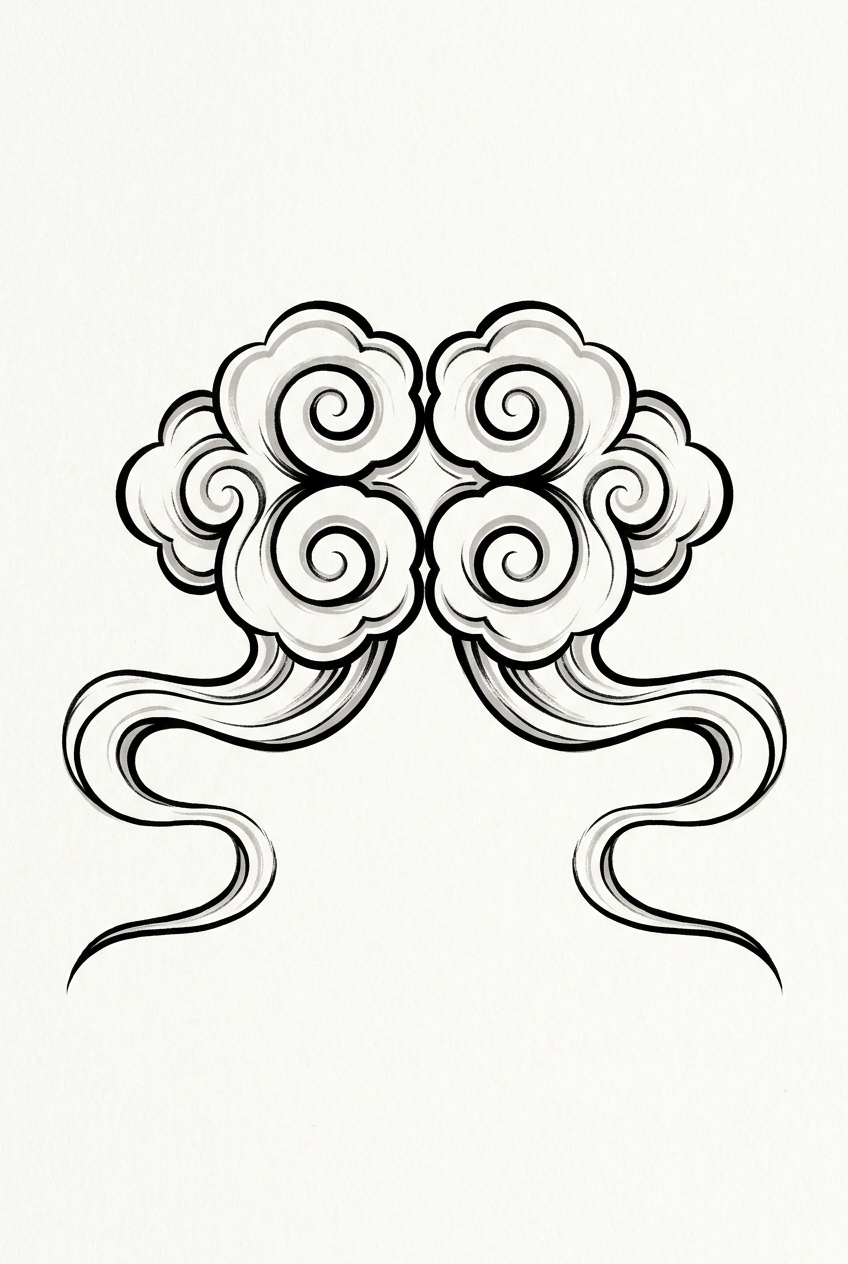
祥云纹 · Xiáng Yún Wén
The Auspicious Cloud
系列: 符号纹样 · Design #01
笔法: Cloud band or single ruyi cloud head · standalone or framing element · scalable 3–15 cm
形态: 云纹带/如意云头,可环绕其他元素使用
名字
祥云纹(xiáng yún wén)——上行的运气。中国唯一一个五千年一路流行、从未过时的图案。
*xiáng yún wén* — the auspicious cloud pattern: fortune that drifts upward. The only Chinese motif that has been continuously fashionable for five thousand years without a single season out of style.
出处
战国楚墓漆器云纹(前 4–前 3 世纪)——云纹体系最早的成熟形态之一。汉代瓦当"长乐未央"文字云纹、马王堆汉墓帛画云气纹(湖南省博物院藏)。明清"四合如意云"定式——今日最常被识别的经典款。形制参考:卷云纹见于战国漆器至明清织绣。 本设计未使用任何第三方源图像。
Warring States Chu lacquerware cloud scrolls (4th–3rd century BC) — the earliest mature form of the cloud system. Han dynasty roof-tile ends reading "长乐未央" ("Endless Joy Without End") set among clouds; cloud-vapor silk banners from the Mawangdui tombs (Hunan Museum). The Ming–Qing "four-joined ruyi cloud" is the canonical modern-recognizable form. Historical form reference: Cloud-scroll motifs appear on Warring States lacquerware through Ming-Qing textiles. No third-party source image was used for this design.
设计灵感
设计灵感
本版每一处形制决定都有出处可查,逐条对账。① 四合如意云头——明清定式,对称端庄。② 流云尾——战国楚漆器云纹的奔放云气,云纹体系最早的成熟形态。③ 如意头螺旋——「如意」得名的向心紧卷。④ 汉云气谱系——马王堆汉墓帛画云气纹,云带的奔放先祖。
Every form decision on this design points to a recorded source, element by element. ① The four-joined ruyi head — the Ming–Qing canonical form, symmetric and composed. ② The streaming tails — the free vapor of Warring States Chu lacquer scrolls, the cloud system's earliest mature form. ③ The scepter-head spiral — the tight inward curl the ruyi form is named after. ④ The Han vapor lineage — the cloud-vapor silk banners of the Mawangdui tombs, the unrestrained ancestor of the band.
来历
来历
在所有中国纹样里,祥云是唯一一个从五千年前一路流行到今天、且从未过时的图案。
它的底层逻辑藏在农耕文明的命脉里:云决定雨,雨决定收成,收成决定生死。所以中国人抬头看云的时候,看的从来不是风景,是命运。甲骨文里的"云"字就是一朵卷起的云气,商王为求雨占卜的卜辞里写满了它。
到了战国楚人的漆器上,云开始"起飞"——工匠把云画成盘旋流动的曲线,缠绕着神怪与飞鸟,让整个器物像在气流里旋转。楚人相信魂魄升天,云就是天路上的交通工具。汉代继承了这个想象,马王堆墓的帛画上,云气充满整幅天上世界;宫殿的瓦当刻着"长乐未央",字在云间——住在云里,快乐没有尽头。
而云在中国人的口语里,一直是"往上走"的象征:平步青云、青云直上、蒸蒸日上。一个人运气来了,中国人说他"走云运"了。
明清两代,云纹完成了它最后的定型:"四合如意云"——四个云头向中心回旋如如意,对称、饱满、端庄。你今天在故宫的琉璃瓦、皇帝的龙袍下摆、青花瓷的肩线上看到的都是它。它变得可以和任何元素搭配:龙要踩云、鹤要驾云、蝙蝠要穿云——云是中国纹样系统里的"通用底座",是好运的运载工具。
这也是它作为纹身最妙的地方:它可以单独成纹(一段云带,极简干净),也可以作为配景,让任何主体"升"起来。五千年的云,落在你皮肤上,形态是两千年前的,寓意是一直没变的——愿你一直在上行的气流里。
Among all Chinese motifs, the auspicious cloud is the only one that has been continuously fashionable for five thousand years — and never once gone out of style.
Its logic is rooted in the lifeline of an agrarian civilization: clouds govern rain, rain governs harvest, harvest governs survival. When the Chinese looked up at clouds, they were not looking at scenery — they were reading fate. The oracle bone script already drew "cloud" as a curling mass of vapor, filling the rain-prayer inscriptions of Shang kings.
On the lacquerware of the Warring States, clouds took flight. Craftsmen painted them as swirling spirals wrapping deities and birds until the whole vessel seemed to rotate in wind. The Chu believed souls ascended to heaven — clouds were the vehicle. The Han inherited the vision: silk banners in the Mawangdui tombs fill heaven with drifting vapor, and palace roof-tiles carry the words "Endless Joy Without End" set among clouds — living in the clouds, happiness without a finish line.
In everyday speech, the cloud has always meant *rising*: to rise on the blue cloud is the Chinese idiom for a meteoric career. When fortune arrives, one is said to be "riding cloud luck."
By the Ming and Qing, the motif reached its final canonical form: the "four-joined ruyi cloud" — four cloud heads swirling back toward the center, symmetrical and serene. You see it today on Forbidden City glazed tiles, on the hems of imperial dragon robes, on the shoulders of blue-and-white porcelain. The cloud became the universal chassis of Chinese motifs: dragons tread it, cranes ride it, bats pierce through it — it is the delivery vehicle of good fortune itself.
And this is what makes it perfect as a tattoo: it works alone as a single clean band of vapor, or as a setting that lifts any subject skyward. Five thousand years of cloud, landing on your skin — the form two millennia old, the meaning unchanged: may you always ride the rising air.
释义
释义
平步青云。祥云 = 上行的运气 + 如意的形态化。它是最"百搭"的中国符号:可独立、可衬托、可环绕,也适合作为第一个中国风纹身(低调且处处有典)。
Rising step by step on the blue cloud. The auspicious cloud is upward fortune given form — the most versatile of all Chinese symbols: standalone, framing, or connecting existing tattoos. Often the perfect first Chinese-style tattoo: quiet, but with a story everywhere you look.
位置
位置
全系列里灵活度最高的位置方案:云带横构图适合小臂环、锁骨环、脚踝环;单朵 3–5 厘米如意云头极适合耳后/颈后/腕上。3 厘米单云到 15 厘米云带全部成立——尺寸由你定。
The most flexible placement in the whole collection: a horizontal cloud band wraps the forearm, collarbone, or ankle as a ring; a single 3–5 cm ruyi cloud head sits perfectly behind the ear, at the nape, or above the wrist. Everything from a 3 cm single cloud to a 15 cm band is legitimate — scale is yours to choose.
纹之前
纹之前
云纹变体极多(卷云/朵云/如意云/流云),先选朝代风格:战国流云飘逸、汉云气奔放、明清如意云端庄——本卡 stencil 以明清四合如意云为主。② 云纹常被误认成日式和风(浮世绘云)——中式如意云的对称云头是关键识别特征,stencil 已强调。③ 作为陪衬纹时注意留白比例:云不超过主体面积的三分之一,否则"喧宾夺主"。④ 只宜墨线:对称如意线描即画面本身。⑤ 留够尺寸。 整体不小于 8 厘米(单云头不小于 4 厘米),卷心才清晰;对称构图适配任意部位。
Cloud variants are numerous (scrolling, clustered, ruyi, streaming) — pick your dynasty: Warring States streaming clouds are wild and free, Han vapor is unrestrained, Ming–Qing ruyi clouds are composed and symmetric. This design is built on the Ming–Qing four-joined ruyi cloud. ② Clouds are often misread as Japanese ukiyo-e style — the symmetrical cloud head is the marker of the Chinese ruyi form, and the stencil emphasizes it. ③ As a supporting element, keep the cloud under one-third of the subject's area — more than that and the frame starts competing with the picture. ④ Ink-only by design: the symmetric ruyi linework is the drawing. ⑤ Respect the scale. Keep the motif at least 8 cm (each spiral head at least 4 cm) so the coils stay readable; the symmetry suits any placement.
本卡每一个汉字都由中文母语者选定并逐笔核对。