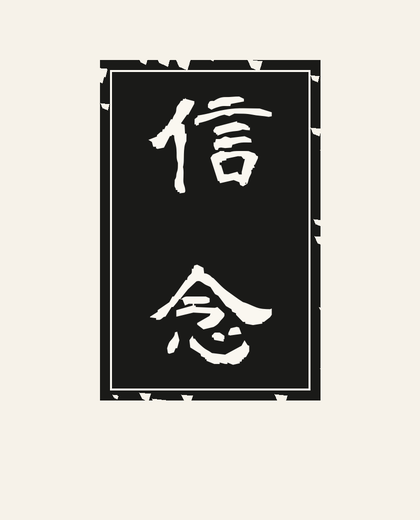
信念 · Xìn Niàn
Conviction
系列: 单字禅意 · Design #63
笔法: Two characters, vertical column · Han-seal filled-white (bǎiwén) stamp — black ground, reversed white glyphs, weathered border · clerical script (lishu) · medium scale
形态: 二字竖列大字;汉印满白文,黑底白字、残边;青柳隶繁形
名字
信念(xìn niàn)——信念,稳稳持有的相信。两个字是「信」(信任、守信——一个人站在自己的话旁边)和「念」(想、记挂——「今」下面一颗心)。「信」是别人能信你的话,「信念」是你一直放在心上、并且反过来信任的东西:一个持续在场的相信。
*Xìn niàn* — conviction, a belief you hold steadily. The two characters are 信 (trust, one's word — a person standing beside their speech) and 念 (to think of, to keep in mind — the heart beneath 今, "now"). Where 信 is the word you can be trusted on, 信念 is the thing you keep in mind and trust in return: a conviction that stays present.
出处
这张图用的是这个词本身,不靠某一条典籍出处。两个部件都很古、都有据——「信」(人言)在儒家经典里是五常之一,「念」(记挂)是古典里表示持续思考的字——但把「信念」合成表示坚定相信的近代词,是后来的发展,没有唯一的权威出处文本。因此本设计不引古典、不攀纹样谱系,只是把这两个字用本系列统一的印形与书体摆出来。它给的就是这个词今天真实的用法:一个守得住的、放在心上的相信。本设计未使用任何第三方源图像。
This design works from the word itself rather than from a single documented classical source. Both components are old and well attested — 信 (a person's word) appears throughout the Confucian canon as one of the five constant virtues, and 念 (to keep in mind) is a classical word for sustained thought — but the compound 信念 as the modern term for "conviction / belief" is a later formation without one authoritative origin text. The design therefore claims no classical quotation and no motif lineage; it sets the two characters plainly in the seal form and script used across this series. What it offers is the word as it is actually used now: a belief that holds, kept in mind. No third-party source image was used for this design.
设计灵感
从上到下,把它当一枚印来读。① 两字一竖列——经典的印章条幅格式,"记挂在心的信任"两半排成一线。② 隶书——汉石经的语域,平稳的横笔给这个词一种已经定了的重量,不是辩出来的。③ 满白文处理——两个字都从黑地里挖出来;信念是墨地里留下来可见的部分。④ 「信」的右边与「念」的心底各自分明——白文印里不让"言"或"心"任何一方丢失。⑤ 残边——手工盖出的印;信念是握在人手里的,不是机器盖出来的。
Read it as a seal, top to bottom. ① Two characters in one vertical column — the classic stamp-strip format, the two halves of "trust kept in mind" set in one line. ② Clerical script — the Han-stone register, its steady level strokes giving the word the weight of something settled rather than argued. ③ The filled-white treatment — both characters cut out of the dark; conviction is what stays visible when the field is ink. ④ The balanced right side of 信 against the heart-base of 念 — kept distinct in white-negative so neither the "word" nor the "heart" is lost. ⑤ Weathered border — a hand-set seal; conviction is held by a person, not stamped by a machine.
来历
把两个字拆开,会看到一座小小的信念建筑。「信」是站在自己话旁边的人——是能被检验的可靠;「念」是「今」下面一颗心——是你保持在场的那念头。「信念」字面就是:你放在心上的信任。不是一瞬间的认定,是持续留在房间里的那种。
这个词是近代的,这也正是它被纹的理由之一。它命名的是人们越来越要自己找的东西——一个自己选定、并且持续持有的相信,而不是现成继承来的那套。它用于对一个事业、一个人、一种活法的信念,始终带着一层"持有者一直在做"的意思,不是一次性发生在他身上的事。
印形配得上它。印章是靠压出来的——重复、有意、留下痕迹。照这个词自己的逻辑,信念也一样:你把信任一次又一次压进当下,直到它清晰可辨。
纹「信念」,宣告的不只是你相信什么,还有你相信的方式:你把它放在心上,而且它守得住。
Take the two characters apart and you get a small architecture of belief. 信 is a person beside their word — the trustworthiness that can be tested. 念 is a heart under 今, "now" — the thought you keep present. A 信念 is, quite literally, the trust you keep in mind: not a momentary conviction but one that stays in the room.
The word is modern, and that is part of why it is worn now. It names something people increasingly seek on their own terms — a belief they have chosen and continue to hold, rather than one inherited ready-made. It is used for faith in a cause, in a person, in a way of living: always with the sense that this is something the holder *keeps doing*, not something that happened to them once.
The seal form suits it. A seal is a mark made by pressing — repeated, deliberate, and leaving a trace. Conviction, in the word's own logic, is the same: the trust you press into the present again and again until it is legible.
To wear 信念 is to declare not just what you believe but the manner of your believing: that you keep it in mind, and that it holds.
释义
放在心上的信任——「信」接上「念」。一个近代的词装进古印形里:是你选定、并且持续压进当下的相信,不是继承来的那一份。
A conviction you keep in mind — 信 (trust) joined to 念 (holding present). A modern word in an old seal: the belief you have chosen and continue to press into the present, rather than one you inherited.
位置
两个竖排的字需要纵向的面。小臂外侧与内侧总列高 7–10 厘米;颈侧或锁骨下 6–8 厘米适合小号;小腿或上背 10–12 厘米。窄长印面需要完整高度——两字保持一竖列。
Two characters stacked want a vertical plane. Outer forearm and inner forearm at 7–10 cm total column height; the side of the neck or below the collarbone at 6–8 cm for a smaller seal; the calf or upper back at 10–12 cm. The tall frame needs its full height — keep both characters in one column.
纹之前
负形印——用随卡附的白底黑线转印页,不要用黑底封面。② 两字一竖列——不要拆成左右并排。③ 「信」的右边与「念」的心底要分明——"言"和"心"都不能糊掉。④ 切勿徒手画汉字。 ⑤ 只用墨;每字最小 3 厘米。 ⑥ 只纹一体——本款隶书,勿以篆书替代。
Negative-form seal — use the supplied white-ground black-line transfer sheet, not the black cover. ② Two characters, one column — do not split them side by side. ③ Keep 信's right side and 念's heart-base distinct — neither the "word" nor the "heart" may merge. ④ No freehand Chinese characters. ⑤ Ink only; minimum 3 cm per character. ⑥ One script only — clerical version; do not substitute seal script.
本卡每一个汉字都由中文母语者选定并逐笔核对。



