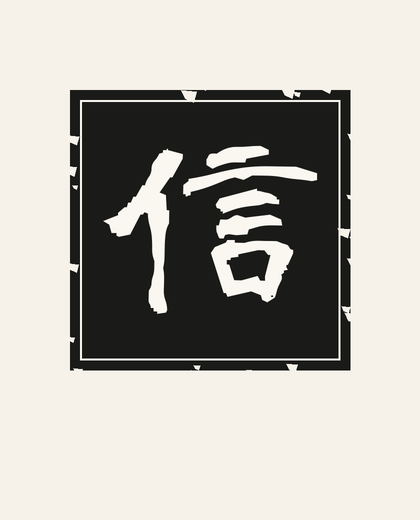
信 · Xìn
Trust / Faith
系列: 单字禅意 · Design #57
笔法: Single character · Han-seal filled-white (bǎiwén) stamp — black ground, reversed white glyph, weathered border · clerical script (lishu) · medium scale
形态: 单字大字;汉印满白文,黑底白字、残边;青柳隶繁形
名字
信(xìn)——信任、信念,以及守信。这个字是一个人(亻)站在自己的话(言)旁边。它说的不是相信某个抽象的东西,而是一个人,他的话靠得住。中国人把"信"这整件事,就用这两个部件搭出来了:一个人,和他说的话。
*Xìn* — trust, faith, and the keeping of one's word. The character is a person (亻) standing beside their own speech (言). It does not mean believing in something abstract; it means a human being whose words can be relied on. The Chinese built the whole idea of trust out of those two parts: a person, and what they say.
出处
字源与出处:《说文解字》(东汉):信,人言也,从人从言。《论语·颜渊》:自古皆有死,民无信不立。信是五常(仁义礼智信)之一;这个字也用来指书信、信物——一个替承诺在场的实物。本设计未使用任何第三方源图像。墨线转写:本设计以传统母题的经典线条造型为底,转写为纹身墨线。
Etymology and text: *Shuōwén Jiězì* (Eastern Han): 信,人言也。从人从言 — "xin is a person's word; it follows person and speech." The *Analects* (*Lúnyǔ*, Yányuān): 自古皆有死,民无信不立 — "death has always been with us, but without trust a people cannot stand." 信 is one of the five constant virtues (五常: 仁义礼智信), and the character was also used to mean a letter or a token — a physical thing that carries a promise. No third-party source image was used for this design. Inking note: this design adapts the classic line construction of the traditional motif and re-inks it as tattoo linework.
设计灵感
本设计每一处形制决定都有出处可查,逐条对账。① 满白文印——人与言刻进暗里,承诺以白色立着。② 隶书——汉石经的语域;「信」是汉代文本用来指那个撑住社会的德性的字。③ 亻与言要平衡——左边的人、右边的言在印里必须读成平等的;一方挤了另一方,字整个的论点(人*站在*话旁边)就垮了。④ 残边——手工盖出的痕迹,就像信是靠一次次行动攒出来的。
Every form decision points to a recorded source, element by element. ① The filled-white seal — a person and their word cut into the dark, the promise left standing in white. ② Clerical script — the Han-stone register; 信 is the word Han texts used for the virtue that holds a society together. ③ The 亻 and 言 kept balanced — the left person and the right speech must read as equals in the seal; if one crowds the other the character's whole argument (person *beside* word) collapses. ④ Weathered border — an impression made by hand, as trust is made by repeated acts.
来历
字源本身就是一个论证:把一个人和他的话放到一起,就成了「信」。没有什么神秘的。这个人的话算数,就有信;不算数,就只剩下声音。
孔子把它放在社会生活的地基上:民无信不立。在一次对话里,他甚至把它排在食物与兵器之上——人会为自己相信的东西死,但如果承诺不作数,就再没有什么可以往上盖了。这个字的第二重生命——指信、信物、信笺——也从同一个根长出来:一个实物,在你不在场的时候替你的话站着。
「信」之所以是很难的纹身,是因为它先指向自己。想被信任很容易,做那个话有分量的人难。这个字安静地问你:你说的是哪一个?
纹「信」,就是把这个问题放上皮肤:你是那个人吗?这是你的话吗?
The etymology is an argument: put a person next to their speech and you get 信. Nothing mystical. Either the person's word holds, and there is trust; or it doesn't, and there is only sound.
Confucius put it at the foundation of social life: 民无信不立 — a people cannot stand without trust. He ranked it above even food and weapons in one exchange, because people will die for what they believe, but if promises mean nothing there is nothing left to build on. The character's second life — as the word for a letter, a token, a keepsake — follows from the same root: something physical that stands in for your word when you are not there.
What makes 信 a demanding tattoo is that it points inward first. It is easy to want to be trusted. It is harder to be the person whose speech can carry weight. The character quietly asks which one you mean.
To wear 信 is to put that question on your skin: are you the person, and is this your word?
释义
信是一个人的话有了分量。这个字是站在自己话旁边的人——可靠、信念、能脱离你本人而成立的承诺。给那些靠"说了就做到"建立名声的人。
Trust as a person's word made weighty. 信 is a figure standing beside their speech — reliability, faith, the promise that can travel without you. For people whose reputation is built on doing exactly what they said.
位置
左右结构匀称的字。小臂外侧与上背 5–8 厘米能让亻和言同等地清楚;后颈 4–6 厘米适合小号;锁骨下 5–7 厘米也成立。避开狭窄收细处,免得左右两半被挤到一起。
A balanced character with a clear left-right structure. Outer forearm and upper back at 5–8 cm keep 亻 and 言 equally legible; back of the neck at 4–6 cm works for a smaller seal; below the collarbone at 5–7 cm is also fine. Avoid narrow tapering areas that squeeze the two halves together.
纹之前
负形印——用白底黑线页转印,不要用黑底封面。② 亻与言要平衡——任何一半都不能描粗。③ 切勿徒手画汉字。 ④ 只用墨。 ⑤ 最小 5 厘米。 ⑥ 只纹一体——本款隶书,勿与篆书「信」混纹。
Negative-form seal — transfer from the white-ground black-line sheet, not the black cover. ② Keep 亻 and 言 balanced — neither half may be redrawn thicker. ③ No freehand Chinese characters. ④ Ink only. ⑤ Minimum 5 cm. ⑥ One script only — clerical version; never mix with seal-script 信.
本卡每一个汉字都由中文母语者选定并逐笔核对。



