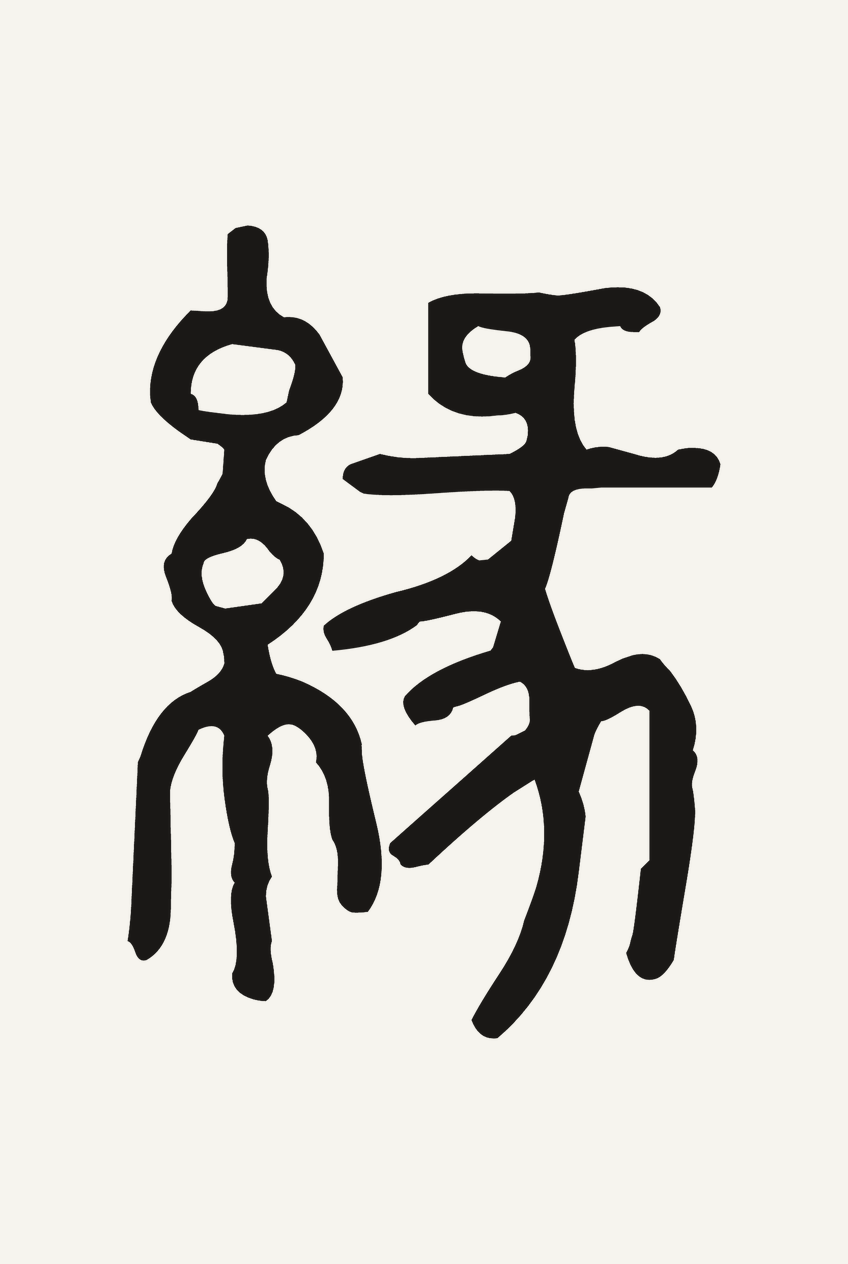
缘 · Yuán
The Bond That Was Written
系列: 单字禅意 · Design #05
笔法: single character, large · small-seal script (zhuanshu) · traditional form 緣 · medium-to-large
形态: 单字大字,篆书
名字
缘——繁体「緣」把「糸」(丝线)放在「彖」旁——这个字最古老的画面是一道衣边:丝线锁住布的边缘。从这个裁缝的意象出发,中国人长出了他们最深的概念之一:那条看不见的线,决定哪些人、哪些地方、哪些时刻会缝进你的生命。西方语言里有命运也有运气;缘两者都不是——它是那种感觉像被书写过、却从来没有署名的连接。
*Yuán* — the bond. The traditional form 緣 puts 糸 (silk thread) beside 彖 — the character's oldest picture is a hem: threads binding an edge of cloth. From that tailor's image, Chinese built one of its deepest ideas: the unseen thread that decides which people, which places, which moments attach to your life. Western languages have fate and they have luck; 缘 is neither — it is connection that feels authored but was never signed.
出处
这个字在古籍里先是具象动词——缘,沿着边缘缝、循边而行——再由佛经翻译(汉唐)神学化:因缘(梵文 hetu-pratyaya,因果与条件)成了业力连接的框架。晚近的民俗综合是帝制晚期才定型的:一世夫妻百世缘、月下老人手中的红线、庙里匾额上的「有缘千里来相会」。墨线转写:本设计以传统母题的经典线条造型为底,转写为纹身墨线。
The character begins as a concrete verb in classical texts — 缘 means "to hem, to trace along an edge" — and is theological-ized by Buddhist translation (Han–Tang), where 因缘 (hetu-pratyaya, "cause and condition") becomes the framework of karmic connection. The folk synthesis is late-imperial: 一世夫妻百世缘, the matchmaking Yue-Lao with his red threads, the temple plaques reading 有缘千里来相会 — "those with yuan meet across a thousand li." Inking note: this design adapts the classic line construction of the traditional motif and re-inks it as tattoo linework.
设计灵感
本设计的每一处形制决定都有出处可查,逐条对账。① 一字、独处、够大——单字格式让「糸」旁被看见,而不是被扫过。② 小篆、繁形「緣」——篆书把丝线旁写成真正缠绕的绳线:这个字最古老的画面,被复原。③ 中到大尺寸——篆形的绕线细节需要余地;小了,丝线的意象就没了。④ 只用墨——一根线,一种颜色:素,即是意义。
Every form decision points to a recorded source, element by element. ① One character, alone, large — the single-glyph format that lets the thread radical be seen, not skimmed. ② Small-seal script, traditional form 緣 — seal script renders the silk-thread radical as actual entwined cords: the character's oldest picture, restored. ③ Medium-to-large scale — the wound-wire detail of the seal form needs room; small, the thread imagery is lost. ④ Black ink only — one thread, one color: the austerity is the meaning.
来历
这个字背后的佛学框架安静而激进:你生命里没有一件事是随机的,也没有一件事是被强迫的。因是你带进来的种子;缘是让它发芽的条件——恰好提到那本书的老师、晚点的那班火车、后来成了十年的那个陌生人。佛学逻辑用这个词很技术——每个事件都是因与缘的格网——但中国民间把这个词从庙里拉到了街上,给了它体温:有缘——陌生人之间说出这两个字,意思是线是真的,至于机制,僧人爱怎么讲怎么讲。
民间的意象最得人心:月下老人,在注定相逢的人脚踝间系红线的老人——今天整个东亚的情侣还在庙里拜他。谚语群把「相逢」长成了一整套伦理:有缘千里来相会,无缘对面不相逢。还因为这条线不署名,传统里带着西方命运观缺少的温柔:缘能解释相遇,却不担保结局。两个人可以确凿地被系着,仍然走不同的路——结是真实结下的,条件没有凑齐。缘起缘灭:线起,线灭,看见这一点本身就是智慧。
现代中文用它指一切「挂上」的事:你找到的那间房、找上你的那份工作、算法永远不会预测到的那位朋友。说一声有缘,是同时拒绝两种解释——不是偶然,不是计划——然后在恰当的距离上道谢。
The Buddhist framework behind the character is quietly radical: nothing in your life is random, and nothing is forced. 因 is the seed you carried in; 缘 is the condition that lets it sprout — the teacher who happened to mention the book, the train that was late, the stranger who became the decade. Buddhist logic uses the word technically — every event is a lattice of causes and conditions — but Chinese folk usage pulled the word out of the monastery and into the street, and gave it warmth: 有缘 — we have yuan — said between strangers means the thread is real, whatever the monks say about its mechanism.
The folk images are the best-loved: Yue-Lao, the old man under the moon, who ties red cords between the ankles of people destined to meet — couples pray to him in temples across East Asia today. The proverb set built a whole ethics of encounter: 有缘千里来相会,无缘对面不相逢 — "those with yuan meet across a thousand li; those without pass as strangers face to face." And because the thread is not signed, the tradition carries a tenderness missing from Western fate: yuan can explain a meeting without promising an outcome. Two people can be unmistakably bound and still walk different roads — the bond was real; the conditions were not. 缘起缘灭: threads rise and threads dissolve, and the seeing of that is its own wisdom.
Modern Chinese uses it for everything that attaches: the apartment you found, the job that found you, the friend the algorithm would never have predicted. To say 有缘 is to refuse both explanations — not chance, not plan — and to simply be grateful at the right distance.
释义
那条你没有系上、也解不开的线。给那些你不肯称之为巧合的人与时刻——那场相遇、那座城、那门手艺、那个人。它是带字形的感谢:挂上的,就是挂上了;理由从未给过你,你也不再需要。
The thread you did not tie and cannot untie. This is a design for the people and moments you refuse to call coincidence — the meeting, the city, the craft, the person. It is gratitude with a glyph: what attached, attached for a reason you were never given and no longer need.
位置
一个字,一个平面:腕内侧、后颈、胸骨、脚踝。缘是人们放在自己看得见的位置的字——它是一张写给本人生命的感谢条。6–10 厘米读作私记;居中放大,读作取向宣言。避开会把篆书绳线折断的关节。
One character, one plane: the inner wrist, the nape, the sternum, the ankle. 缘 is the character people place where they will see it — it is a thank-you note to one's own life. 6–10 cm reads as a private marker; centered and larger, a statement of orientation. Avoid folding joints that break the seal script's cords.
纹之前
一字,不加饰。 丝线旁就是设计;四周的装饰性花活会让意义起毛边。② 繁形「緣」。 篆形里看得见的丝线是这个字最古老的画面——简体缘丢掉了绳线。③ 篆书不断。 匀线、不淡——线不能看起来是被剪断的。④ 5 厘米起,绕线细节才立得住。⑤ 它解释相遇,不解释结局。 要纹缘,就纹整套哲学:线起线灭,两者是同一种善意。
One character, no additions. The thread radical is the design; decorative flourishes around it fray the meaning. ② Traditional form 緣. The silk thread visible in the seal form is the character's oldest picture — simplified 缘 loses the cords. ③ Seal script is unbroken. Even line, no fading — the thread must not look cut. ④ Minimum 5 cm for the wound-wire detail. ⑤ It explains meetings, not endings. If you wear 缘, wear the whole philosophy: threads rise and dissolve, and both are the same kindness.
本卡每一个汉字都由中文母语者选定并逐笔核对。



