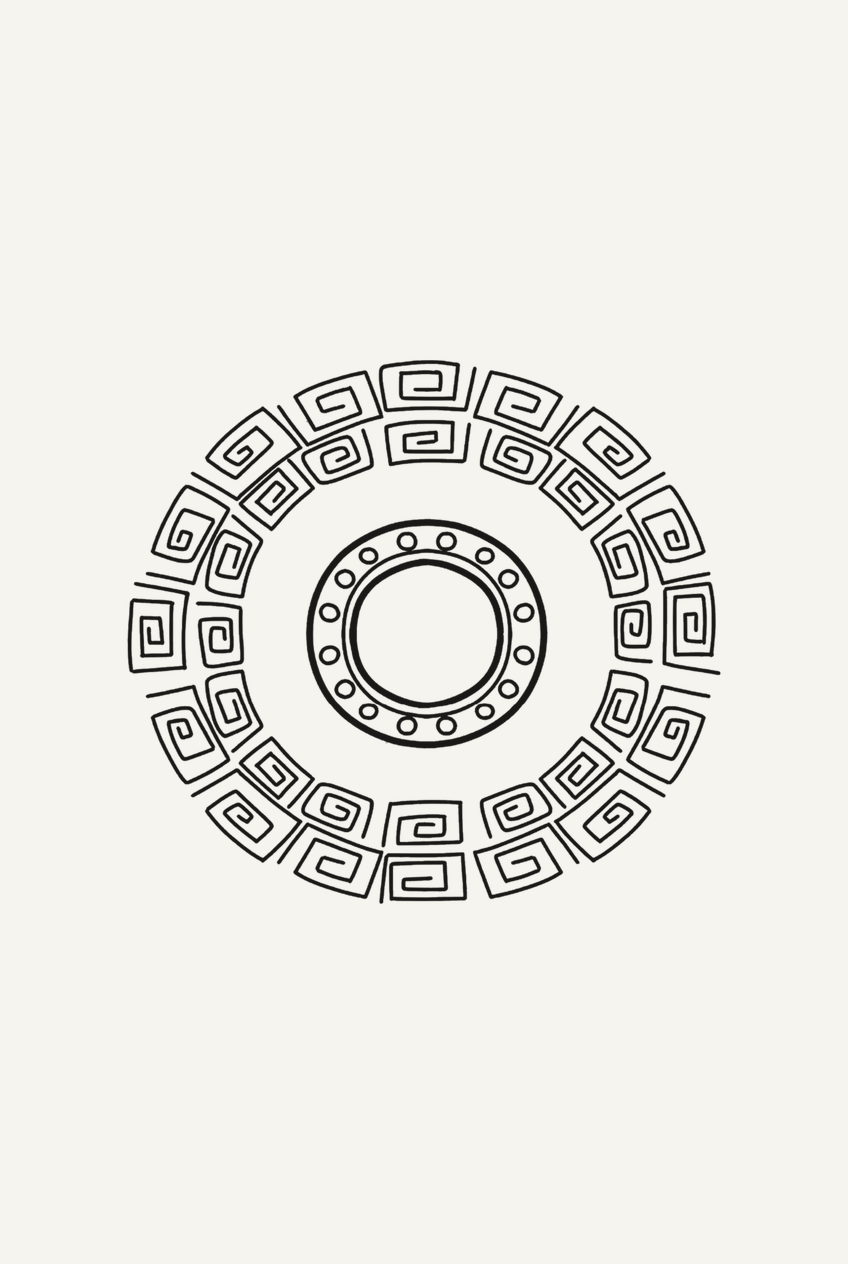
云雷纹 · Yún Léi Wén
The Thunder Spiral
系列: 符号纹样 · Design #03
笔法: Alternating circular and square spirals in a band · fine-line · standalone or ground texture · scalable 5–12 cm
形态: 云雷纹带,圆涡与方回螺旋交替,可作环带或填充底纹
名字
云雷纹(yún léi wén)——圆转的螺旋是云,方折的螺旋是雷。比龙早、比凤早、比任何叫得出名字的动物都早,这是中国青铜时代的基本纹样——它不是器物的主角,却是主角脚下的空气。它密密铺满每一件铜器的背景,让整件器物像在嗡嗡作响。
*yún léi wén* — the cloud-and-thunder pattern: circular spirals read as cloud, square spirals read as thunder. Before the dragon, before the phoenix, before any animal you can name, this was the pattern of the Chinese Bronze Age — not the hero of the vessel, but the air the hero breathes. It filled every background on every bronze, so densely that the whole surface seemed to hum.
出处
商周青铜礼器(约前 1600—前 771 年)——兽面与龙纹背后的云雷纹地,铸在鼎、爵、尊上,世界各大博物馆都能见到。「圆者为云、方者为雷」的分法出自宋代金石学家。更早的源头在甘青地区马家窑彩陶的旋涡纹带(约前 3300—前 2000 年)——螺旋在第一件青铜器之前两千年就已经在转了。形制参考:青铜器地纹螺旋与新石器时代彩陶旋涡带。墨线转写:本设计以传统母题的经典线条造型为底,转写为纹身墨线。
Shang and Zhou ritual bronzes, c. 1600–771 BC — the leiwen spiral ground behind taotie masks and dragon bands, cast on dings, jues and zun vessels in museum collections worldwide. The circular-versus-square naming comes from Song-dynasty antiquarians, who sorted the spirals by shape. Older still: the painted vortex bands on Neolithic Majiayao pottery, c. 3300–2000 BC, Gansu — the spiral was already running two thousand years before the first bronze. Historical form reference: bronze ground spirals and Neolithic painted vortex bands. Inking note: this design adapts the classic line construction of the traditional motif and re-inks it as tattoo linework.
设计灵感
本版每一处形制决定都有出处可查,逐条对账。① 圆涡云螺旋——青铜地纹里向内收卷的圆转涡线。② 方折雷螺旋——宋代金石学家定名的「回」形方折螺旋。③ 圆方交替的带状节奏——周代铜器口沿上的云雷相间纹带。④ 一笔不断线——地纹的连续性:一条线在整幅设计里旋转到底。
Every form decision on this design points to a recorded source, element by element. ① The circular cloud spiral — the inward-coiled round vortex of bronze ground work. ② The square thunder spiral — the angular 回-spiral that Song antiquarians named lei. ③ The alternating band rhythm — the cloud-thunder pairing running as a border, as on Zhou vessel rims. ④ The continuous line — the unbroken path of the ground pattern, one line spinning through the whole design.
来历
把一件中国青铜器上的龙和兽面全部拿掉,剩下的就是这个时代本身的质地:螺旋,成千上万,圆的方的,密密地铺满每一件礼器的背景。宋代著录铜器的金石学家按形状给螺旋定了名:圆的叫云,方的叫雷。云与雷——天上的事物,神的气象——被提纯成几何,铸成圣物的地面。
底下的逻辑古老而务实:云生雨,雷报雨,雨定收成。云雷纹就是「天在干活」的图案。但到青铜时代它已经超越了天气:在铜器上它成为纯粹的节奏,托在兽面与龙迹底下的视觉低音。黄河上游的新石器陶工早在青铜诞生前两千年就在画同一个涡纹——马家窑的葬具陶瓮缠满螺旋,今天的眼睛看它像欧普艺术。中国的螺旋不是舶来品,它生在中国的陶器上,而且从未停止旋转。
然后它开枝散叶:方折的雷螺旋拉长成后来叫「回纹」的回环带;圆涡螺旋柔化成云头,最终变成如意云。几乎每一种中国几何纹样——明瓷上的回纹、清袍上的云头——沿着家谱往上追,都汇到这一处:青铜时代的云雷纹,是中国几何纹样的共同祖先。
纹它的人是懂行的人:没有人会把「背景纹」穿在身上——除非他清楚自己穿的是什么。它作为环带极好看,寓意也是最安静的那种好运:天在转,雨在点上,收成是定的。三米外低调,凑近了深不见底。
Strip a Chinese bronze of its dragons and its monster masks, and what remains is the texture of the age itself: spirals, thousands of them, circular ones and square ones, packed edge to edge across the background of every ritual vessel. The Song antiquarians who catalogued these bronzes gave the spirals their names by shape: the round ones were cloud, the square ones were thunder. Cloud and thunder — sky-stuff, the weather of the gods — reduced to pure geometry and cast into the very floor of the sacred.
The logic underneath is agricultural and old. Cloud brings rain; thunder announces rain; rain decides the harvest. A pattern of cloud-and-thunder is a pattern of the sky doing its job. But by the Bronze Age it had already outgrown weather: on the vessels it became pure rhythm, the visual bass note under taotie faces and dragon tracks. Neolithic potters along the upper Yellow River had been painting the same vortex two thousand years before bronze existed — Majiayao burial urns wrapped in spirals that a modern eye reads as almost op-art. The Chinese spiral is not a borrowed form; it was born on Chinese pottery and never stopped spinning.
Then it diversified. The square thunder spiral stretched into the fret band later called 回纹; the round spiral softened into cloud heads and, eventually, the ruyi cloud. When you trace the genealogy of almost every Chinese geometric pattern — the fret on a Ming bowl, the cloud head on a Qing robe — the family tree converges on this one: the cloud-thunder spirals of the Bronze Age are the common ancestor. Three thousand years of patterns, one original stock.
As a tattoo it is the connoisseur's choice of this collection: nobody wears the ground pattern — the thing every museum labels "background" — unless they know exactly what they are wearing. It wraps beautifully as a band, and its meaning is the quietest kind of good fortune: the sky turning, the rain on schedule, the harvest certain. Understated from three meters away. Bottomless up close.
释义
中国几何纹样的祖先。把「天空的机械」——云、雷、雨、收成——提纯成一根可以永远用手指描下去的螺旋,纹它是一种低调的懂行。可以独立成环带,可以填在既有纹身之间,也可以做让别的纹样更沉的框。
The ancestor of all Chinese geometric patterns. Wearing the ground pattern is a quiet flex of literacy: the sky's machinery — cloud, thunder, rain, harvest — reduced to a spiral you can trace with one finger, forever. Ideal as a standalone band, a filler between existing tattoos, or the frame that makes another motif sit deeper.
位置
它是环带构图:环绕小臂或脚踝成闭合圈,宽 5–8 厘米;横置于锁骨上方或侧腰沿线同样成立。想让人远看就认出「雷」,选方螺旋为主的加宽版(至 12 厘米)。
Built as a band: it wraps the forearm or ankle as a closed ring, 5–8 cm wide, and sits equally well as a horizontal strip above the collarbone or along the side waist. The square spiral version runs slightly wider (up to 12 cm) if you want the thunder to read clearly at distance.
纹之前
别和回纹搞混:回纹是它的后代——被拉直、方折的版本——纹祖先的更稀有。② 环带的节奏感来自等距:请纹身师保持螺旋间距一致,否则韵律会断。③ 它可以做任何中式纹样的底纹——鹤、龙、云头——和青铜器上的用法一模一样。④ 只宜墨线:螺旋是纯线描,线条粗细就是画面全部。⑤ 注意磨损。 小臂或脚踝环带最窄 5 厘米;脚踝环褪色最快,补色周期会比其他部位更早到来。
Do not confuse it with 回纹: the fret is this pattern's descendant — straightened and squared — wearing the ancestor is the rarer choice. ② The band reads best with even spacing; ask your artist to keep the spiral pitch consistent or the rhythm breaks. ③ It pairs as ground texture under any other Chinese motif — a crane, a dragon, a cloud head — exactly as it did on bronze. ④ Ink-only by design: the spirals are pure linework, and line weight is the whole drawing. ⑤ Mind the wear. Minimum 5 cm band width on forearm or ankle; ankle rings fade fastest — expect a touch-up sooner than anywhere else.
本卡每一个汉字都由中文母语者选定并逐笔核对。