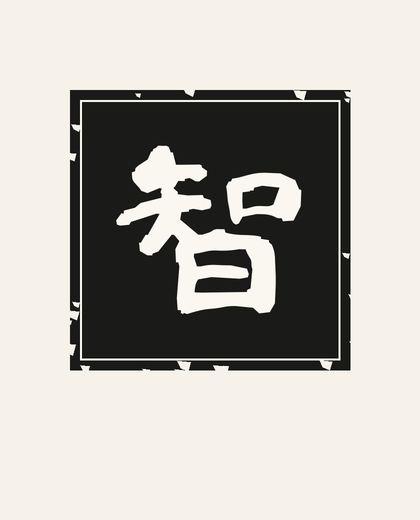
智 · Zhì
Wisdom
系列: 单字禅意 · Design #53
笔法: Single character · Han-seal filled-white (bǎiwén) stamp — black ground, reversed white glyph, weathered border · clerical script (lishu) · medium scale
形态: 单字大字;汉印满白文,黑底白字、残边;青柳隶繁形
名字
智(zhì)——智慧,看得清、做得对的那种知道。这个字从「知」长出来,底下加了个「日」:被日头晒过、验证过的知道。多数中国人第一次遇见它,是在《论语》那句「知者不惑」。
*Zhì* — wisdom, the knowing that sees clearly and acts rightly. The character grew out of 知 (*zhī*, to know) with a 日 — sun/day — added underneath: knowledge that has been out in the daylight and proved itself. The Confucian line 知者不惑 — "the wise are not confused" — is where most Chinese readers first meet it.
出处
字源与出处:「智」是「知」的后起分化字。《说文解字》(东汉):知,识也。《论语·子罕》:知者不惑,仁者不忧,勇者不惧——知者不困惑,仁者不忧愁,勇者不畏惧。这三句并列,成了中国传统里被引用最多的君子定义之一。后世用法里「知」与「智」分开:前者是知道,后者是判断。本设计未使用任何第三方源图像。墨线转写:本设计以传统母题的经典线条造型为底,转写为纹身墨线。
Etymology and text: 智 is the later differentiation of 知. *Shuōwén Jiězì* (Eastern Han): 知,识也 — "zhi is to recognize/know." The *Analects* (*Lúnyǔ*, Zǐhǎn): 知者不惑,仁者不忧,勇者不惧 — "the wise are not confused, the humane are not anxious, the brave are not afraid." This three-part sequence became one of the most quoted definitions of a good person in the Chinese tradition. In later usage 知 (knowing) and 智 (wisdom) separate: the first is information, the second is judgment. No third-party source image was used for this design. Inking note: this design adapts the classic line construction of the traditional motif and re-inks it as tattoo linework.
设计灵感
本设计每一处形制决定都有出处可查,逐条对账。① 满白文印——知识从暗里被刻出来,留白的才是经得起看的部分。② 隶书——汉石经的语域,配得上这个靠书写与传抄取得权威的字。③ 繁密的上半保持通透——「智」笔画多,白文印要求内部留白干净,密处才不会糊成一块。④ 残边——真盖过印的痕迹,让一个书房气太重的字不显板。
Every form decision points to a recorded source, element by element. ① The filled-white seal — knowledge carved out of darkness; what is left in white is what survives scrutiny. ② Clerical script — the Han-stone register, matched to a word whose authority comes from being written down and handed on. ③ The dense upper structure kept open — 智 is a strokes-heavy character; the seal's white-negative demands that its internal counters stay clean so the dense top does not clog into a block. ④ Weathered border — the mark of an actual impression, keeping a scholarly word from looking sterile.
来历
《论语》把三种德性并排,第一句是「知者不惑」。让人记住的是这个说法有多克制——它没说智者无所不知,只说他们*不困惑*:分得清什么是要紧的、什么只是吵,所以不会被噪声拖着走。
这个字本身就把这层分别写在结构上。「知」是知道,「智」在底下加了个「日」——日光。知道经过日晒、经过世事的验证还站得住,才成了智。它不是更多的信息,是同样的信息,被后果养过一遍。
中国文化后来把「智」列进五常(仁义礼智信),是统辖其余四者的那一德——因为你可以勇敢却造成伤害,可以仁慈却被人骗。智负责让其余的德性指向对的方向。它是五者里最安静的一个,也是传统最放心交给它掌舵的一个。
纹「智」,不是宣布自己聪明。是选一件更难的日课:让自己的知道底下始终有日光,并且有意地不困惑。
The *Analects* put three virtues in a row, and the first is 知者不惑 — the person who knows is not confused. What strikes readers is how modest the claim is. It does not say the wise person knows everything. It says they are not *confused*: they can tell what matters from what is merely loud, and so they do not get dragged around by the noise.
The character itself carries that distinction. 知 is knowing; 智 adds a 日 beneath it — daylight. Knowledge becomes wisdom when it has been out in the open, tested against the world, and still holds. It is not more information. It is the same information, seasoned by consequence.
Chinese culture eventually made 智 one of the five constant virtues (五常: 仁义礼智信), the one that governs the others — because you can be brave and still do harm, kind and still be fooled. Wisdom is what keeps the rest pointed the right way. It is the quietest of the five and the one the tradition trusted to steer.
To wear 智 is not to declare yourself clever. It is to choose the harder daily work: to keep the daylight under your knowledge, and to be not-confused on purpose.
释义
经过检验仍清醒的知道。「智」是判断,不是信息——是知识底下那层日光,让勇敢不至于伤人、让仁慈不至于受骗。给已经明白"懂得多"和"有智慧"不是一回事的人。
The knowing that has been tested and stays clear. 智 is judgment rather than information — the daylight under knowledge that keeps courage kind and kindness sharp. For people who have learned that being well-informed and being wise are not the same thing.
位置
密字需要平整、宽容的面。5–9 厘米时,小臂外侧与上背能让「智」繁多的笔画透气;后颈做到 4–6 厘米也可以,前提是印章不要大。低于 4 厘米,内部留白开始合拢、字会变成纹理——要避开。
A dense character needs a flat, forgiving plane. At 5–9 cm, the outer forearm and the upper back give 智's many strokes room to breathe; the back of the neck works at 4–6 cm if the seal stays small. Below 4 cm the internal counters begin to close and the character turns into texture — avoid that.
纹之前
负形印——用随卡附的白底黑线页转印,切勿拿黑底封面描。② 密字格外小心。「智」的笔画远比「力」「光」多,转印时每一处内部空隙都要张开。③ 切勿徒手。 ④ 只用墨。 ⑤ 这个字建议最小 5 厘米。 ⑥ 只纹一体——本款是隶书印,勿与篆书版混纹。
Negative-form seal — transfer from the supplied white-ground black-line sheet, never from the black cover. ② Dense character, extra care. 智 has far more strokes than 力 or 光; insist the transfer keeps every internal gap open. ③ No freehand. ④ Ink only. ⑤ Minimum 5 cm recommended for this character specifically. ⑥ One script only — this is the clerical-script seal; do not mix with a seal-script version.
本卡每一个汉字都由中文母语者选定并逐笔核对。



