龙身人面神 · Lóng Shēn Rén Miàn
The Mountain's Own Face
系列: 中国龙 · Design #06
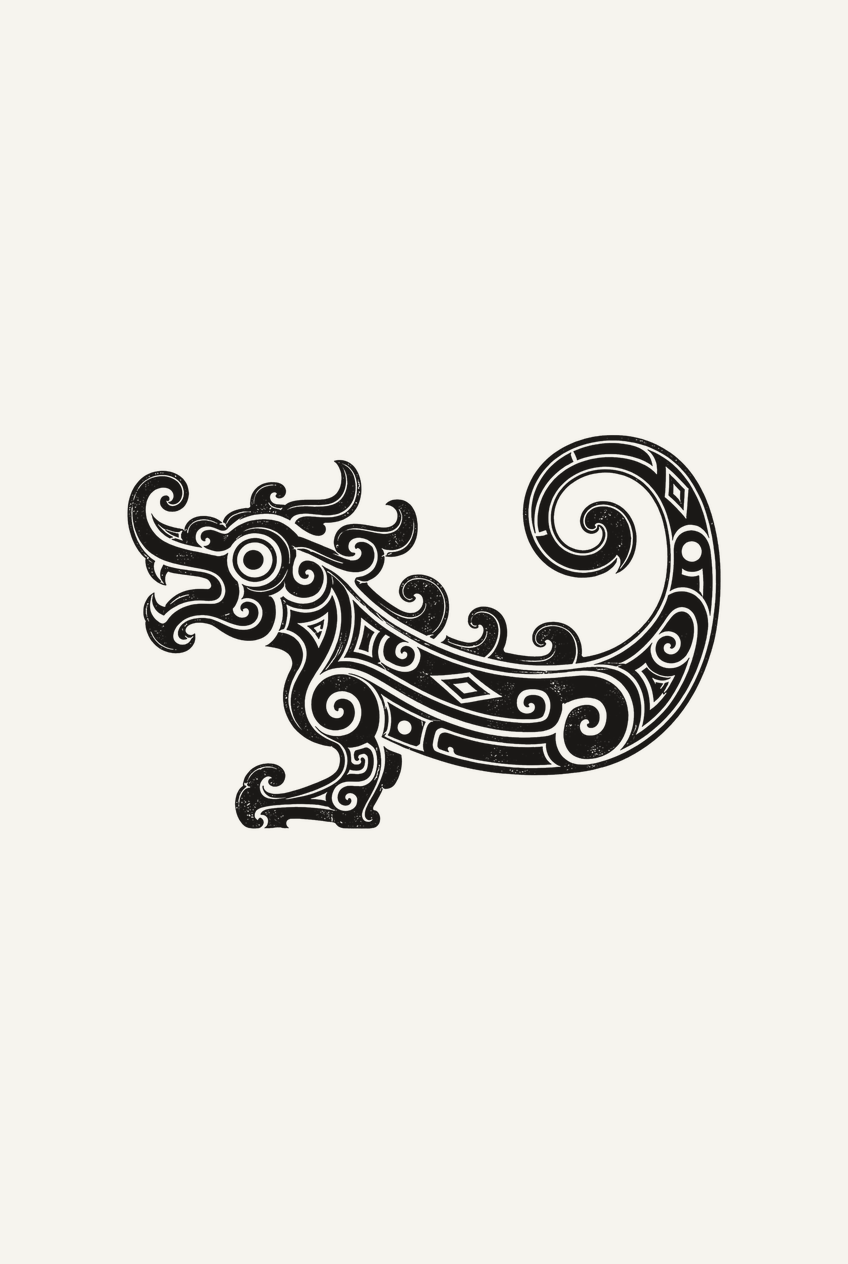
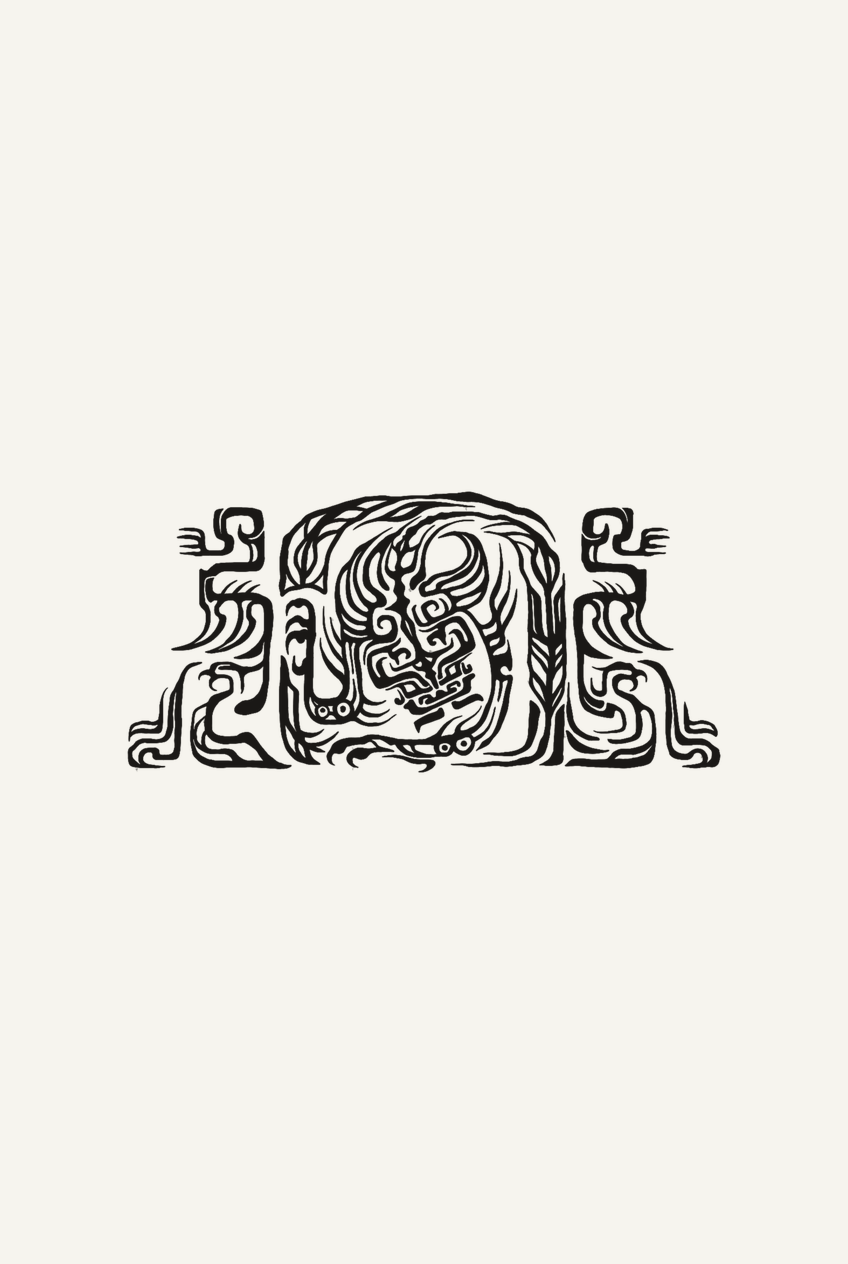
笔法: Coiled serpent deity with a serene human face, scroll-coiled scaled body, flanked by symmetric totem columns · black-grey · landscape composition · scalable 14–18 cm
形态: 龙身人面神盘绕居中,人面安详,鳞身回卷,两侧对称鸟龙图腾柱,满铺回纹,横构图
名字
龙身人面神(lóng shēn rén miàn shén)——极南之地的诸山之神,经文用一句反复出现的话打发他们:身体是龙,脸是人。每条山系各有其神;经典点名山系、数完峰头,然后用一幅集体肖像一笔带过——下身蛇盘,上身人面。本设计把这句话当真了:盘绕的鳞身是山的江河与棱线,那张安详的脸,是山回头看你的样子。
*lóng shēn rén miàn shén* — the gods of the far south, described in one repeated clause: their bodies are dragon, their faces are human. Every mountain range has its own; the classic names the ranges and counts the peaks, then dismisses the individual gods with a single collective portrait — serpent-coiled below, human above. The design takes that clause literally: the coiled body is the mountain's rivers and ridges; the calm face is the mountain looking back at you.
出处
《山海经·南次三经》(约成书于前 4—前 2 世纪)卷末总述:「凡南次三经之首,自天虞之山以至南禺之山,凡一十四山,六千五百三十里。其神皆龙身而人面。其祠皆一白狗祈,糈用稌。」十四座山,六千五百三十里,诸神一概龙身人面;祭法也一律:一只白狗祈福,精米为糈。经典记下了他们的祭祀,却从没记下任何一个名字——这些神像山丘一样无名。墨线转写:本设计以这幅集体山神肖像为底,转写为纹身墨线。
The *Shanhaijing*, *Nan Ci San Jing* chapter (compiled c. 4th–2nd century BC), closing summary: 「凡南次三经之首,自天虞之山以至南禺之山,凡一十四山,六千五百三十里。其神皆龙身而人面。其祠皆一白狗祈,糈用稌。」 — fourteen mountains, six thousand five hundred and thirty li, and every god of them dragon-bodied and human-faced; the rite for all alike, one white dog, rice millet. The classic records their worship but never their names — the gods are as anonymous as the hills. Inking note: this design adapts the collective mountain-god portrait and re-inks it as tattoo linework.
设计灵感
本版每一处形制决定都有出处可查,逐条对账。① 安详人面——「人面」,正面、平静,画在盘绕的中心,是全图唯一不动的元素;山的脸不表情绪。② 回卷鳞身——「龙身」,蛇形盘绕填满构图中央,每一圈都是鳞纹卷钩,山的江河折进一个结里。③ 对称图腾柱——神主两侧的鸟龙双柱,是南方水泽部族的祖先柱——正是以白狗精米行祭的那些人。④ 满铺回纹地——神主身后的密集卷纹场,与这场祭祀同代的铜器纹样世界。
Every form decision on this design points to a recorded source, element by element. ① The serene human face — 人面, drawn frontal and calm at the coil's heart, the only still element in a body of spirals; the mountain's face does not emote. ② The scroll-coiled scaled body — 龙身, the serpent coil filling the composition's center, each loop a ring of scale-hooks, the mountain's rivers folded into a single knot. ③ The symmetric totem columns — the paired bird-dragon pillars flanking the deity, the ancestral poles of the southern shore tribes who kept these rites with white dogs and millet. ④ The full meander ground — the dense scroll field behind the figure, the pattern-world of the bronze vessels its worship must have shared.
来历
注意经典是怎么对待这些神的:它清点他们。十四座山,几千里的里程,同一类神,同一种祭法。那是户口册,不是神话——整部博物志里最公文气的一句话,也因此是最动人的一句。这些是真实存在的滨水社群的神,江淮以南,经文把他们的祭祀保存成了一份清单:白狗一只,精米为糀,毕。神本身无名,以复数形式没有面孔,龙身即是他们所化的江河。
然而经文给了他们的唯一特征——反复的、集体的、不容商量的——是我们的脸。龙身而人面:身体是山水,脸是人。每一位都是。仿佛编纂者无法想象没有一张人脸从中望出的神圣;仿佛这些山神在把名字、个性与故事都交给了户口册之后,只保留了唯一一件私人的东西:那张脸。
所以纹它,纹的是什么?这是一张关于「属于一个永远不会知道你名字的地方——却仍被它认得」的图。盘绕的鳞身说:山更老、更大,对你的生平没有兴趣。安详的脸说:它见过你,它认得你,你在册上。它属于那种在辽阔到令自己感到无名的山水里站过的人——并且莫名觉得,那注视是善意的。山不记名,山认得你。
Notice what the classic does with these gods: it counts them. Fourteen mountains, so many thousand li, all one kind of god, worshiped one way. It is a census, not a mythology — the most bureaucratic sentence in the whole bestiary, and for that reason one of the most moving. These were the gods of real shore-dwelling communities, south of the river deltas, whose worship the text preserves as inventory: one white dog, rice millet, done. The gods themselves stay nameless, faceless in the plural, dragon-bodied as the rivers they embody.
And yet the one feature the text does give them — repeated, collective, non-negotiable — is our face. 龙身而人面: the body is the landscape, but the face is human. Every one of them. As if the compilers could not imagine sacredness without a human expression looking out of it; as if, having surrendered their names, their individuality, and their stories to the census, the mountain gods kept exactly one thing personal: the face.
So what does it mean to wear it? This is a design about belonging to a place that will never know your name — and being known by it anyway. The coiled body says: the mountain is older, larger, and not interested in your biography. The calm face says: it has seen you, it recognizes you, you are on the register. As a tattoo it belongs on the person who has stood in a landscape vast enough to make them feel anonymous — and felt, somehow, watched kindly. 山不记名,山认得你。
释义
无名的归属。人与一个不记名字的地方之间的约——山之身,人之面,祭祀简化到最省的清单。给那些来自一个永远无法真正离开的地方的人:山的认得,不需要你的自我介绍。
Anonymous belonging. The covenant between a person and a place that keeps no names — body of the land, face of a human, worship reduced to its simplest inventory. For the ones from somewhere they can never fully leave: the mountain's recognition does not require your introduction.
位置
天生的横密构图:16—18 厘米沿小臂外侧作山神环带,神面正落臂中线;或 18 厘米横贯上背。12 厘米变体压缩盘绕入胸口,舍去图腾双柱。中央神面是全图的锚——保持端正、不截断。
Built horizontal and dense: 16–18 cm across the outer forearm as a mountain-god band, the face riding the arm's center line; or 18 cm on the upper back. A 12 cm variant compresses the deity coil for the chest, dropping the totem columns. The central face is the design's anchor — keep it upright and unbroken.
纹之前
此图只宜墨线。它的力量在「静面」与「盘身」的对比——灰阶会把脸上的安详糊成阴郁,黑线才守得住那份静。最小尺寸 10 厘米:再小,盘身内的鳞卷钩会粘连,整个身体读作一块实心。避开小臂内侧与胯部——扭转区最先糊掉的是盘身的细缝,而盘身是这张图一半的论点。
This design belongs to ink only. Its power is the contrast between still face and coiled body — greyscale would muddy the face's calm into gloom; black line keeps the stillness. Minimum size 10 cm: below that the scale-hooks inside the coil bridge over and the body reads as a solid mass. Keep it off the inner forearm and the hip — twist zones will blur the fine coil gaps first, and the coiled body is half the argument.
本卡每一个汉字都由中文母语者选定并逐笔核对。