貔貅 · Pí Xiū
The Fortune Swallower
系列: 神兽灵禽 · Design #02
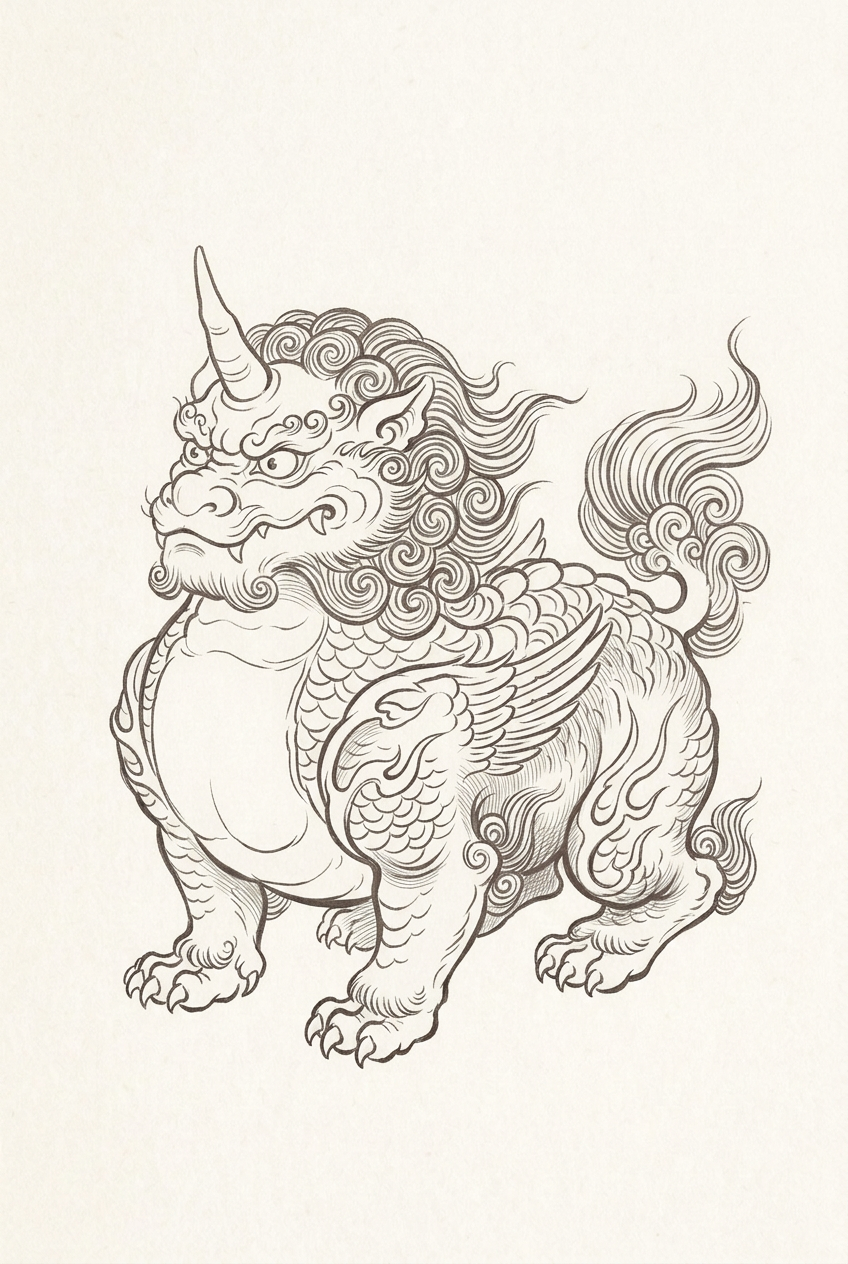
笔法: Crouching guardian beast · folk jade-carving convention: curly mane cap, single horn, closed mouth, with a Han-lineage wing and scaled haunches · black-grey
形态: 蹲坐式神兽主体,汉辟邪—明清民俗玉雕谱系
名字
貔貅(pí xiū)——只进不出之兽。轮廓一眼可辨:如狮蹲坐,卷鬃覆首,眼神警惕,口衔所吞,不再吐出。
*pí xiū* — the beast that takes in and never lets out. Its silhouette is unmistakable: a crouching lion-like guardian with a curly-maned head, eyes alert, mouth closed on what it has swallowed.
出处
《史记·五帝本纪》(西汉·司马迁,约前 91 年):(黄帝)教熊罴貔貅貙虎,以与炎帝战于阪泉之野——貔貅名列黄帝驯养的战兽。"吞财"设定出自民俗传说(《清稗类钞》等笔记所载民间口传系统),本卡如实分层标注。形制参考:貔貅类瑞兽见于汉至清的玉雕与石刻。 本设计未使用任何第三方源图像。
*Records of the Grand Historian, Annals of the Five Emperors* (Sima Qian, c. 91 BC): the Yellow Emperor "trained bears, tigers — and Pixiu — to do battle with the Yan Emperor at Banquan." The treasure-swallowing legend comes from the folk-tale tradition (recorded in Qing miscellanies), and we mark that layer honestly. Historical form reference: Bixie-like beasts appear on Han-Qing jade and stone carving. No third-party source image was used for this design.
设计灵感
设计灵感
本版每一处形制决定都有出处可查,逐条对账。① 战兽出身——《史记·五帝本纪》(司马迁,约前 91 年):阪泉之战列于黄帝阵中。② 吞财守财设定——清代笔记所录民俗传说层,如实标注为传说而非典章。③ 蹲坐守卫形态——图像谱系:上承汉代辟邪(型证:大都会博物馆藏六朝鎏金铜辟邪,3–6 世纪),下接明清民俗玉雕——今日貔貅的模样是玉雕匠人定的。古籍只给了它名字,匠人给了它脸。
Every form decision on this design points to a recorded source, element by element. ① The war-beast pedigree — *Records of the Grand Historian, Annals of the Five Emperors* (Sima Qian, c. 91 BC): the beast marches in the Yellow Emperor's ranks at Banquan. ② The treasure-keeping role — the folk-tale layer recorded in Qing miscellanies, marked as legend rather than statute. ③ The crouching guardian form — the image lineage runs from Han-dynasty bixie chimeras (the type specimen: a gilt-bronze Bixie, 3rd–6th century, The Metropolitan Museum of Art) through Ming-Qing folk jade carvings, where the pixiu's familiar form was set. The ancient texts gave the beast only its name; the carvers gave it its face.
来历
来历
貔貅的起点不是财神,是战争。
《史记》记载,五千年前黄帝与炎帝决战阪泉,黄帝驱使熊、罴、貔、貅、貙、虎六种猛兽冲锋陷阵——貔貅名列其中,是上古战场上的"特种兵"。它的凶,是刻在出身里的。
让貔貅从战兽变成"财神"的,是一个流传甚广的民间故事:貔貅触犯天条,玉皇大帝罚它——只能吞四方之财,不许泻出一分。从此貔貅"有口无肛",吞下的金银玉帛只进不出,越积越满。
这在中国人的财富哲学里是极精妙的一笔:中国人羡慕的不只是"赚",更是"留住"。赚十漏九,等于没赚;只进不出,才是聚宝。貔貅把这个朴素的愿望变成了一只神兽——它蹲在那里,昂首挺胸,眼神警惕,仿佛随时盯着从八方涌来的财气,一口吞下,绝不再还。
于是明清两代,貔貅成了玉器、镇纸、扳指、腰牌上最常见的题材之一:商人的柜上有它,官宦的案头有它,赌客的腰间有它。今天的中国商家开业,门口依然常摆一对貔貅——头朝外,意思是"把外面的财吞进来"。
值得说明的是:典籍里的貔貅是战兽,"吞财"设定来自民俗传说——本卡如实区分这两层来历。但这恰恰是真实的中国:正史负责它的威严,民间负责它的可爱。一只上古战兽,被五千年的市井烟火改造成了最接地气的财神,这个过程本身就是中国文化"活在人间"的证据。
The Pixiu did not begin as a god of wealth. It began as a weapon.
The Records of the Grand Historian tell us that five thousand years ago, the Yellow Emperor drove bears, tigers — and Pixiu — into battle against the Yan Emperor at Banquan. The Pixiu was special forces of the ancient world; its ferocity was written into its origin.
What turned a war beast into a magnet for fortune is a beloved folk tale: the Pixiu broke a heavenly law, and as punishment the Jade Emperor decreed that it could swallow the wealth of the world but never release a single coin. From that day, it took in everything — gold, silver, jade — and kept it all.
This captures something precise in the Chinese philosophy of money: what is admired is not merely *earning* but keeping. Earn ten and lose nine, and you have earned nothing. Take in and never leak — that is the treasury that matters. The Pixiu turns this wish into a creature: it crouches, head raised, eyes alert, watching fortune pour in from all directions, swallowing once and never returning it.
By the Ming and Qing dynasties, the Pixiu had become one of the most carved subjects in jade: on merchants' counters, on officials' desks, at gamblers' waists. Even today, Chinese shops open with a pair of Pixiu at the door — facing outward, to swallow incoming fortune from the street.
One honest note, true to how we present every design: in the classical texts the Pixiu is a war beast; the treasure-swallowing role comes from folk legend, and we mark the difference plainly. But this layered history is the real China — the official histories gave it majesty; the marketplace gave it warmth. An ancient battle beast, remade by five thousand years of ordinary hopes into the most approachable god of fortune. That transformation is itself proof of a culture alive in everyday life.
释义
释义
只进不出,是为聚。貔貅管两件事——聚财与守财,兼有上古战兽的辟邪之力。它适合"正在积累期"的人:攒第一桶金的创业者、守护家庭资产的人、想把"漏财体质"变成"聚财体质"的人。
All that enters, stays. That is accumulation. The Pixiu governs two things at once — gathering wealth and guarding it — with the warding power of an ancient war beast behind it. It belongs to people in their building years: founders saving their first capital, protectors of a household, anyone converting a "leaky purse" into a treasury.
位置
位置
经典位是肩头——"貔貅趴肩"是传统最爱,其次大臂外侧与胸侧。民俗讲究头朝外/朝上,喻吞外财。中幅 10–18 厘米适合完整蹲姿;轮廓极干净,5–8 厘米细线小图同样成立。
The classic placement is the shoulder — the "Pixiu perched on the shoulder" is the traditional favorite — with the outer upper arm and side of the chest close behind. Folk custom says the head should face outward or upward, toward incoming fortune. A medium 10–18 cm suits the full crouching form; the silhouette is so clean that a 5–8 cm fine-line version works perfectly too.
纹之前
纹之前
民俗有"貔貅需开光"之说,属信仰范畴——本站只讲文化来历,不做宗教背书,是否在意由你决定。② 传说貔貅凶猛,民俗认为"心不正者镇不住"——当作文化趣闻了解即可,但先确信你喜欢它的气质再纹。③ 成对纹(夫妻/合伙)注意左右镜像方向约定(左雄右雌)。④ 只宜墨线:黑灰合它的气质。⑤ 留够尺寸。 爪牙细节不小于 8 厘米;头是设计重心,排部位时先保头。
Folk tradition holds that a Pixiu should be ritually consecrated (开光) — that is a matter of personal faith, and we document the culture without endorsing it. ② Legend calls it fierce — "the unrighteous cannot subdue it" — enjoy that as a story, but be sure you actually like its temperament before wearing it. ③ Pairs (couples, business partners) follow a mirroring convention: male on the left, female on the right — get the directions right before you both book chairs. ④ Ink-only by design: black-grey suits its temperament. ⑤ Respect the scale. Claw and fang detail needs at least 8 cm; the head carries the design — protect it first when planning placement.
本卡每一个汉字都由中文母语者选定并逐笔核对。