麒麟 · Qí Lín
The Benevolent Beast
系列: 神兽灵禽 · Design #01
笔法: Mythical beast motif · vertical composition · fine-line or bold brushwork · optional 「麟」 seal
形态: 神兽主体,可无文字 / 可配「麟」字小印
名字
麒麟。中国孩子一眼就能认出它——仁兽,圣人的坐骑。但坑恰恰藏在这两个字本身:传统说法是麒为雄、麟为雌,连很多母语者都会自信地说反。你的纹身应该在别人开口问之前,先把这个细节做对。
One creature, every Chinese child can name it on sight: *qí lín* — the benevolent beast of sages. The trap hides in the two characters themselves: tradition says 麒 is the male and 麟 the female, yet even many native speakers confidently reverse them. Your tattoo should get this right before anyone asks.
出处
《诗经·周南·麟之趾》(约公元前 11–前 7 世纪)——最早以麒麟足迹喻仁厚的诗。《春秋·哀公十四年》(前 481 年)——西狩获麟,孔子绝笔。《礼记·礼运》——"麟、凤、龟、龙,谓之四灵。"形制参考:麒麟纹见于明清补服、织绣与玉雕。 本设计未使用任何第三方源图像。
*Book of Songs, "Zhi of the Lin"* (c. 11th–7th century BC) — the earliest poem honoring the Qilin's gentle hoofprints. *Spring and Autumn Annals, Year 14 of Duke Ai* (481 BC) — the capture of the Lin that made Confucius set down his brush. *Book of Rites* — "The Lin, the Phoenix, the Turtle, and the Dragon: these are the Four Spirits." Historical form reference: Qilin motifs appear on Ming-Qing rank badges, textiles and jade carving. No third-party source image was used for this design.
设计灵感
设计灵感
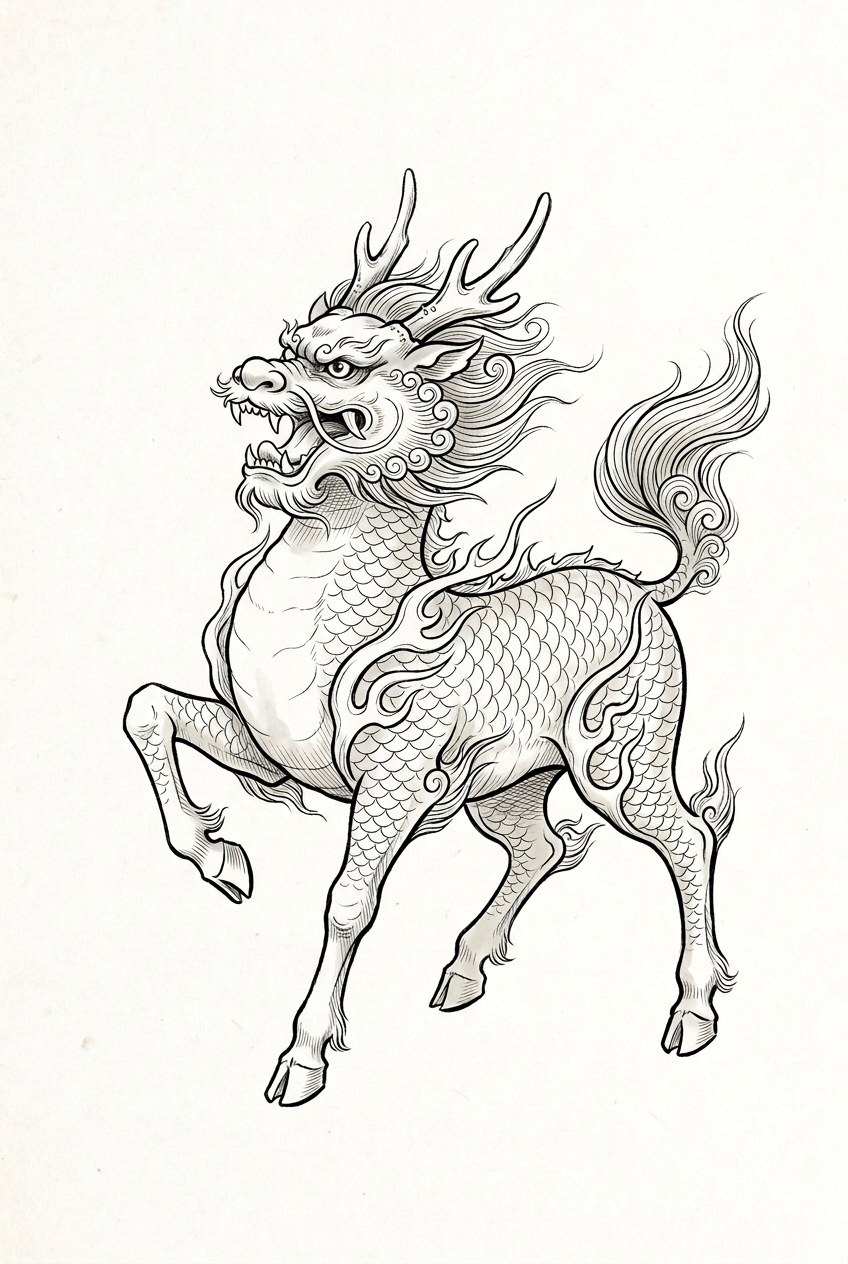
本版每一处形制决定都有出处可查,逐条对账。① 仁厚之趾——《诗经·麟之趾》(约前 11–前 7 世纪)。② 绝笔获麟——《春秋·哀公十四年》(前 481 年)。③ 四灵之列——《礼记》:「麟、凤、龟、龙,谓之四灵。」④ 明清华彩形态——本设计所本,见于补服、织绣与玉雕。古籍笔下的麟是独角肉角;明清匠人把它对称成一对鹿角入图——本设计从明清之制。
Every form decision on this design points to a recorded source, element by element. ① The gentle hoofprints — *Book of Songs*, "Zhi of the Lin" (c. 11th–7th century BC). ② The capture that closed the Annals — *Spring and Autumn Annals*, year 14 of Duke Ai (481 BC). ③ The Four Spirits rank — *Book of Rites*: the lin, the phoenix, the turtle, the dragon. ④ The Ming–Qing flamboyant form — this design's basis, from rank badges, textiles and jade carving. The old records describe a single fleshy horn; Ming–Qing artisans re-imagined it as a symmetric pair of deer antlers — this design follows the Ming–Qing form.
来历
来历
公元前 481 年的春天,鲁国国君带队西行打猎,叔孙氏的车夫捕获一头怪兽:麇身、牛尾、马蹄,头上有一只独角。所有人都以为是不祥之物,折断它的左前臂拉回来,请孔子来看。
孔子只看了一眼,就哭了。
他说:这是麟啊。麟是仁兽——它走路不踩活物,不啃青草,额上的角是肉做的,从不用来伤人。它只在天下有圣王的时候才出现。可是它为什么现在出现?天下无明王,它来得不是时候。孔子拂袖说:"吾道穷矣。"他停笔,不再修《春秋》。两年后,孔子去世。
这是中国历史上最著名的一次动物目击——因为它承载的不是动物学,而是中国人对"盛世"的全部想象:麒麟现身,意味着仁政已至、圣人当生、社会温柔到连最温柔的生灵都敢于露面。
所以两千多年来,中国人在最重要的时刻请出麒麟:子孙降生,称"麒麟儿",祝愿孩子成为仁厚出众之人;婚庆堂前挂麒麟送子图;宅门上雕麒麟镇宅——它镇的不是邪,是"提醒住在里面的人要行仁义"。
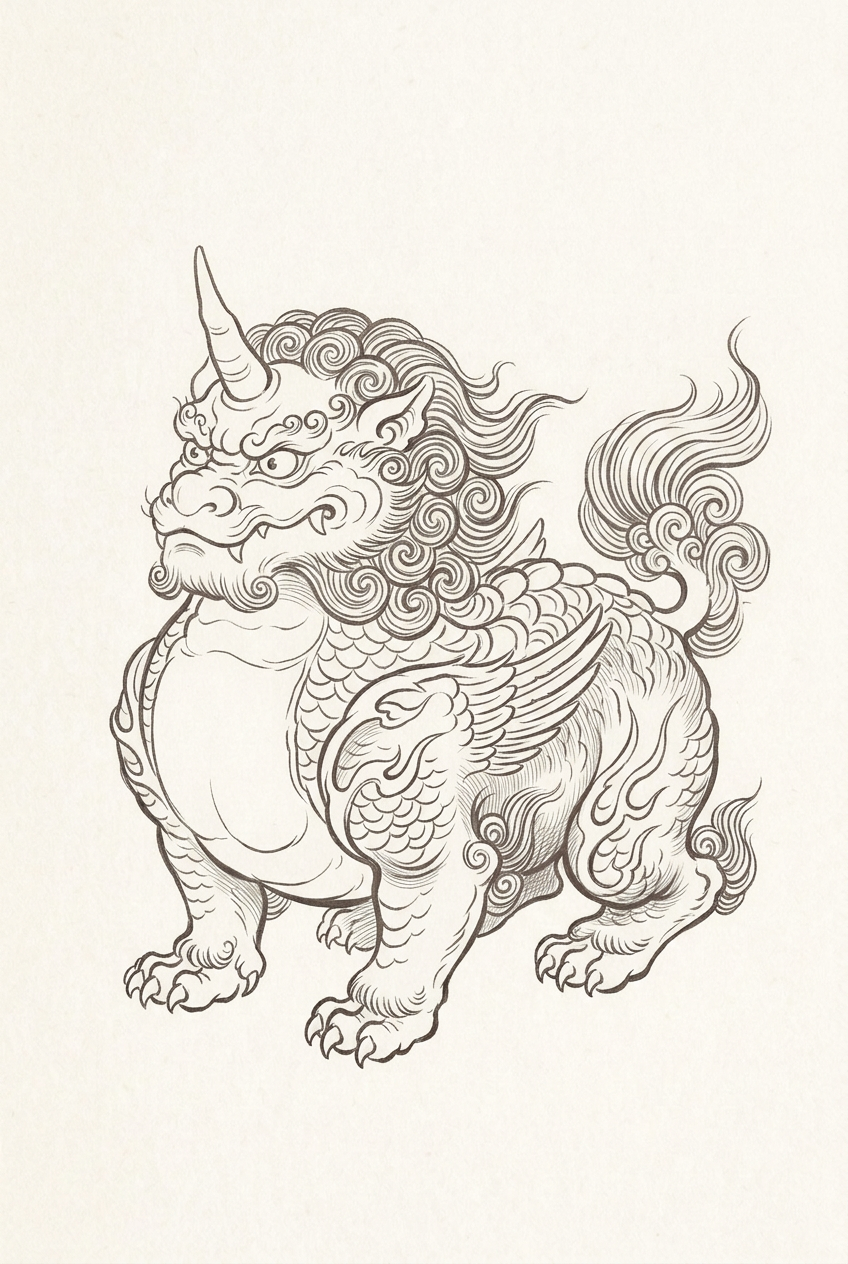
细看麒麟的形象,它是一个"缝合的奇迹":龙首取其智,鹿身取其速,牛尾取其韧,马蹄取其行,鱼鳞取其润——中国人把所有好品质拼成一只兽,然后让它一只角都不用于伤害。这是极东之地的温柔:连神兽的力量都被仁义驯化。
把它纹在身上的人,纹的不是威风,是这个意思。
In the spring of 481 BC, a hunting party in the State of Lu captured a strange creature: the body of a deer, the tail of an ox, the hooves of a horse, and a single horn of flesh. They broke its foreleg dragging it back and sent for Confucius.
The philosopher took one look and wept.
"This is a Qilin," he said. A benevolent beast — it walks without trampling the living, grazes without biting down a single blade of grass, and its horn is soft flesh, made never to wound. It appears only when a sage king rules the world. But no sage king ruled now. It had come at the wrong time. "My Way is exhausted," Confucius said, and set down his brush, never to finish the Spring and Autumn Annals. He died two years later.
This is China's most famous animal sighting — not because of zoology, but because of what it carried: the entire Chinese vision of a golden age. A Qilin appears only when governance is kind enough that the gentlest of creatures dares to show its face.
For two millennia afterward, the Chinese summoned the Qilin at their most hopeful moments. A gifted child is called a *Qilin'er* — "a Qilin among sons." Bridal chambers hung paintings of the Qilin bringing children. Door lintels carved it as a guardian — not to repel demons, but to remind everyone who passed beneath: practice benevolence.
Look closely at its form, and you see a miracle of assembly: the head of a dragon for wisdom, the body of a deer for grace, the tail of an ox for endurance, the hooves of a horse for journeying, the scales of a fish for adaptability. The Chinese combined every virtue into one beast — then gave it a horn it could never use to harm.
That is the tenderness of the Far East: even a mythical beast's power is tamed by righteousness. Whoever wears this creature is not wearing ferocity. They are wearing mercy with strength behind it.
释义
释义
一身集众长,一角不伤人。麒麟是"强而不霸、仁而有威"的人格化身。适合把"力量"与"善良"视为一体的人——力量不必张牙舞爪,善良不必软弱可欺。
All strength assembled; a horn that never wounds. The Qilin is the personification of *strong but not dominant, kind but not soft* — for those who hold that power and goodness are one thing, not two.
位置
位置
神兽构图需纵向空间:全身版(12–25 厘米)经典位是大臂外侧或小腿。想要更安静的第一只,可只取头部侧影——5–8 厘米细线,落在小臂或肩头同样好看。
A mythical beast needs vertical room: the classic spots are the outer upper arm or the calf for a full-body composition (12–25 cm). For a quieter first piece, the head alone in profile — 5–8 cm of fine-line work — sits beautifully on the forearm or shoulder.
纹之前
纹之前
麒麟形象历代差异极大——明清式繁复华丽、汉代式古拙简练。本设计以明清织绣纹样为底,先确认你要的朝代美学。② 民俗中麒麟是纯瑞之兽,无"扛不动"之说(与关公不同),男女皆宜。③ 若加文字,配「麟」单字小印即可,勿与其他神兽名混排。④ 只宜墨线:明清织绣线描黑灰最净。⑤ 留够尺寸。 鳞与鬣不小于 10 厘米;蹄与火纹小尺寸尚可简化,鳞不可。
Qilin imagery varies enormously by era — Ming–Qing style is flamboyant, Han style austere. This design is built on Ming–Qing textile motifs; know which aesthetic you're asking for. ② In folk custom the Qilin is a purely auspicious beast — no "too heavy to carry" restrictions (unlike Guan Gong); suitable for anyone. ③ If you add text, a single 「麟」 seal is enough — never mix beast-name characters together. ④ Ink-only by design: Ming-Qing textile linework reads cleanest in black. ⑤ Respect the scale. Scales and mane need at least 10 cm; hooves and flames simplify gracefully smaller — the scales do not.
本卡每一个汉字都由中文母语者选定并逐笔核对。