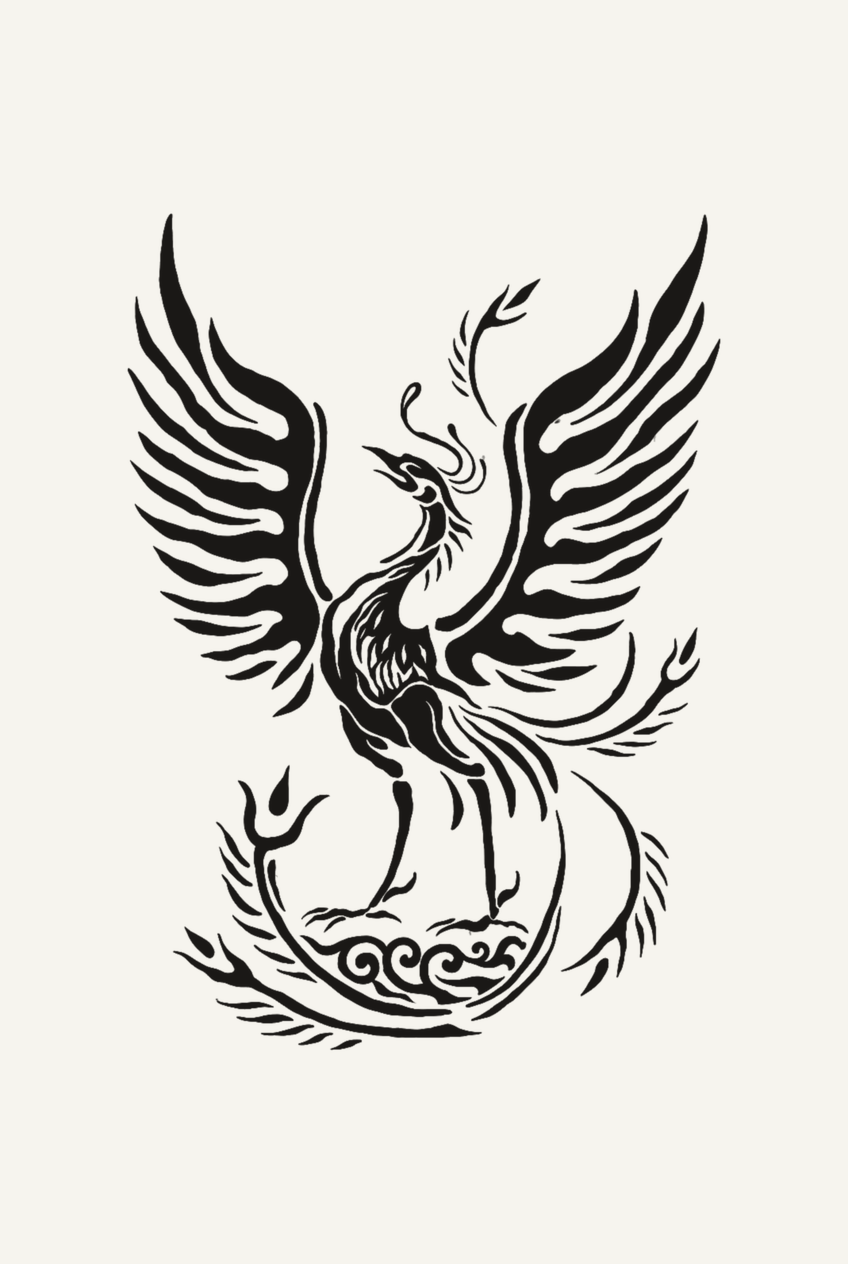
凤皇 · Fèng Huáng
Born Wearing Its Virtues
Series: Mythical Beasts & Sacred Animals · Design #14
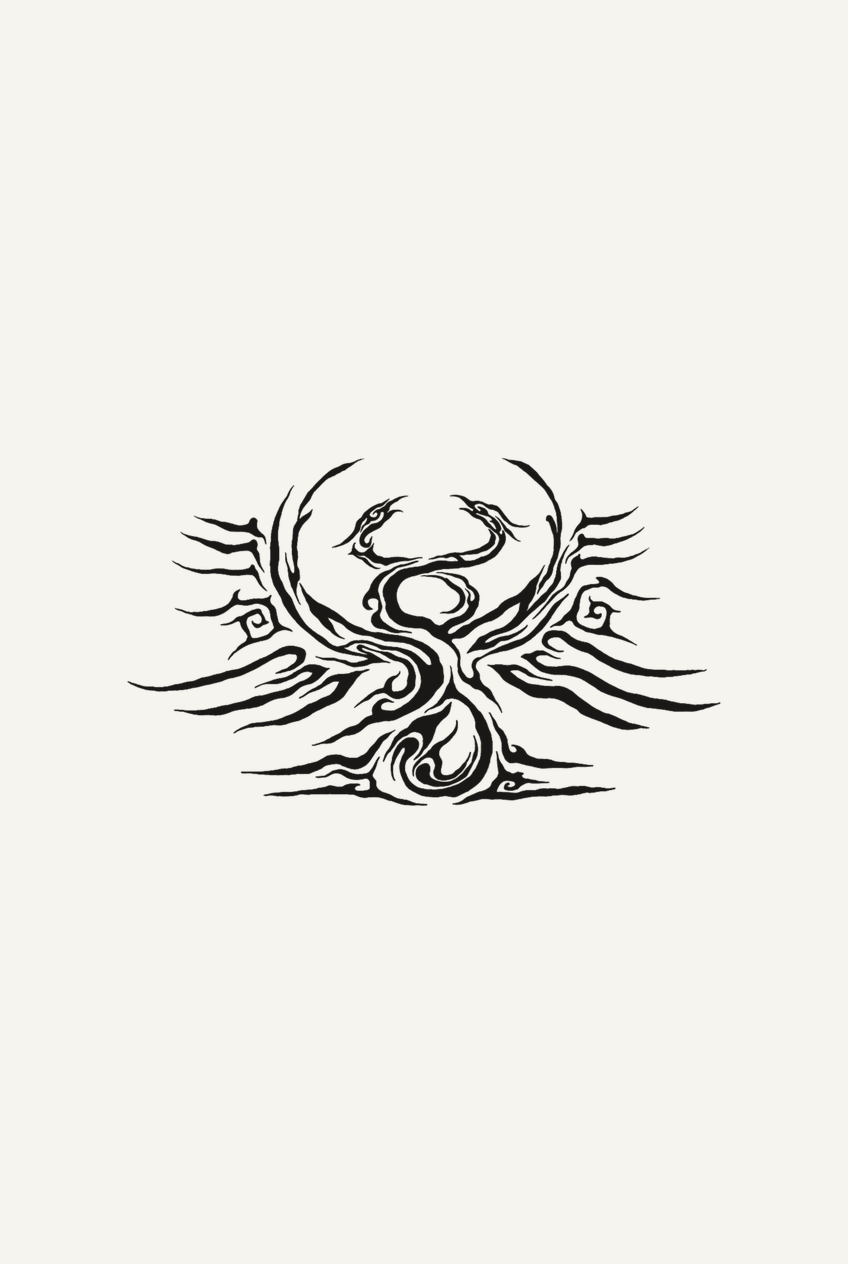
Style: Dancing phoenix with both wings spread in layered tapered plumes, curling crest ribbons, standing on a ring of flames, long tail sweeping around · black-grey · vertical composition · scalable 12–16 cm
Form: 图案
The Name
*fèng huáng* — the phoenix of the southern mountains, and the text gives it something no other sacred bird gets: a written body. 首文曰德,翼文曰义,背文曰礼,膺文曰仁,腹文曰信 — the pattern on its head spells Virtue, on its wings Duty, on its back Rite, on its breast Benevolence, on its belly Trust. The phoenix is not a bird that symbolizes virtue. It is a bird that is *tattooed* with virtue at birth — characters carried on the body, legible to whoever knows how to read a pattern. Of course this is the design for this studio: the original tattooed creature of the classic.
凤皇(fèng huáng)——南山之凤,经文给了它任何神禽都没有的一样东西:一身可读的文字。首文曰德,翼文曰义,背文曰礼,膺文曰仁,腹文曰信——头上的纹样写的是德,翼上是义,背上是礼,胸上是仁,腹上是信。凤皇不是「象征」美德的鸟。它是一出生就*把美德纹在身上*的鸟——文字长在身体上,认得纹样的人就读得出来。这正是本店的题眼:典籍里第一只被纹身的生灵。
Source & Provenance
The *Shanhaijing*, *Nan Ci San Jing* chapter (compiled c. 4th–2nd century BC), Danshu Mountain entry: 「有鸟焉,其状如鸡,五采而文,名曰凤皇,首文曰德,翼文曰义,背文曰礼,膺文曰仁,腹文曰信。是鸟也,饮食自然,自歌自舞,见则天下安宁。」 — shaped like a rooster, five-colored and written-over; the markings named in order; eating and drinking by its own nature, singing and dancing of itself; when it appears, the world is at peace. The self-dancing clause — 自歌自舞 — is the oldest recorded image of the bird performing for no audience at all. Inking note: this design adapts the dancing-pose iconography of the classical phoenix and re-inks it as tattoo linework.
《山海经·南次三经》(约成书于前 4—前 2 世纪)丹穴之山条:「有鸟焉,其状如鸡,五采而文,名曰凤皇,首文曰德,翼文曰义,背文曰礼,膺文曰仁,腹文曰信。是鸟也,饮食自然,自歌自舞,见则天下安宁。」状如鸡——不神化起点;五采而文——通身纹样各有其名;「自歌自舞」——为自己起舞、不需要观众的姿态,是典籍里最古老的一次独舞记录。墨线转写:本设计以古典凤纹的舞姿图像为底,转写为纹身墨线。
Design Inspiration
Every form decision on this design points to a recorded source, element by element. ① The layered spread wings — 翼文曰义, the wings carry the written word for Duty; here they fan out in tiers of tapered plumes, the widest element of the composition, duty being what covers the most ground. ② The curling crest ribbons — 首文曰德, Virtue rides on the head; the crest rises as two long ribbons, leading every line of the design. ③ The ring of flames beneath the feet — 自歌自舞, the dance floor the bird generates for itself, drawn as a single ring of fire it stands *on*, not inside — mastery, not ordeal. ④ The long tail sweeping around the ring — the flowing tail plumes close the circle, 见则天下安宁, peace drawn as a completed loop.
本版每一处形制决定都有出处可查,逐条对账。① 层叠展翼——「翼文曰义」,翼上写的是义;此处分层铺开羽扇,是全图最宽的元素——义,本来就覆盖最广。② 卷曲冠带——「首文曰德」,德在首;冠作两条长带扬起,领起全图所有线条。③ 足下焰环——「自歌自舞」,凤为自己造出的舞池;画成一圈火,凤立于环*上*而非环*中*——是驾驭,不是受炼。④ 环周流曳长尾——尾羽顺焰环合拢成圆,「见则天下安宁」,太平画成一个闭合的环。
The Story
The shock of the entry is the honesty of its first clause: 其状如鸡 — shaped like a chicken. The most glorious bird in the language starts its record looking ordinary, and the five colors only begin where the shape ends. Then the text does its most remarkable move: instead of describing beauty, it lists vocabulary. The phoenix's markings are not decoration; each body part *carries a word* — 德义礼仁信, the complete Confucian set, distributed across the anatomy two centuries before Confucius systematized it. The bird is a text worn on a body.
And then the behavior clause, quiet but radical: 饮食自然,自歌自舞 — it eats and drinks by its own nature, sings and dances *of itself*. No mate sought, no audience required, no phoenix-pair needed for the performance. In a bestiary where almost every creature's meaning depends on being seen — 见则 how it affects the world — the phoenix's omen is the gentlest in the whole classic: 见则天下安宁, when it appears, the world is calm. Not victories, not wealth. Calm.
So what does it mean to wear it? Not rebirth — that reading is largely a later, western-inflected merger with the Egyptian phoenix, and the honest record here is older and different. The Nan Shan phoenix is the being whose qualities are *structural*: the virtues are not aspirations written on a to-do list, they are markings grown into the feathers, part of the body from hatching. As a tattoo it belongs on the person who has stopped performing their values and started wearing them — who dances, like the bird, of themselves. 身上生文字,自歌复自舞。
入口第一句就让人一震,因为它诚实:其状如鸡——状如鸡。这门语言里最华彩的神鸟,记载的起点毫不起眼,五采是从形体结束的地方才开始的。然后经文做了最惊人的一步:不描写美,而是罗列词汇。凤的纹样不是装饰;每个身体部位*携带一个词*——德、义、礼、仁、信,整套儒家的字,在孔子将其系统化的两个世纪之前,已经分配在这副身体上了。这只鸟,是一篇穿在身上的文本。
然后是行为条款,安静而激进:饮食自然,自歌自舞——按自己的天性饮食,为自己而歌舞。不求偶,不要观众,不需要另一半凤凰来凑成演出。在一部几乎每种生灵的意义都系于「被看见」的博物志里——见则如何如何——凤的兆头是全部经里最温和的一条:见则天下安宁。不是胜利,不是财货。是安宁。
所以纹它,纹的是什么?不是浴火重生——那个读法很大程度是后世与埃及 phoenix 的合流,这里的诚实记载更古老,也不同。南山之凤是那个品质*长在结构里*的存在:美德不是待办清单上的愿望,而是长进羽毛里的纹样,破壳之日起就是身体的一部分。它属于那种已经停止表演自己的价值观、开始把它穿在身上的人——像这只鸟一样,自歌自舞。身上生文字,自歌复自舞。
What It Means
Virtue as anatomy. The five words are not goals to reach but markings already on the body — a self you don't have to announce, because it reads in the pattern. For the ones whose principles have stopped being a performance and become plumage: 自歌自舞, the dance that needs no witness.
美德即身体构造。那五个字不是要抵达的目标,而是早已长在身上的纹样——一种不必宣布的自己,因为它在纹样里写得明明白白。给那些原则已从「表演」变成「羽毛」的人:自歌自舞,不需要观众的那支舞。
Where It Sits
Built vertical and tall: 14–16 cm along the spine or outer forearm, the crest ribbons running upward along the body's line. A 10–12 cm variant sits on the calf or side waist. The flame ring is the design's stage — keep it whole; breaking the circle across a joint kills the 安宁 reading.
天生的竖长构图:14—16 厘米顺脊柱或小臂外侧落下,冠带沿身体线条向上走。10—12 厘米变体收进小腿或侧腰。焰环是全图的舞台——保持完整;跨关节截断圆环,「安宁」的读法就断了。
Before You Ink
This design belongs to ink only. Its authority comes from 五采而文 being translated into black-line patternwork — color would make it decorative; black makes it textual. Minimum size 10 cm: below that the layered wing plumes merge into a solid slab. Keep it off the inner arm and the ribcage floor — the two highest-friction, lowest-light zones will blur precisely the written markings the whole design is about.
此图只宜墨线。它的说服力在于把「五采而文」转译成黑线纹样——上色会让它变成装饰,黑线才让它成为文本。最小尺寸 10 厘米:再小,层叠翼羽会糊成一块实心。避开大臂内侧与肋底——摩擦最高、光线最暗的两个位置,糊掉的恰好是全图立意所在的「文字纹」。
Every character on this card was selected and checked stroke by stroke by a native reader of Chinese.