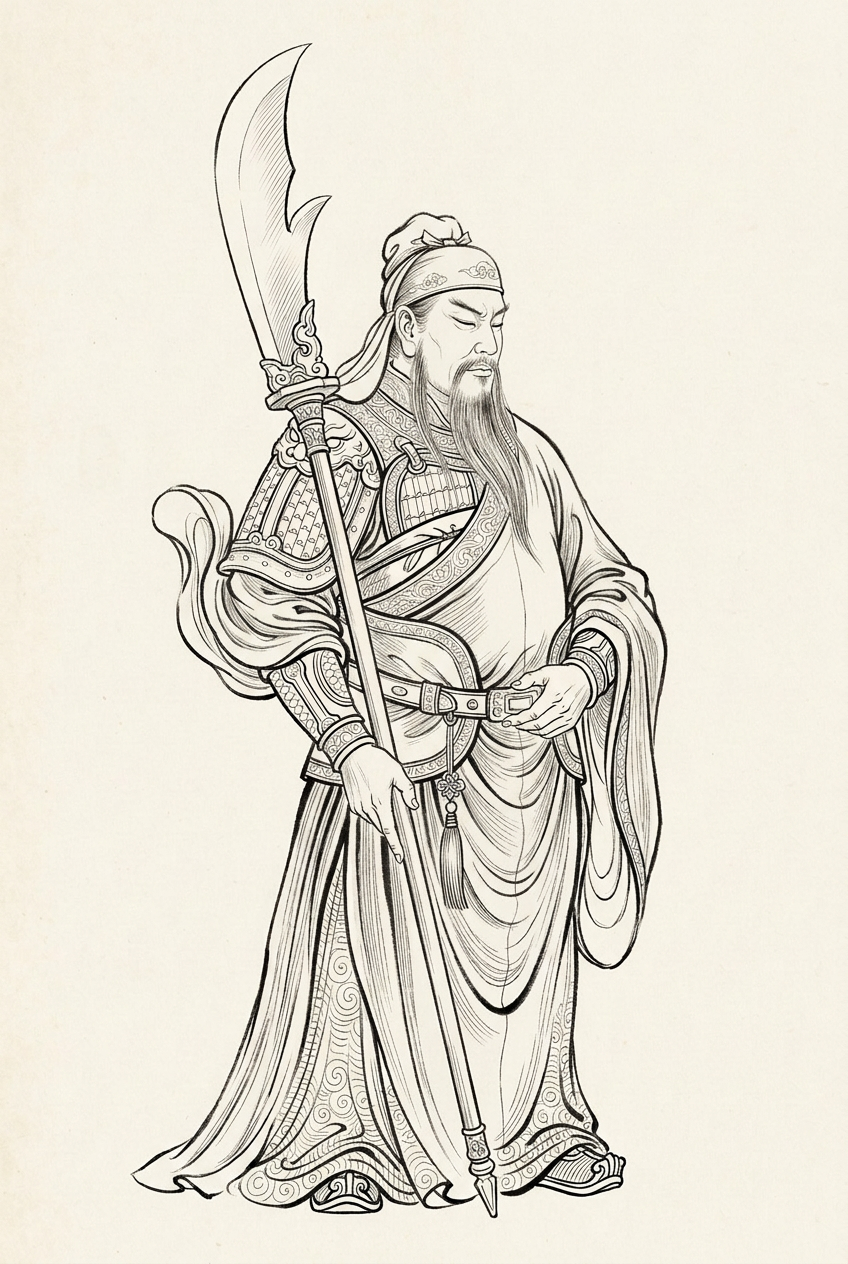
关公 · Guān Gōng
the God of Loyalty
Series: What China Actually Inks · Design #01
Style: portrait / half-sleeve / full back · blackwork or traditional
The Name
*Guān Gōng* — "Duke Guan." The man was Guan Yu, a general who died in 220 AD, but nobody in a Chinese tattoo studio calls him that. He is 关二爷, "Second Master Guan" — the way you'd speak of a family elder, someone with standing in the household. Among all figures in Chinese culture, none is tattooed more often. None comes with more rules, either.
关公。他的本名叫关羽,卒于公元 220 年——但在中国任何一家纹身店里,没人这么叫他。大家都喊「关二爷」,那语气像在称呼自家一位有分量的长辈。在中国文化的众神谱里,被纹上皮肤次数最多的就是他;讲究最多的,也是他。
Source & Provenance
The man lives in *Records of the Three Kingdoms* (Chen Shou, 289 AD); the legend grew in *Romance of the Three Kingdoms* (14th century); and the face in everyone's head — crimson, long-bearded, the Green Dragon Crescent Blade across the shoulder — was cast by a thousand years of temple statuary and opera stages. He is one of the most painted subjects in Chinese art, so period-accurate reference material is inexhaustible.
人在《三国志》里(陈寿,289 年成书),神在《三国演义》里(14 世纪成书),而所有人脑海里的那张脸——枣红脸膛、五绺长髯、肩扛青龙偃月刀——是一千年庙宇造像和戏台行当共同塑出来的。他是中国艺术史上被描绘最多的题材之一,考据素材取之不尽。
Design Inspiration
Design Inspiration
Every form decision on this design points to a recorded source, element by element. ① The man — *Records of the Three Kingdoms* (Chen Shou, 289 AD). ② The legend — *Romance of the Three Kingdoms* (14th century). ③ The canonical face — crimson complexion, five-strand beard, the Green Dragon Crescent Blade — cast by a millennium of temple statuary and opera stages. ④ The lowered gaze — following temple practice, where opening the eyes is a consecration rite, never a carving step.
本版每一处形制决定都有出处可查,逐条对账。① 其人——《三国志》(陈寿,289 年成书)。② 其神——《三国演义》(14 世纪成书)。③ 经典面容——枣红脸膛、五绺长髯、青龙偃月刀——千年庙宇造像与戏台行当共同铸成。④ 低垂的目光——从庙宇规矩来:「开光」是仪式,不是造像的一道工序。
The Story
The Story
Here's the thing nobody expects: Guan Yu was a loser. He lost the province he was sworn to hold, then his head, and the cause he died for collapsed within a generation. And yet within a few centuries the loser was a god — bumped upward by dynasty after dynasty, from marquis to duke to emperor, until he sat beside Confucius himself as the Martial Saint of the civilization. Why? Because of the one thing everyone — his enemies included — had to admit: the man could not be bought.
Cao Cao captured him and treated him like royalty: gold, rank, banquets, gifts beyond counting, all designed to keep him. Guan Yu acknowledged every courtesy, sealed every gift away untouched, wrote one farewell letter — and rode through five passes to rejoin a brother who had nothing left to offer him but a shared defeat. That ride, not a single one of his victories, is why his image ends up on skin. Chinese merchants pray to him for honest profit; soldiers and police swear oaths in his name; so does the underworld — and remarkably, all of them are praying to the same god. In the tattoo world, Guan Gong is the patron of people who treat loyalty as a debt rather than a strategy.
说一件很多人想不到的事:关羽,是个失败者。荆州丢了,人头丢了,他誓死效力的那份基业,不出一代人也塌了。可就是这样一个人,死后几百年间被一路抬上神坛——由侯而公,由公而王,由王而帝,最终与孔子并肩,做了这个文明的武圣。凭什么?凭所有人——包括他的敌人——都不得不认的一件事:这个人,收买不了。
曹操擒住他,以上宾之礼相待:金银、官爵、宴席,赏赐多得数不清,目的只有一个——留下他。关羽把每一份赏赐原封不动封存起来,留下一封辞别信,过五关,回到那位除了共同败局之外一无所有的兄弟身边。让他在皮肤上活到今天的,不是他打过的任何一场胜仗,而是这一趟出走。中国商人拜他求正财,军警在他面前起誓,江湖结拜也要拜他——奇妙的是,所有人拜的是同一位神。所以在纹身的世界里,关公是那些把「义」当债、而不是当算计的人的守护神。
What It Means
What It Means
Loyalty as identity, righteousness that doesn't do the math. In Chinese tattoo culture his image carries a further claim: courage in conflict, and a name defended before profit is counted. And make no mistake, he is a statement piece — the most instantly readable subject in Chinese tattooing, recognized by every Chinese person at ten meters.
忠是身份,义不算账。在中国纹身的语境里,一尊关公还有另一层意思:遇事敢扛,先把名声护住,再谈得失。也别怀疑他的分量——他是中国纹身谱系里辨识度最高的形象,十米开外,每个中国人都认得出。
Where It Sits
Where It Sits
Guan Gong is a large-scale subject: a full back (25 cm and up) or a full upper-arm sleeve. Chinese wearers almost never take him small — scale is respect. If you're drawn to him but not ready for that weight, the sanctioned minimal variant is the single character 义 ("righteousness") beside a silhouette of his blade — 6–10 cm, inner forearm or shoulder.
关公是大题材:满背(25 厘米起步),或整条大臂。中国人几乎不把他纹小——体量就是敬意。若你敬他但还没准备好这份重量,正统的极简变体是单字「义」配一柄偃月刀剪影——6–10 厘米,小臂内侧或肩头。
Before You Ink
Before You Ink
Never take Guan Gong with open eyes. Tradition keeps his gaze lowered or closed; the eye-opening consecration (开光) is a temple rite, not a tattoo-chair ritual, and Chinese wearers read the open-eyed version as summoning a weight you haven't earned. ② Face him outward — toward the shoulder edge, never toward the heart. Standard convention in every Chinese studio. ③ Understand what you're carrying: in Chinese communities, this image reads as a pledge of seriousness. If that's not you, take the blade-only or 义 variant — he doesn't mind; brotherhood was the whole point of him. ④ Stay black-grey. Color pushes the image toward shrine-statue territory; ink keeps the weight. ⑤ Advanced work. The face is the whole design — book an artist with heavy-black portrait experience and give it at least 20 cm; small versions flatten the expression.
关公不可睁眼。 传统里他的目光或垂或闭;「开光」是庙宇里的仪式,不是纹身椅上的环节——许多中国人认为睁眼关公是"请"了超出自己承载的东西。② 朝向向外——朝肩缘,绝不朝心口,这是中国纹身店人人遵守的行规。③ 想清楚你背上的是什么:在华人社区,这尊像被看作一份关于"分量"的承诺。如果那不是你,就选纯刀剪影或单字「义」——关公不会介意;讲兄弟情义,本来才是他的初衷。④ 黑灰为限。 上色易滑向神像感;墨灰保住分量。⑤ 高阶作品。 面部即全部——选有人像与重黑经验的纹身师,尺寸不小于 20 厘米;小图会压平神态。
Every character on this card was selected and checked stroke by stroke by a native reader of Chinese.