鲤跃龙门 · Lǐ Yuè Lóng Mén
Carp Leaping the Dragon Gate
Series: Mythical Beasts & Sacred Animals · Design #04
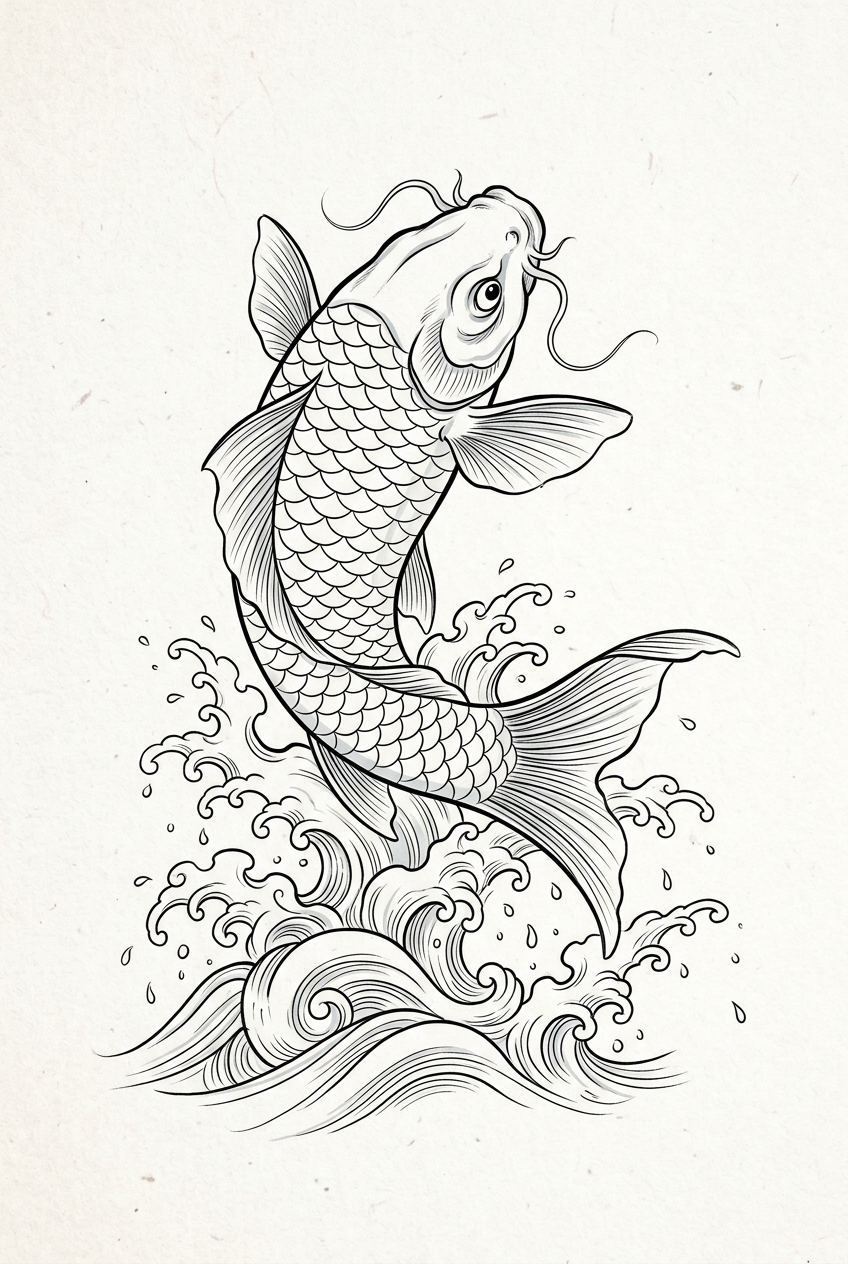
Style: Upward-leaping carp over rolling waves · vertical composition · ink-only, no text
Form: 图案
The Name
*lǐ yuè lóng mén* — the carp that leaps the Dragon Gate becomes a dragon. A single image holding an entire national story about probability, effort, and next year.
鲤跃龙门(lǐ yuè lóng mén)——跃过龙门的鲤鱼,化为龙。一幅图里装着一整个民族关于概率、努力与"来年"的故事。
Source & Provenance
*Records of the Three Qins* (Han dynasty; original lost, fragments preserved): "At Hejin stands the Dragon Gate... great fish gather below by the thousands; those that cannot ascend remain fish — those that ascend become dragons." *Book of the Later Han*, Biography of Li Ying (5th century): scholars called passing the court's gate "ascending the Dragon Gate." The landmark is real: Dragon Gate (Yumenkou) on the Yellow River, at the Shanxi–Shaanxi border. Historical form reference: Carp-and-dragon imagery appears on Song-Qing ceramics, inkstones and New Year prints. No third-party source image was used for this design.
《三秦记》(汉·辛氏撰,原书佚、辑本存):河津一名龙门……江海大鱼薄集龙门下,数千,不得上,上则为龙。《后汉书·李膺传》士人以登龙门为喻(南朝宋·范晔,5 世纪成书)。地标:黄河龙门(禹门口,晋陕交界)。形制参考:鲤鱼化龙题材见于宋至清的瓷器、砚台与年画。 本设计未使用任何第三方源图像。
Design Inspiration
Design Inspiration
Every form decision on this design points to a recorded source, element by element. ① The gate-and-leap narrative — *Records of the Three Qins* (Han dynasty; fragments preserved). ② The literati metaphor — "ascending the Dragon Gate," from *Book of the Later Han*, Biography of Li Ying. ③ The real landmark — Yumenkou on the Yellow River, at the Shanxi–Shaanxi border. ④ The carp-to-dragon pairing — the motif's pictorial treatment on Song–Qing ceramics, inkstones and New Year prints.
本版每一处形制决定都有出处可查,逐条对账。① 龙门跃鱼叙事——《三秦记》(汉·辛氏撰,原书佚、辑本存)。② 文人典故——「登龙门」,出《后汉书·李膺传》。③ 真实地标——黄河龙门(禹门口,晋陕交界)。④ 鱼化龙图像配对——宋至清的瓷器、砚台与年画。
The Story
The Story
The Yellow River pours down through the gorge between Shanxi and Shaanxi, and at Yumenkou the cliffs suddenly squeeze the water into a thunderous drop. The ancients stood at this place, looked up at a barrier they could not pass, and named it: the Dragon Gate.
Then they told a story. Every year in late spring, carp from the river and its tributaries gather beneath the gate by the thousands — swimming upstream, gathering force, leaping. The overwhelming majority fail: they slam into the rock wall and fall back into the current, and come again the next year. But the legend holds that any carp that clears the gate transforms into a dragon.
The most moving part of this story is its brutal probability. It does not promise that effort guarantees success — it promises that most will fail, and that some fish will make it. The Chinese accepted these terms and brought their children to the story. From the Sui dynasty onward, the imperial examination system became the only narrow gate through which commoners could change their fate. Scholars called themselves "fish," and passing the exam was called "ascending the Dragon Gate." Between a fish and a dragon lies one leap, contested by millions.
An entire universe of Chinese family culture grew from this: a fish on the New Year's table, a carp at a baby's first-month feast, prayers at the temple before exams.
But the real power of the story hides in the fish that don't make it. The legend never says the failures die — they fall back into the water and come again next year. The Gate stands every year; the carp return every year. Chinese culture holds a nearly stubborn forgiveness for trying again: the scholar who fails the exam returns home and studies once more. This is not a culture of failure. It is a culture of *next year*.
So the complete meaning comes in two sentences: Leap it, and you are no longer who you were. Fail it, and the Gate will still be there.
The people who wear this fish are usually in the water right now.
黄河从晋陕大峡谷奔涌而下,在禹门口被两岸峭壁骤然夹紧,水位陡落,声如雷吼。古人走到这里,抬头看见的是一道过不去的关——于是给它取名:龙门。
然后他们讲了一个故事:每年暮春,黄河与各条支流里的鲤鱼成群结队游到龙门之下,聚集数千条,逆流、蓄力、起跳。绝大多数鱼跳不过去——撞在石壁上,跌回浪里,明年再来。而传说中,凡能跃过这道门的鲤鱼,化身为龙。
这个故事最动人的地方在于它的残酷概率:不是"努力就能过",而是"大多数过不去,但总有鱼能过去"。中国人接受了这个设定,并且把自己的孩子领到故事面前——从隋朝开始,科举成为平民改变命运的唯一窄门,读书人自称"鱼",把金榜题名叫"登龙门"。一条鱼想变成龙,中间隔着一场千万人竞争的跳跃。
由此衍生出整座中国的家长宇宙:年夜饭桌上必须有鱼,叫"年年有余"更暗含"望子化龙";孩子满月吃鲤鱼;考试前拜文庙……
但这个故事真正的力量,其实藏在没跃过去的鱼身上。传说里没有说失败的鲤鱼被处死——它们只是跌回水里,明年再来。龙门每年都在,鲤鱼每年都来。中国人对"复读"这件事有种近乎固执的宽容:落第的读书人回乡再读,落榜的少年再来一年——这不是失败文化,这是"来年"文化。
所以鲤跃龙门的完整寓意是两句话:跃过去,你就不是原来的你;跃不过去,门永远在那里。
把这条鱼纹在身上的人,通常正在水里。
What It Means
What It Means
Clear the gate and become a dragon; fail, and the gate still stands. This is China's original underdog narrative — it admits the odds are brutal, and bets on *next year*. For students, immigrants, career-changers, anyone mid-crossing — and for those marking the moment they made it over.
跃过去化龙,跃不过,门永远在。鲤跃龙门 = 逆袭叙事的中国原型——承认概率残酷,但赌"来年"。适合升学/上岸/移民/转行等"正在渡劫"的人,以及纪念自己"跃过去"的时刻。
Where It Sits
Where It Sits
The composition is vertical by nature — fish rising, water falling — so it wants a vertical canvas: outer upper arm, calf, or a large piece along the ribs. A fine-line carp at 6–10 cm works above the wrist or ankle. Full traditional sleeve backgrounds are available everywhere; this house style is Chinese — the leap, the waves, negative space — not Japanese body-suit work.
构图天然纵向——鱼向上、水向下——所以它要一块纵向画布:大臂外侧、小腿,或肋侧大图。细线小鱼 6–10 厘米适合腕上/脚踝。日式半甲式背景不推荐——本站主打中式留白黑灰(跃势+浪花+负空间)。
Before You Ink
Before You Ink
Carp and koi overlap visually but not in context: what makes this a Carp-Leaping-the-Dragon-Gate design is the upward leap and the backward glance — a static swimming fish is a different design. ② Japanese koi tattooing is visually dominant worldwide. This design stays on the Chinese source: the leap, the backward glance — and the *Records of the Three Qins*, cited on the story page. ③ If you add text, choose either the single character 跃 or the full phrase 鲤跃龙门 — never mix in other idioms. ④ Ink-only by design: waves and scales read best in black-grey. ⑤ Respect the scale. The leaping carp and the waves need at least 12 cm; smaller, they compress into noise.
鲤鱼与锦鲤(koi)视觉重叠但语境不同:本作的身份是跃起的纵向动势与回望——静态游鱼是另一个设计。② 日式鲤鱼(koi tattoo)审美强势。本作守的是中国出处:跃起的动势、回望的目光——出处《三秦记》在故事页可查。③ 如搭配汉字,配「跃」或全称「鲤跃龙门」二选一,勿混加其他成语。④ 只宜墨线:浪与鳞在黑灰里最耐读。⑤ 留够尺寸。 跃起的鲤鱼与浪花不小于 12 厘米;再小就挤成一团。
Every character on this card was selected and checked stroke by stroke by a native reader of Chinese.