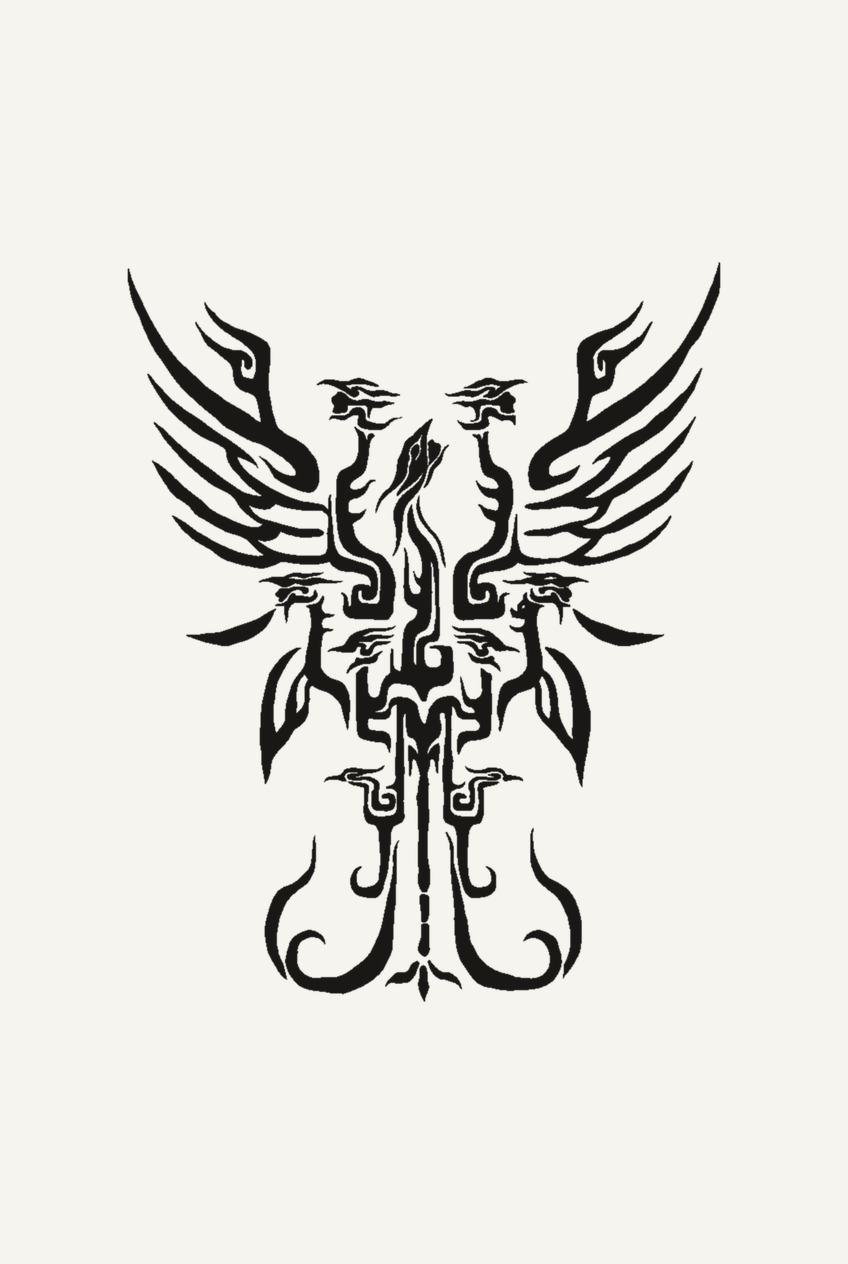
九凤 · Jiǔ Fèng
Nine Faces, One Cry
系列: 神兽灵禽 · Design #18
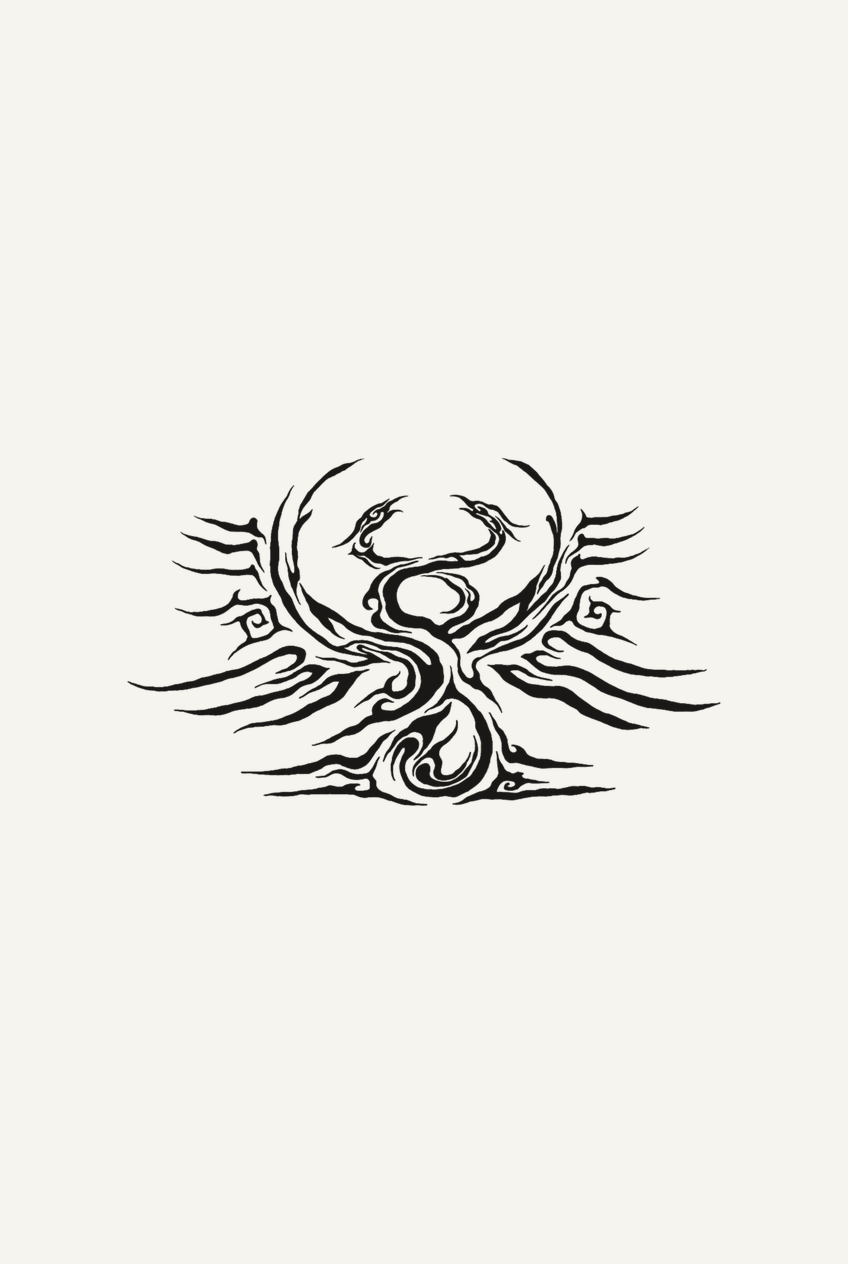
笔法: Symmetric phoenix with two enormous spread wings, bird heads nested along the central axis, curling flame-scroll tails · black-grey · square composition · scalable 14–18 cm
形态: 九凤对称而立,双翼大张层叠羽扇,鸟首嵌套纵轴居中,卷焰尾下扫外扬,方构图
名字
九凤(jiǔ fèng)——极北之凤。在记载地图的边缘,越过北海,有一座经文称作「北极天柜」的山,山上有神,九首,面面皆人,身则是鸟。九面,是一次同时用九种方式注视;凤形,是那声鸣叫始终只有一个声音。经典没有给这个形象任何故事——只给了名字、方位,和一个完整到独自存活了两千年的形状。
*jiǔ fèng* — the nine-headed phoenix of the far north. At the edge of the record's map, past the northern sea, stands a mountain the text calls the Cabinet of the North Pole, and on it a god with nine heads, a human face on each, and the body of a bird. Nine faces means nine ways of looking at once; the phoenix form means the cry is still one voice. The classic gives this figure no story at all — only a name, a place, and a shape so complete it has survived on its own for two thousand years.
出处
《山海经·大荒北经》(约成书于前 4—前 2 世纪):「大荒之中,有山名曰北极天柜,海水北注焉。有神,九首,人面鸟身,名曰九凤。」大荒之中有山北极天柜,海水从北注入;有神,九首,人面鸟身,名曰九凤。无事迹,无祭祀,无征兆——经典对这个形象的沉默是彻底的,而这个形象照样立住了。墨线转写:本设计以九首人面鸟身的神形为底,转写为纹身墨线。
The *Shanhaijing*, *Da Huang Bei Jing* chapter (compiled c. 4th–2nd century BC): 「大荒之中,有山名曰北极天柜,海水北注焉。有神,九首,人面鸟身,名曰九凤。」 — in the Great Waste stands the mountain Arctic Heaven's Cabinet, the northern sea pouring into it; there is a god, nine-headed, human-faced, bird-bodied, named Nine Phoenixes. No deeds, no worship, no omen — the classic's silence around this figure is total, and the figure holds anyway. Inking note: this design adapts the nine-faced bird-god form and re-inks it as tattoo linework.
设计灵感
本版每一处形制决定都有出处可查,逐条对账。① 双翼大张——「鸟身」,鸟身以全幅画出,层叠羽扇左右对称铺开,是全图最宽的一片静默。② 中轴嵌套的鸟首——「九首」,画成一根纵轴上的图腾柱,头与头上下叠压,一层目光摞着一层目光,全部朝前。③ 卷焰尾羽——凤的范式,尾羽带钩下扫外扬、左右互为镜像,火被驯进对称里。④ 方形自足的框——无故事的神不需要叙事流动;构图向自身闭合,正如记载那样。
Every form decision on this design points to a recorded source, element by element. ① The two enormous spread wings — 鸟身, the bird-body drawn at full span, layered tapered plumes fanning left and right in perfect symmetry, the widest silence in the composition. ② The bird heads nested on the central axis — 九首, rendered as a totem column of overlapping heads rising through the middle, one gaze stacked above another, all reading forward. ③ The curling flame-scroll tails — the phoenix nature 範式, the tails sweeping down and outward in hooked plumes that mirror each other, fire disciplined into symmetry. ④ The square self-contained frame — a god with no story needs no narrative flow; the composition closes into itself the way the record does.
来历
体会一下这条记录有多奇怪。《山海经》是一部细节的闲话——它告诉你生灵吃什么、身后拖着什么兆、治什么病。经典里几乎每个形象都有用途、有警告或有故事。对九凤:什么都没有。一个名字,一座地图尽头的山,一副身体。它是全部经文里唯一表现得像纯粹图像的一条——文本记下这个形状,仿佛它早已被知晓,不需要介绍,也不给教训。
两千年的注家大多绕开了它——而它自持如初。当地民间记得它;楚人清点九头鸟的征兆;但经典自己的这位九首之神只是站在北方山上,九面朝前,双翼张开,一言不发。《山海经》满纸喧哗的生灵里,它最安静。再注意这份沉默保护了什么:没有附带任何征兆,九凤不意味着任何*关于世界*的事——没有洪水,没有兵戈,没有收成。它无法被读成警告。它只能被当作一个形来穿戴。
所以纹它,纹的是什么?这是给那种深度不在任何一个单独故事里陈列的人的设计——九面,是同时拥有九个观察位的内在生活;一鸣,是在所有观察位上都保持一致的完整。它属于看得多、说得少的人,属于那份镇定常被误认为空白的人,而实际上是房间里最完整的那个形象。九面同向,一鸣如初。
Sit with how strange this entry is. The Shanhaijing is a gossip of details — it tells you what creatures eat, what omen they drag behind them, what disease they cure. For almost every figure in the classic there is a use, a warning, or a story. For the Nine Phoenixes: nothing. A name, a mountain at the top of the map, a body. It is the one entry that behaves like pure icon — a shape the text records as if it were known already, needing no introduction and offering no lesson.
Two thousand years of commentators mostly passed it by — and the figure kept its composure. Folk religion in the region remembered it; the Chu people counted nine-headed bird omens; but the classic's own nine-headed god simply stands on its northern mountain, nine faces forward, wings open, saying nothing. Among all the Shanhaijing's noisy creatures, its quietest. And notice what the silence protects: with no omen attached, the Nine Phoenixes means nothing *about* the world — no flood, no war, no harvest. It cannot be read as a warning. It can only be worn as a form.
So what does it mean to wear it? This is a design for the person whose depth is not on display in any single story — nine faces is an inner life with nine simultaneous vantage points; one voice is integrity kept across all of them. It belongs on someone who watches more than they say, whose composure people mistake for blankness, and who is in fact the most complete figure in the room. 九面同向,一鸣如初。
释义
无故事而完整。一种不需要情节来维持形状的自己——九种看法,一个标准,静收的翼同时也是全幅张开的翼。给安静的、有层次的人:你不是没被读懂;你是那条不需要脚注的记载。
Complete without a story. A self that does not need a plot to hold its shape — nine ways of seeing, one standard, wings at rest that are also wings at full span. For the quiet ones with layered depth: you are not unread; you are the record that needs no footnote.
位置
天生的方形对称构图:14—16 厘米收在肩头,翼展随三角肌走,首柱居中;或 14 厘米收在后背颈下。10—12 厘米变体收进小腿。中央首柱是全图的中轴——保持垂直;一歪,九道目光就散了。
Built square and symmetric: 14–16 cm on the shoulder cap, the wing span following the deltoid, head column centered; or 14 cm on the upper back below the neck. A 10–12 cm variant sits on the calf. The central head column is the design's axis — keep it vertical; tilting it turns nine gazes into a scatter.
纹之前
此图只宜墨线。它的力量是黑线撑住的对称——上色会把九重目光散成装饰,灰阶会糊掉承载全图的嵌套首柱。最小尺寸 10 厘米:再小,叠压的鸟首会融成一张脸。避开大腿外侧与手臂内侧——摩擦区最先闭合的是嵌套首之间的细缝,而两张脸一融合,数目就永远错了。
This design belongs to ink only. Its force is symmetry held in black line — color would scatter the nine-fold gaze into decoration, and greyscale would blur the nested head column that carries the whole figure. Minimum size 10 cm: below that the stacked heads merge into a single face. Keep it off the outer thigh and the inner arm — friction zones close the fine gaps between nested heads first, and once two faces merge, the count is wrong forever.
本卡每一个汉字都由中文母语者选定并逐笔核对。