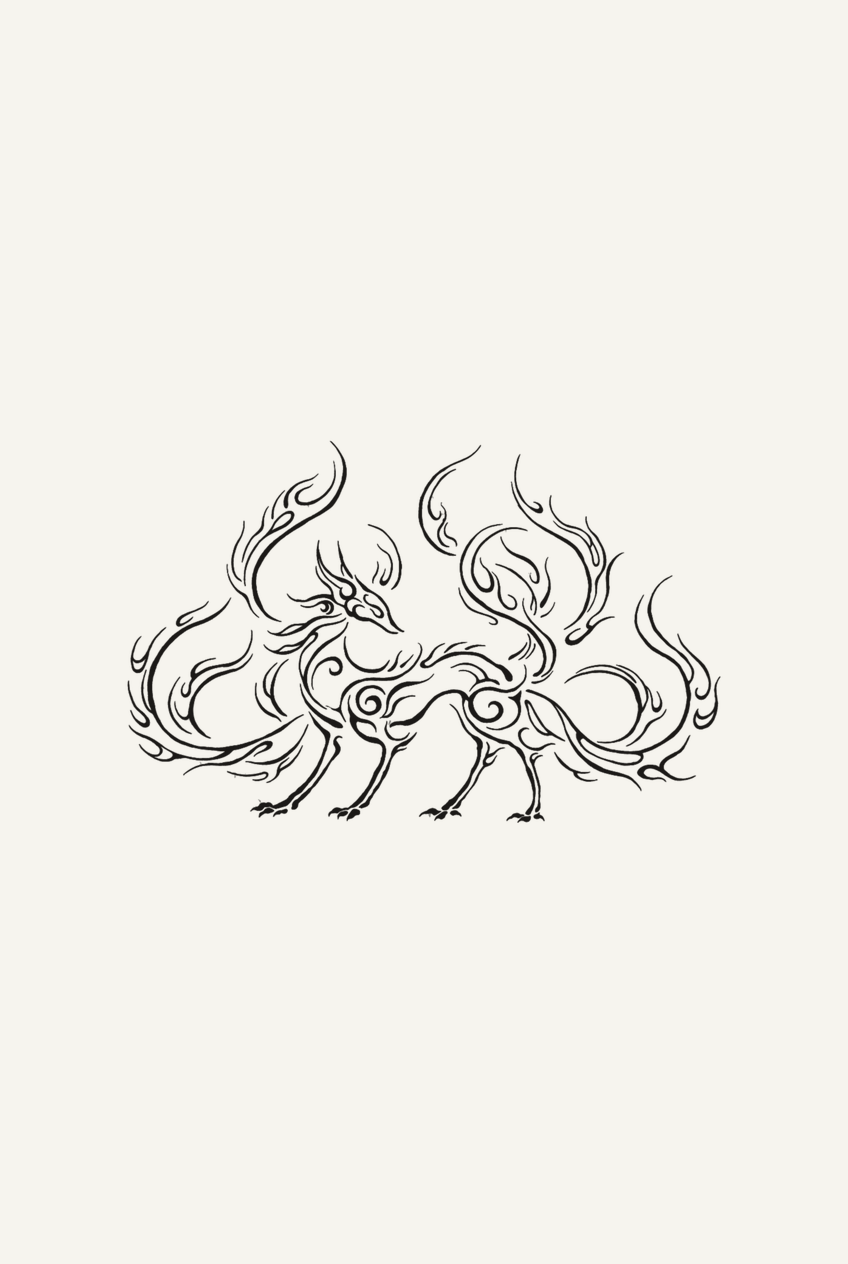
九尾狐 · Jiǔ Wěi Hú
The Misread Blessing
系列: 神兽灵禽 · Design #11
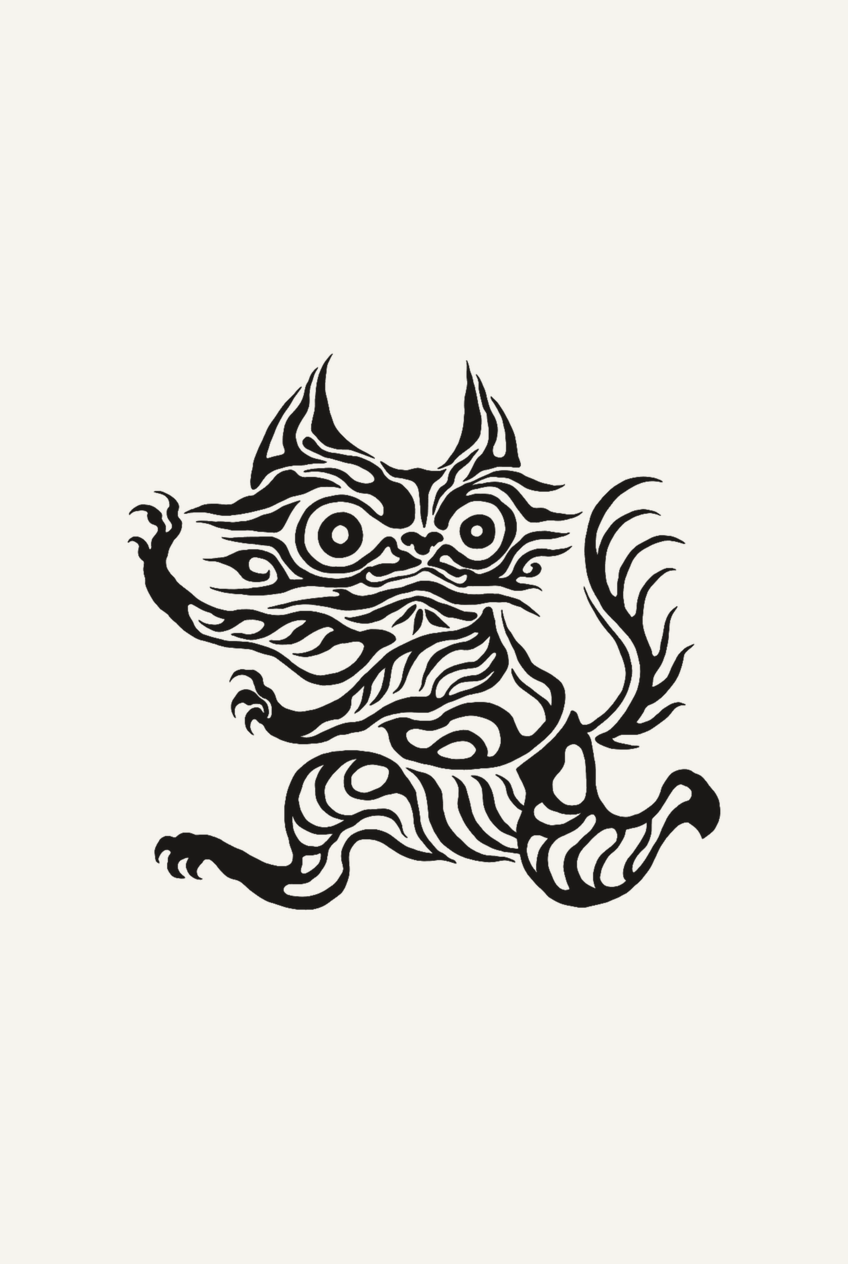
笔法: Nine-tailed fox, horned head, flame-form tails sweeping around a coiled body · black-grey · horizontal composition · scalable 12–18 cm
形态: 九尾狐,狐首枝角,焰形飘尾环绕全身,四足踏地,横构图
名字
九尾狐(jiǔ wěi hú)——中国志怪谱系里被误读得最深的一只兽。《山海经》介绍它用了前后两句本不该共存的话:它能食人——而吃掉它,则食者不蛊,百毒不侵,恶念不近。危险与护身符,写在同一句话里。一千年后,同一只狐出现在大禹的婚谣里;再一千年,它蹲进了汉画像石,与玉兔蟾蜍并侍西王母之侧,是堂堂正正的祥瑞。人人怕的那只狐,恰恰是赐福的那只狐。
*jiǔ wěi hú* — the nine-tailed fox of Qingqiu, the most misread beast in the Chinese bestiary. The *Shanhaijing* introduces it with two consecutive clauses that should not be able to coexist: it devours people — and eating it protects you from 蛊, from malice and bewitchment. Danger and talisman in the same breath. A thousand years later the same fox appears in a marriage song, and a thousand years after that it sits beside the Queen Mother of the West in Han tomb art as an emblem of good fortune. The fox people feared is the fox that blesses.
出处
《山海经·南山经》(约成书于前 4—前 2 世纪)青丘条:「青丘之山,有兽焉,其状如狐而九尾,其音如婴儿,能食人;食者不蛊。」后续正典:《吴越春秋》载大禹娶涂山氏前闻「绥绥白狐,九尾庞庞……成家成室,我造彼昌」之谣——九尾成了开国联姻与子孙昌盛的吉兆;汉画像石中九尾狐与玉兔、蟾蜍并侍西王母,位列祥瑞。墨线转写:本设计以传统母题的经典线条造型为底,转写为纹身墨线。
The *Shanhaijing*, *Nan Shan Jing* chapter (compiled c. 4th–2nd century BC), Qingqiu entry: 「青丘之山,有兽焉,其状如狐而九尾,其音如婴儿,能食人;食者不蛊。」 — on Mount Qingqiu there is a beast, fox-formed and nine-tailed, crying like a human infant; it devours people, yet those who eat it are immune to 蛊. Later canon: the *Wu Yue Chunqiu* records the white nine-tailed fox in the courtship song of Yu the Great and the Tu Shan clan — 「绥绥白狐,九尾庞庞……成家成室,我造彼昌」 — nine tails as the omen of a founding marriage and abundant heirs; Han pictorial stone carvings place the fox beside Xiwangmu as an auspicious beast. Inking note: this design adapts the classic line construction of the traditional motif and re-inks it as tattoo linework.
设计灵感
本版每一处形制决定都有出处可查,逐条对账。① 狐首——「其状如狐」,尖吻竖耳,警觉而平视。② 九尾——「九尾」,化作九条焰形飘带绕体成弧,数目对得起名字。③ 盘身与云卷——古典兽纹的行云卷法,整只狐像一道决定长出腿的火焰。④ 枝状角——艺术处理,取汉代瑞兽角饰的路数;经文未提角,本图以「祥瑞生角」作答。
Every form decision on this design points to a recorded source, element by element. ① The fox head — 其状如狐, slender muzzle, upright ears, alert and level. ② The nine tails — 九尾, rendered as nine flame-form ribbons sweeping in an arc around the body, the count kept honest to the name. ③ The coiled body and cloud curls — the running-vapor scrollwork of classical beast patterns, the fox moving like a flame that decided to have legs. ④ The antler-like horns — artistic license, in the manner of auspicious-beast hornwork from Han ornament; the text is silent on horns and this design answers with the woodland-crest of a lucky beast.
来历
慢慢读青丘这一条,因为语法就是全部重点。有兽焉,其状如狐而九尾——兽在这里,狐形,九尾。其音如婴儿——叫声像婴儿(古人把这归为诡异,不是可爱)。能食人——它吃人。句号,威胁完毕。紧接着,不带喘地补了一句:食者不蛊——吃掉它的人百蛊不侵。同一具身体,既是毒,也是解药。《山海经》全书只这样写了一次,就给了狐。
之后两千年,中国一直在决定怎么处理这份暧昧——结论出奇地站在了「赐福」这边。大禹的婚谣把九尾白狐指为成亲的征兆:九尾庞庞,九条丰满的尾巴被读成世代、读成子孙,成家成室,家道因之而昌。汉画像石给狐在西王母——掌不朽的神——身旁留了座次,与玉兔、蟾蜍同列祥瑞。那个声音像婴孩、生吃人的狐,最后成了王朝婚礼的司仪。
所以它到底是凶是吉?记载给出的诚实回答是:都是——区别只在你站在它哪一边。 对怀恶意者,它是食人的那一位;对它护着的人,它是护身的那一道符——食者不蛊,恶念近不了身。作为纹身,它属于那种「劲儿总被误读」的人:直接的被说成凶,安静的被说成冷,忠诚的被当成危险,直到证明相反为止。你不用再解释了。狐从来懒得解释。它不辩解,它只是不吃亏。
Read the Qingqiu entry slowly, because the grammar is the whole point. 有兽焉,其状如狐而九尾 — here is the beast, fox-formed, nine-tailed. 其音如婴儿 — it cries like a human infant (the ancients file this under uncanny, not cute). 能食人 — it eats people. Full stop, threat delivered. Then, without pausing: 食者不蛊 — and those who eat *it* are never bewitched. The same body is the poison and the antidote. The *Shanhaijing* does this exactly once, and it did it with the fox.
China then spent two millennia deciding what to do with that ambivalence — and came down, remarkably, on the side of blessing. The courtship song of Yu the Great names the nine-tailed white fox as the sign to marry: 九尾庞庞, nine full tails, 成家成室, so the household is founded and flourishes — the tails were read as generations, abundance multiplying down the years. Han stone carvings give the fox a seat beside the Queen Mother of the West, keeper of immortality, listed with the hare and the toad among the lucky. The fox that whispers like a child and eats men ends up officiating dynastic weddings.
So what is it, menace or blessing? The honest answer of the record: both, and the difference is which side of it you stand on. To what intends harm, the fox is the eater. To what it keeps, the fox is the charm — 食者不蛊, malice does not stick. As a tattoo, it is for the person whose intensity keeps getting misread: the direct one called aggressive, the quiet one called cold, the loyal one mistaken for dangerous until proven otherwise. You stop explaining. The fox never did. 它不辩解,它只是不吃亏。
释义
一种从不解释自己的保护。狐同时顶着两条头条——被怕的,和赐福的——而记载坚称两者皆真。给被误读的人、自守的人、那些「在场就被当成威胁」的人:这道符安安静静地生效,食者不蛊,恶念不粘身。
Protection that never explains itself. The fox carries two headlines — feared, and fortunate — and the record insists both are true. For the misread, the self-protective, the ones whose presence is mistaken for threat: the charm works quietly, and 食者不蛊 — malice does not stick.
位置
天生的横构图:14–18 厘米横贯上背或大腿外侧,狐首领路,尾焰绕体成弧。10–12 厘米变体收进小臂外侧,尾带顺臂线垂向手腕。狐首是全图最精细的部分——给它留足空间,避开关节。
Built horizontal: 14–18 cm across the upper back or the outer thigh, head leading, tails fanning over and around. A 10–12 cm variant wraps the outer forearm, tail ribbons tracing down toward the wrist. The head is the finest work on the design — give it room, keep it off joints.
纹之前
上转印稿之前数尾焰——本图的数目对得起名字;每条尾都该读得出独立的飘带,不能糊成一团。② 狐首小而精——请纹身师在这里放慢:吻部、双耳、平视的目光撑起整张图。③ 尾是动势:落针前与纹身师确认飘带的走向,让弧线顺着你的身体结构走(绕肩胛,或顺小臂而下)。④ 只宜墨线:线条为黑灰呈现;若想要狐「醒着」,眼上点一粒朱砂是落针时的传统可选项。⑤ 留够尺寸。 不小于 10 厘米,否则尾焰粘成一片、狐首糊成噪点。
Count the flame-ribbons before the stencil goes on — the design keeps the count honest to the name; each tail should read as its own ribbon, not a merged mass. ② The head is small and fine — ask your artist to slow down there: muzzle, ears, and the level gaze carry the whole design. ③ The tails are movement: confirm the sweep direction with your artist so the arc follows your anatomy (over the shoulder blade, or down the forearm). ④ Ink-only by design: the linework is black-grey; a single cinnabar dot at the eye is the traditional at-the-needle option if you want the fox awake. ⑤ Respect the scale. Minimum 10 cm, or the tail ribbons fuse and the face becomes noise.
本卡每一个汉字都由中文母语者选定并逐笔核对。