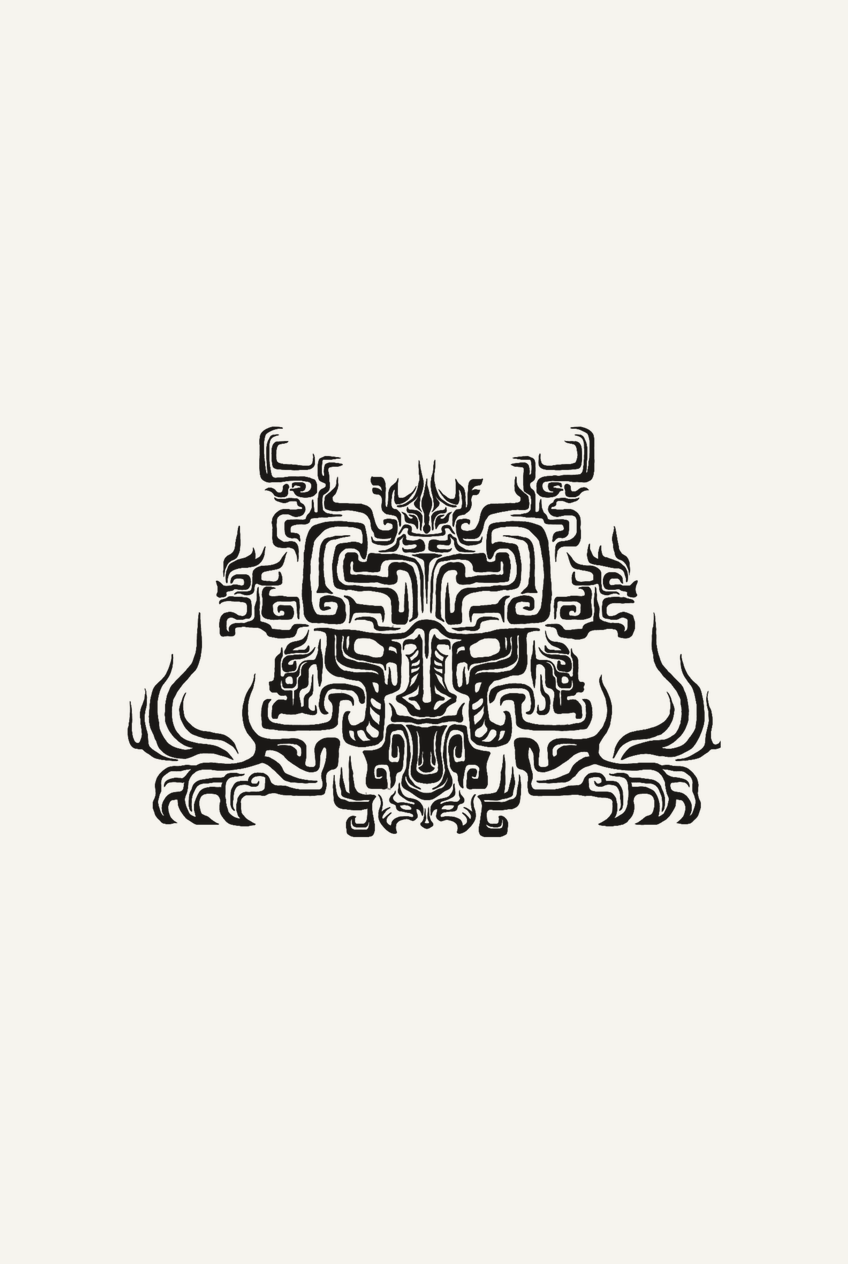
开明兽 · Kāi Míng Shòu
The Nine-Headed Doorkeeper
系列: 神兽灵禽 · Design #15
笔法: Nine human-faced heads in symmetric array, dense meander scrollwork, flame-plume crests flaring both sides, clawed base · black-grey · landscape composition · scalable 16–20 cm
形态: 开明兽九首人面对称排列,回纹卷绕满铺,焰羽冠向两侧扬起,底座利爪,横构图
名字
开明兽(kāi míng shòu)——开明之兽。它立在人间尽头:昆仑之巅,天帝下都的九门之前,九门配九首,一门一哨。彻底到极致的守卫——每一张脸只盯一扇门,除非它面对你、放你过,否则谁也过不去。名字的意思是「亮起来的那一下」:开明,在边界上看清楚的那一刻。守门,守成了一种觉悟。
*kāi míng shòu* — the Opening-Brightness beast. It stands where the mortal world ends: on the Kunlun mountain, at the nine gates of the earthly residence of the Supreme Divinity, nine doors for its nine heads, one sentry per threshold. A guardian so total that each face watches one gate — nothing passes unless it faces you and lets you. The name means the light that switches on: 开明, the moment of seeing clearly at the boundary. Doorkeeping, done as a form of enlightenment.
出处
《山海经·海内西经》(约成书于前 4—前 2 世纪):「海内昆仑之虚,在西北,帝之下都。昆仑之虚,方八百里,高万仞。……面有九门,门有开明兽守之,百神之所在。」又:「开明兽身大类虎而九首,皆人面,东向立昆仑上。」昆仑之虚,方八百里,是天帝在人间的官邸;九门,每门一只开明兽把守;兽身大类虎,九首皆人面,面向东立在昆仑之上。墨线转写:本设计以古典守门神的图像为底,转写为纹身墨线。
The *Shanhaijing*, *Hai Nei Xi Jing* chapter (compiled c. 4th–2nd century BC): 「海内昆仑之虚,在西北,帝之下都。昆仑之虚,方八百里,高万仞。……面有九门,门有开明兽守之,百神之所在。」 and 「开明兽身大类虎而九首,皆人面,东向立昆仑上。」 — the Kunlun compound, eight hundred li square, the Divinity's earthly residence; nine gates, each kept by a kaiming beast; the beast itself tiger-bodied, nine heads, all with human faces, standing facing east. Inking note: this design adapts the classical guardian iconography and re-inks it as tattoo linework.
设计灵感
本版每一处形制决定都有出处可查,逐条对账。① 九首人面——「九首,皆人面」,沿中轴对称排布,经文里一门一首,首首等大——平等的哨兵。② 满铺回纹——守门神真正的出身是青铜铸造传统:兽身化作方折的回纹卷钩,正是守护祭器的那些铜器上的纹样语言。③ 两侧扬起的焰羽冠——「身大类虎」的虎身放大成仪式性的鬃毛,在构图两肩处破开边框。④ 利爪底座——「东向立昆仑上」,「立」就是它的职责描述;底座层层加宽如须弥座,一副生来就不离岗的身形。
Every form decision on this design points to a recorded source, element by element. ① The nine human-faced heads — 九首,皆人面, drawn in a symmetric array climbing the vertical axis, one face per gate of the text, none larger than another — equal sentries. ② The dense meander scrollwork — the bronze-casting tradition the guardian actually comes from: the beast's body rendered as squared spiral hooks, the pattern language of the vessels that guarded offerings. ③ The flame-plume crests flaring outward — the tiger-body 大类虎 magnified into ceremonial mane, breaking the rectangle of the composition at both shoulders. ④ The clawed base — 东向立昆仑上, standing is its job description; the tiered base widens like a pedestal, a figure built to never leave its post.
来历
开明兽在守卫者里的异样之处在于:它不凶。记载里没有一句它搏斗、追逐或吞食。它的全部方法就是「在场」——一副排成建筑的身体,九面对九门,永远朝一个方向站立。经文那句「东向立昆仑上」几乎像一句公文:面向东,站立。它的守卫方式是*被安装在那里*,像一堵墙那样守。
而那些脸是人的脸。《山海经》几百个 hybrid 生灵里,这个细节是题眼:立在人间与百神之间的那个东西,每一颗头上都是我们的脸。经文没有解释,而沉默正是要害——守门不是兽的本能,是人的制度,最古老的那一种:有人守在门口不睡,其他人才睡得着。名字里的「开明」暗示了这个岗位内置的回报:守边界的人,看得比门内所有人都清楚。
所以纹它,纹的是什么?不是攻击性——这张图里没有任何攻击姿态,而这正是它的声明。它是「守住一条线的人」的徽记:每个家、每个队伍、每个幸存者圈子里,那个把自己安排在入口处、数着谁进来的人。九面九首,但那个姿势做过的人一眼认得:站着,面对,不离开。九门九首,一门一诺。
Here is what makes the kaiming beast strange among guardians: it is not fierce. Nothing in the record says it fights, chases, or devours. Its whole method is presence — a body arranged as architecture, nine faces for nine doors, standing in one direction forever. The text's phrase 东向立昆仑上 is almost bureaucratic: facing east, standing. It guards by *being installed*, the way a wall guards.
And the faces are human. Among the Shanhaijing's hundreds of hybrid creatures, this detail is the tell: the thing standing between the mortal world and the hundred gods has our face on every head. The classic offers no explanation, and the silence is the point — doorkeeping is not a beast's instinct but a human institution, the oldest one: someone stays awake at the threshold so everyone else can sleep. The 开明 in its name suggests the reward built into the post: the one who watches the boundary sees clearly what those inside cannot.
So what does it mean to wear it? Not aggression — the design carries no attack posture at all, and that is its statement. It is the emblem of the person who holds a line: the one in every family, every crew, every band of survivors who stations themselves at the entrance and counts who comes in. Nine heads, but the posture is familiar to anyone who has done it for real: standing, facing, not leaving. 九门九首,一门一诺。
释义
在场即守卫。保护不是暴力,是安装——一副立在门槛上的身体,一面对一事,面面不睡。给守门的人:值守本身就是荣誉,而看清,就是这份工的工钱。
The guardianship of presence. Protection not as violence but as installation — a body placed at the threshold, one face per responsibility, none of them asleep. For the ones who hold the door: the watch itself is the honor, and the clarity is the wage.
位置
天生的横宽构图:18—20 厘米横贯上背或胸口,九面读作一列冠线。14 厘米变体沿小臂外侧绕作守卫环带,九面随臂环行。对称阵列是全图的语法——不要跨关节拆散它。
Built horizontal and wide: 18–20 cm across the upper back or chest, the nine faces reading as one crest line. A 14 cm variant wraps the outer forearm as a guardian band, faces tracking around the arm. The symmetric array is the design's grammar — never break it across a joint.
纹之前
此图只宜墨线。回纹是青铜铸造的语言——它的威严来自几何,灰阶会让它在本该读作铸铜的地方变软。最小尺寸 12 厘米:再小,方折卷钩会粘连,九面的分隔会消失。避开小臂内侧与膝盖——屈曲区最先闭合的就是回纹内部的细缝,一旦桥接,整块图案就成了一片实黑。
This design belongs to ink only. The meander scrollwork is bronze-casting language — its authority is geometric, and greyscale shading would make it soft where it should read as cast metal. Minimum size 12 cm: below that the squared spiral hooks merge and the nine faces lose their separation. Keep it off the forearm underside and the knee — flexion zones will close the fine gaps inside the scrollwork first, and once those bridges merge, the pattern reads as solid black.
本卡每一个汉字都由中文母语者选定并逐笔核对。