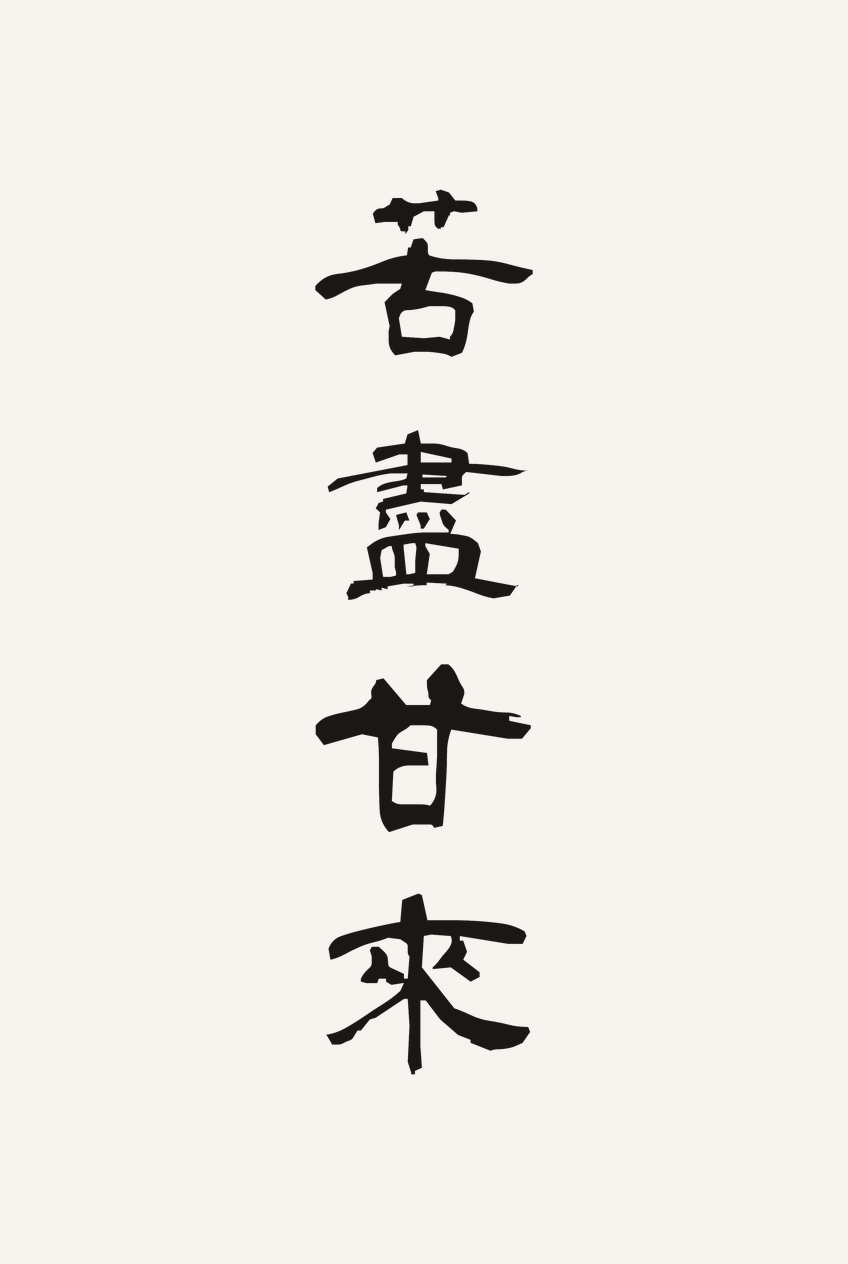
苦尽甘来 · Kǔ Jìn Gān Lái
Bitterness Ends; Sweetness Arrives
系列: 吉语成语 · Design #26
笔法: four characters, vertical column · clerical script (lishu) · traditional form 苦盡甘來 · medium
形态: 四字竖列,隶书
名字
苦的用尽,甘的到来。任何语言里最常被纹身的句子,也是最诚实的句子:它不承诺甜可以脱离苦存在——它承诺的是一个次序。苦在前,甜在后;先尽,后来。全世界的救赎叙事都跑在这个语法上,从监狱纹身到戒瘾奖章。纹上苦盡甘來的,多是还在苦的那一半里、需要这个句子有个下文的人。
Bitterness runs out; sweetness comes in. The most tattooed sentiment in any language, and the most honest: it does not promise that sweetness exists without bitterness — it promises an ordering. Bitter first, sweet after; end and arrival, in that sequence. Redemption narratives worldwide run on this grammar, from prison tattoos to recovery medallions. As a tattoo, 苦盡甘來 is worn by people who are still in the bitter half and need the sentence finished.
出处
民间谚语,元杂剧定型:「苦盡甘來」在元曲与明代小说(《西遊記》《牡丹亭》)中均有用例。诚实注:先秦经典没有四字连文;它的义理属于民间智慧——带有承诺弧线的忍耐。我们断代为民间晚出,并如实说明。墨线转写:本设计以传统母题的经典线条造型为底,转写为纹身墨线。
A folk proverb fixed by Yuan-dynasty drama: 王實甫《西廂記》has 不見了糖,苦也甜… and the form 苦盡甘來 appears in 元曲 and Ming fiction (《西遊記》《牡丹亭》用例). Honest note: no pre-Qin classic prints the four characters; the doctrine belongs to folk wisdom — endurance with a promised arc. We date it as folk-late and say so. Inking note: this design adapts the classic line construction of the traditional motif and re-inks it as tattoo linework.
设计灵感
本设计的每一处形制决定都有出处可查,逐条对账。① 四字竖列——两种味道两两成对:苦/尽在上,甘/來在下;纹身本身就是那个转折点。② 隶书、繁形「苦盡甘來」——「盡」致密的盘点(把苦的东西一件件列清)压在「來」敞开的抵达之上。③ 中尺寸——12–14 厘米。④ 只用墨——设计的主张靠结构说出,不靠颜色。
Every form decision points to a recorded source, element by element. ① Four characters, one vertical column — the two tastes paired two-by-two: bitter/exhausted above, sweet/arriving below; the tattoo is the pivot itself. ② Clerical script, traditional form 苦盡甘來 — 盡's dense inventory (bitter things, itemized) sits over 來's open arrival. ③ Medium scale — 12–14 cm. ④ Black ink only — the design states its claim in structure, not color.
来历
这句话的盛名在戏台上:观众看着角色失去一切——家、身份、爱——然后靠剧作家的慈悲或自己的忍耐,把它赢回来。谚语是戏台与观众的合同:苦只有在弧线闭合时才看得下去。观众知道、角色后来才明白的,是这个句子的机关:盡才是关键字。苦不是淡去;苦是「用完」——像药剂的剂量用完、刑期结束、债务清零一样地尽。苦有底,而这个底是承重墙。
这就是为什么这四个字总被纹在艰难故事的中段,而不是结尾。这个纹身不是凯旋绕场;它是仍在写后半篇的人的论点陈述——值夜班的护士、候诊室里的家长、月底的负债人。它说:剂量会尽。甘不是天真;甘是日程。
The phrase's fame lives in theater: audiences who watched characters lose everything — family, status, love — and then, by the playwright's mercy or their own endurance, win it back. The proverb is the theater's contract with its audience: suffering is watchable only if the arc closes. What the audiences knew, and the characters learned, is the phrase's secret: 盡 is the operative character. Bitterness does not fade; it finishes — it runs out the way a dose runs out, a sentence, a debt. The bitter has a bottom, and the bottom is load-bearing.
This is why the four characters are worn at the midpoint of hard stories, not after them. The tattoo is not a victory lap; it is the thesis statement of someone still writing the second half — the nurse on nights, the parent in the waiting room, the debtor at month's end. It says: the dose ends. Sweetness is not naïveté; it is schedule.
释义
给身处苦的那一半的人——治疗中、恢复中、重建中。它不催你;它只坚持事物的次序:先尽,后來。
For anyone inside the bitter half — mid-treatment, mid-recovery, mid-rebuild. It does not rush you; it only insists the order of things: 尽 before 來.
位置
四字,一个平面:小臂内侧最佳,脊柱、肋侧(私人读法)次之。12–14 厘米可读;低于 9 厘米「盡」的密度会糊。
Four characters, one plane: inner forearm best, spine, ribcage for the private reading. 12–14 cm legible; below 9 cm the 盡 density clogs.
纹之前
四个字就是全部设计。 ② 繁形「苦盡甘來」。 ③ 隶书、体量平正。 ④ 9 厘米起,「盡」的密度才立得住。⑤ 次序就是一切。 两半对调,它就变成一句抱怨。每天向下读:这个纹身的论证就是方向本身。
Four characters are the whole design. ② Traditional form 苦盡甘來. ③ Clerical script, level weight. ④ Minimum 9 cm for 盡's density. ⑤ The order matters. Swap the halves and it becomes a complaint. Read it downward every day: the tattoo's argument is the direction.
本卡每一个汉字都由中文母语者选定并逐笔核对。