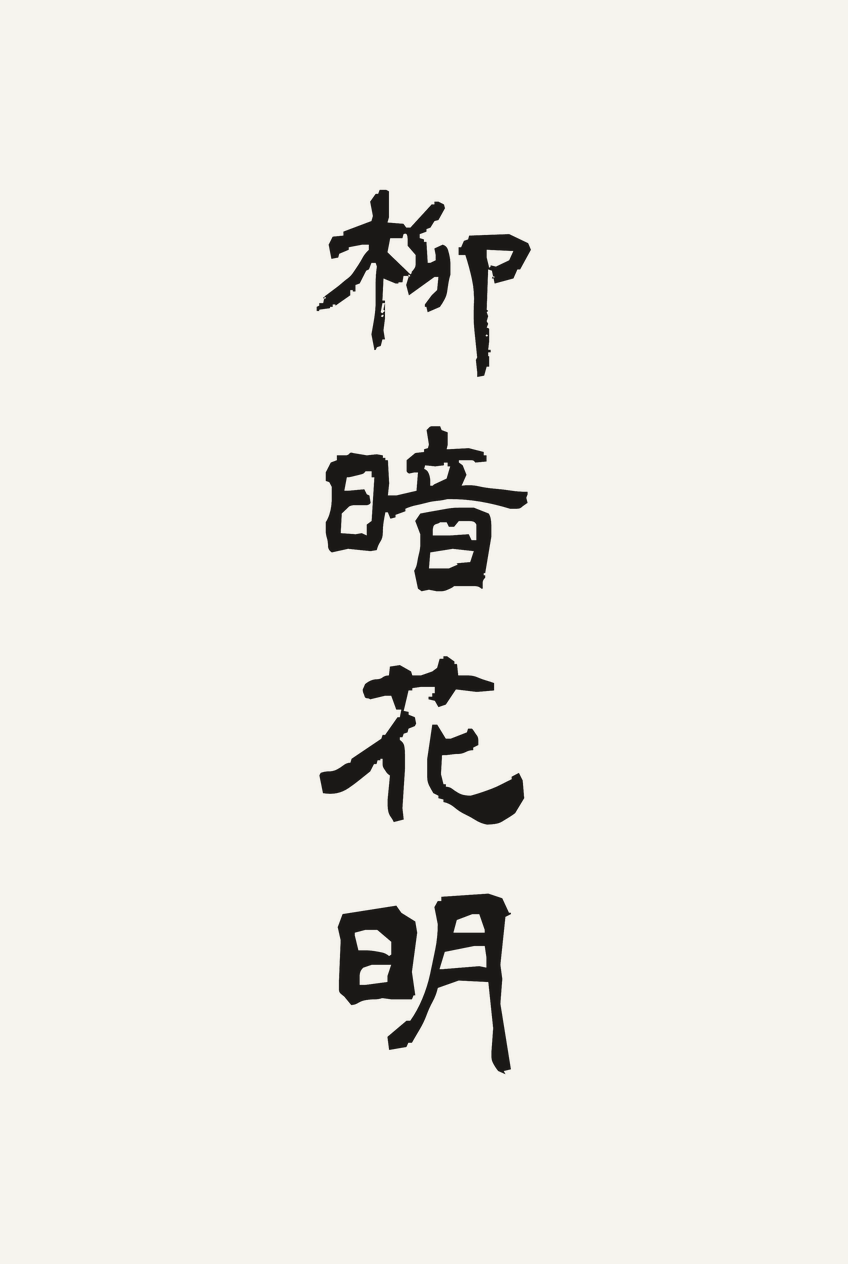
柳暗花明 · Liǔ Àn Huā Míng
Willows Dark, Flowers Bright
系列: 吉语成语 · Design #17
笔法: four characters, vertical column · clerical script (lishu) · same form 柳暗花明 · medium-to-large
形态: 四字竖列大字,隶书
名字
柳暗花明——柳色沉暗,花光明亮。四个音节压着一整幅山水:你正跋涉的那段柳荫幽岸,和只隔一道弯、藏着的满树繁花。它是「站在原地看不见的转机」的成语——不是路的尽头,是发现这条路原来有弯。纹下它的人,都至少绕过一次弯,并且不打算忘记。
*Liǔ àn huā míng* — willows dark, flowers bright. A complete landscape compressed into four syllables: the shadowed willow bank you are plodding through, and the bright blossoming that was hidden one bend ahead. It is the idiom for the rescue you could not see from where you stood — not the end of the road, but the discovery that the road had a bend. As a tattoo, it is worn by people who have been around at least one bend and do not intend to forget it.
出处
陆游《游山西村》,1168 年:山重水複疑無路,柳暗花明又一村——山峦重叠水道交缠,我疑心路已经没了;柳色沉暗花光明亮——又出现一座村子。写下它时陆游刚被罢官,正在家乡山里把失意走出来。四个字是从联句里直接取的,那是这门语言里被引用最多的诗句之一。墨线转写:本设计以传统母题的经典线条造型为底,转写为纹身墨线。
Lu You, 《游山西村》, 1168: 山重水複疑無路,柳暗花明又一村 — "mountains doubled, streams braided, I suspected the road was gone; willows dark, flowers bright — another village." Written after Lu You was dismissed from office and was walking off the disappointment in his home hills. The four characters are a direct lift from the couplet, one of the most quoted lines in the language. Inking note: this design adapts the classic line construction of the traditional motif and re-inks it as tattoo linework.
设计灵感
本设计的每一处形制决定都有出处可查,逐条对账。① 四字竖列——联句自己的节奏:两拍暗,两拍明。② 隶书、同形「柳暗花明」——「柳」低垂的木旁对着「明」敞开的日与月:同一列里,荫与光共处。③ 中到大尺寸——小臂 12–15 厘米;压缩到这种程度的山水需要够宽的笔画才盛得下两种天气。④ 只用墨——光靠对比建成,不靠颜色。
Every form decision points to a recorded source, element by element. ① Four characters, one vertical column — the couplet's own rhythm: two beats dark, two beats bright. ② Clerical script, same form 柳暗花明 — the willow's drooping 木 radical against 明's open sun-and-moon: shade and light sharing one column. ③ Medium-to-large scale — 12–15 cm forearm; a landscape this compressed needs strokes wide enough to hold both weathers. ④ Black ink only — the light is built by contrast, not by color.
来历
诗句背后那次散步:一位四十多岁、罢职还乡的前官员,在绍兴附近的山里走路消愁。联句前半是真真切切的行旅绝望——山重水复,路径折回来折过去,直到根本没有路。然后山水转弯了:柳荫加深,花光打开,一座本来就在那里的村子露出来,只隔一道看不见的山脊。陆游没有写「相信自己」。他写的是经验事实:路在你看不见它的时候就已经存在。
这才是成语的脊梁:柳暗花明不是乐观主义——它是一段关于险途的「光学事实」的记录。从重山内部,「无路可走」像数据;其实它是采样误差。此后这个词走进每一场关于「无可挽回」的中文谈话:落榜的、沉船的、结束的感情——以及之后出现的村子。纹在皮肤上,它保留了原始的诚实:它不承诺弯就在前面。它只承诺地图上有弯。
The walk behind the line: a former minister, forty-something, sent home without a post, tramping through the hills near Shaoxing. The first half of the couplet is a genuine traveler's despair — the path doubled back on itself until there was no road at all. Then the landscape turned: a willow shade deepening, blossom light opening, and a village that had been there all along, one ridge out of sight. Lu You did not write "believe in yourself." He wrote the empirical fact: the road existed before the seeing of it.
That is the idiom's spine: 柳暗花明 is not optimism — it is the record of an optical fact about hard passages. From inside the doubled mountains, "no way forward" feels like data; it is actually a sampling error. The phrase has since walked into every Chinese conversation about the unrecoverable: exams failed, ventures sunk, loves ended — and the village that appeared after. Worn on skin, it keeps the original honesty: it does not promise the bend is near. It promises only that the map has bends.
释义
给正处在重山里的人——失业的、被拒的、路折出视野的。它不是喝彩;它是更正:路的消失是「视野」的事实,不是「路」的事实。
For the ones inside the doubled mountains — the jobless, the rejected, the ones whose road has folded out of sight. It is not a cheer; it is a correction: the road's disappearance is a fact about the view, not the road.
位置
四字,一个平面:小臂内侧、脊柱、沿锁骨到肩的线。12–15 厘米读作一幅山水;低于 10 厘米「暗」与「明」的对比会被抹平。
Four characters, one plane: inner forearm, spine, along the collarbone-to-shoulder line. 12–15 cm reads as a landscape; below 10 cm the 暗 and 明 contrast flattens.
纹之前
四个字就是全部设计。 暗的那一半承重——只留「柳暗」就成了悲伤纹身。② 同形「柳暗花明」——简繁同形。③ 隶书保持平。 荫与光需要同一只稳定的手。④ 10 厘米起。 ⑤ 当作记录戴,别当作许愿。 这句话要绕过一次弯才算挣得。如果你还在山中段,它是地图——也可以。弄清自己戴的是哪一个。
Four characters are the whole design. The dark half is load-bearing — 柳暗 alone is a sad tattoo. ② Same form 柳暗花明 — identical in traditional script. ③ Clerical script stays level. Shade and light need the same steady hand. ④ Minimum 10 cm. ⑤ Wear it as a record, not a wish. This phrase is earned by having already come around one bend. If you are still mid-mountain, it is a map — also fine. Know which one you are wearing.
本卡每一个汉字都由中文母语者选定并逐笔核对。