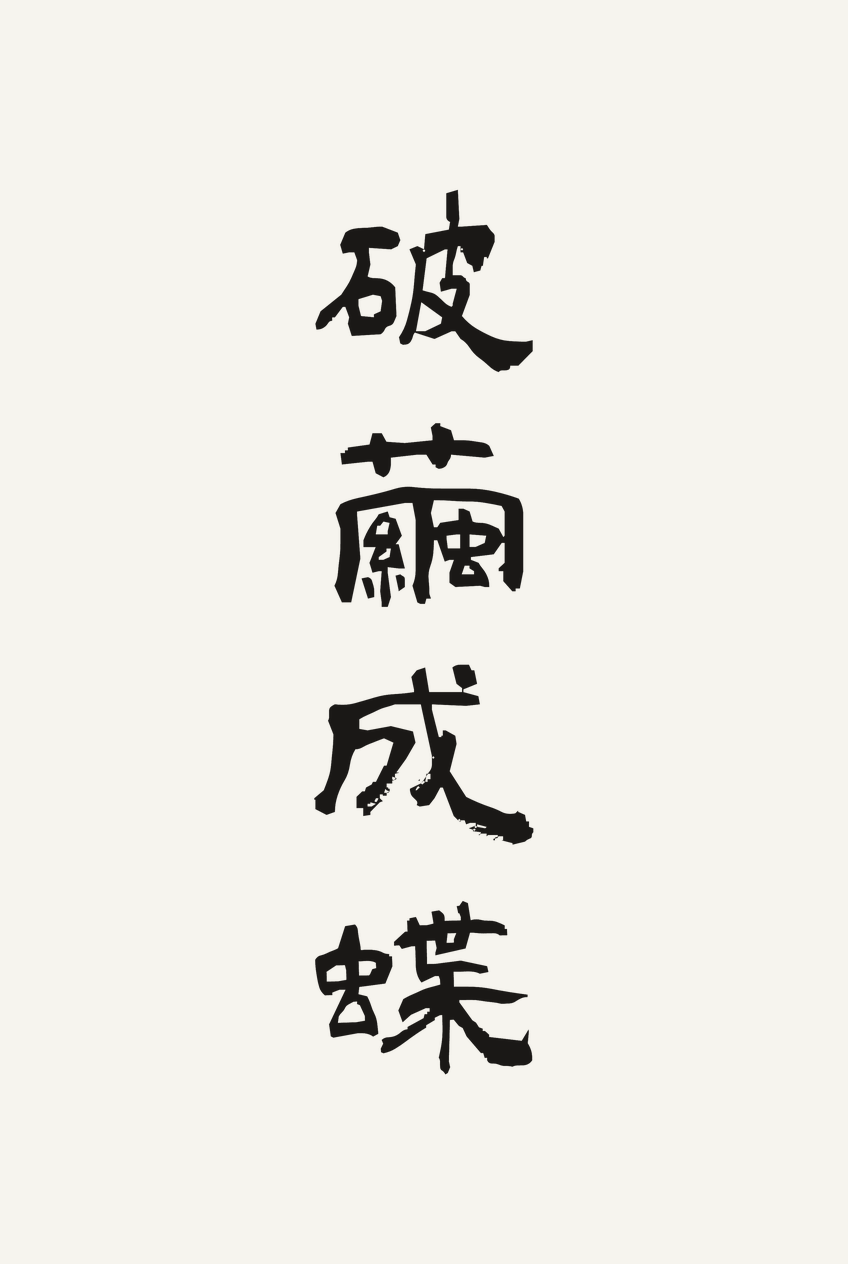
破茧成蝶 · Pò Jiǎn Chéng Dié
Break the Cocoon, Become the Butterfly
系列: 吉语成语 · Design #16
笔法: four characters, vertical column · clerical script (lishu) · traditional form 破繭成蝶 · medium-to-large
形态: 四字竖列大字,隶书
名字
破茧成蝶——咬破茧,成了蝶。这个现代成语讲的是记录在案的最古老的变形剧本:一段逼仄、潮湿、看不见的阶段,终点是翅膀。它比大多数蜕变口号诚实——蝶不是被找到的,是「破」这个动作做成的,而破茧只能由里面的那个完成。纹下它,是标记一场从内部付清了账的转变。
*Pò jiǎn chéng dié* — break the cocoon, become a butterfly. The modern idiom for the most ancient transformation plot on record: the restricted, wet, blind phase that ends in wings. It is honest in a way transformation slogans rarely are — the butterfly is not found; it is made by the breaking, and the breaking is done by the one inside. As a tattoo, it marks a change you paid for from the inside.
出处
四字成句是现代的;义理不是——我们绝不伪托一句古董引文。它的两条根都扎得深:茧的意象来自比文字更老的蚕桑文明;庄子(《齐物论》)让蝴蝶成为「自我变得连前一个自己都无法核对」的正典形象——昔者莊周夢為胡蝶。成语把两者焊在一起:茧的劳动,蝶的存在论升级。墨线转写:本设计以传统母题的经典线条造型为底,转写为纹身墨线。
The four-character phrase is modern; the doctrine is not, and we do not fake an antique quote. Its two roots run deep: the silk-husbandry imagery of the cocoon is older than writing itself, and Zhuangzi's butterfly dream (《齐物论》) made the butterfly the canonical figure of a self changing so completely it cannot check its own previous identity — 昔者莊周夢為胡蝶. The idiom welds the two: the cocoon's labor, the butterfly's ontological upgrade. Inking note: this design adapts the classic line construction of the traditional motif and re-inks it as tattoo linework.
设计灵感
本设计的每一处形制决定都有出处可查,逐条对账。① 四字竖列——两幕剧情叠置:上面是破,下面是成。② 隶书、繁形「破繭成蝶」——「繭」的致密丝纹承住受困阶段的重量;「蝶」张开的双翅落成整列最宽的字。③ 中到大尺寸——12–15 厘米;变形需要弧线的空间。④ 只用墨——蝶抵达墨里的方式与它抵达自然的方式一致:不预告,就完整。
Every form decision points to a recorded source, element by element. ① Four characters, one vertical column — the two-part plot stacked: the break above, the becoming below. ② Clerical script, traditional form 破繭成蝶 — 繭's dense silk-work carries the weight of the confined phase; the spreading wings of 蝶 land as the column's widest character. ③ Medium-to-large scale — 12–15 cm; the metamorphosis needs room to arc. ④ Black ink only — the butterfly arrives in ink the way it arrives in nature: unannounced, complete.
来历
从蚕说起,因为中国就是这么开始的。五千年的丝意味着茧在这里最初从不是隐喻——它是产业、是账本、是一条向西的路。每个从手上先懂得这个道理的人都明白:没有人能从外面打开一只茧。哪怕出于好意剪开它,也会把正在改稿中的蛹杀死。那个生灵必须自己劈开自己的牢,而挣扎不是翅膀的障碍——翅里的充实靠的正是它。
庄子负责提供眩晕。他梦见自己是蝴蝶,醒来后没有按你预期的方向收束问题:哪个是梦——梦见蝴蝶的人,还是此刻梦见人的蝴蝶?这个成语接住这份未定的轻,并给它一根脊梁:身份不是固定的财产,是一段有潮湿中段的过程。每个重建过自己的人——康复的、移民的、从错误人生里长期撤退的——都认识那个中段:黑、不体面、无观众。这个纹身只对那个中段承诺一件事:它是蛹,不是墓。它从里面开。
Start with the silkworm, because China did. Five thousand years of silk means the cocoon was never a metaphor here first — it was an industry, an economy, a road west. The lesson everyone's hands knew before any poem recorded it: no one can open a cocoon from outside. Cutting it open, even kindly, kills the chrysalis mid-edit. The creature must split its own prison, and the struggle is not an obstacle to the wings — the wing-filling depends on it.
Zhuangzi supplies the vertigo. He dreams he is a butterfly, wakes, and does not settle the question in the direction you expect: which is the dream — the man who dreamed the butterfly, or the butterfly now dreaming the man? The idiom takes this unresolved lightness and gives it a spine: identity is not a fixed possession but a process with a wet middle. Everyone who has rebuilt themselves — recovery, emigration, the long exit from a wrong life — knows the middle: dark, unglamorous, unstaged. The tattoo promises exactly one thing about that middle: it is a chrysalis, not a tomb. It opens from the inside.
释义
给正处在潮湿中段的人——戒断的、康复的、迁居的、亲手撕掉自己旧形状的所有人。它不为蝴蝶的好看颁奖;它认证那次「破」属于你。
For the ones inside the wet middle — the sober, the recovered, the relocated, anyone who tore their own old shape. It does not celebrate the butterfly for being pretty; it certifies the breaking as yours.
位置
四字,一个平面:小臂内侧、脊柱、从胸骨扫向肋侧的弧面。12–15 厘米;低于 10 厘米「繭」的内部会糊成噪点。
Four characters, one plane: inner forearm, spine, over the sternum-to-ribs sweep. 12–15 cm; below 10 cm the 繭 interior turns to static.
纹之前
四个字就是全部设计。 只留「破茧」就丢了「成」。② 繁形「破繭成蝶」。 致密的「繭」就是用笔画写出的受困阶段。③ 隶书保持平。 平静正是重点——戏剧性属于句子,不属于手。④ 10 厘米起,「繭」的内部才立得住。⑤ 转述时别跳过挣扎。 这是成语的荣誉制:破茧的是谁,翅膀就长在谁身上。
Four characters are the whole design. 破茧 alone loses the becoming. ② Traditional form 破繭成蝶. The dense 繭 is the confined phase rendered in strokes. ③ Clerical script stays level. The calm is the point — the drama belongs to the sentence, not the hand. ④ Minimum 10 cm for 繭's interior. ⑤ Do not skip the struggle in retelling. The idiom's honor system: the one who broke the cocoon is the one wearing the wings.
本卡每一个汉字都由中文母语者选定并逐笔核对。