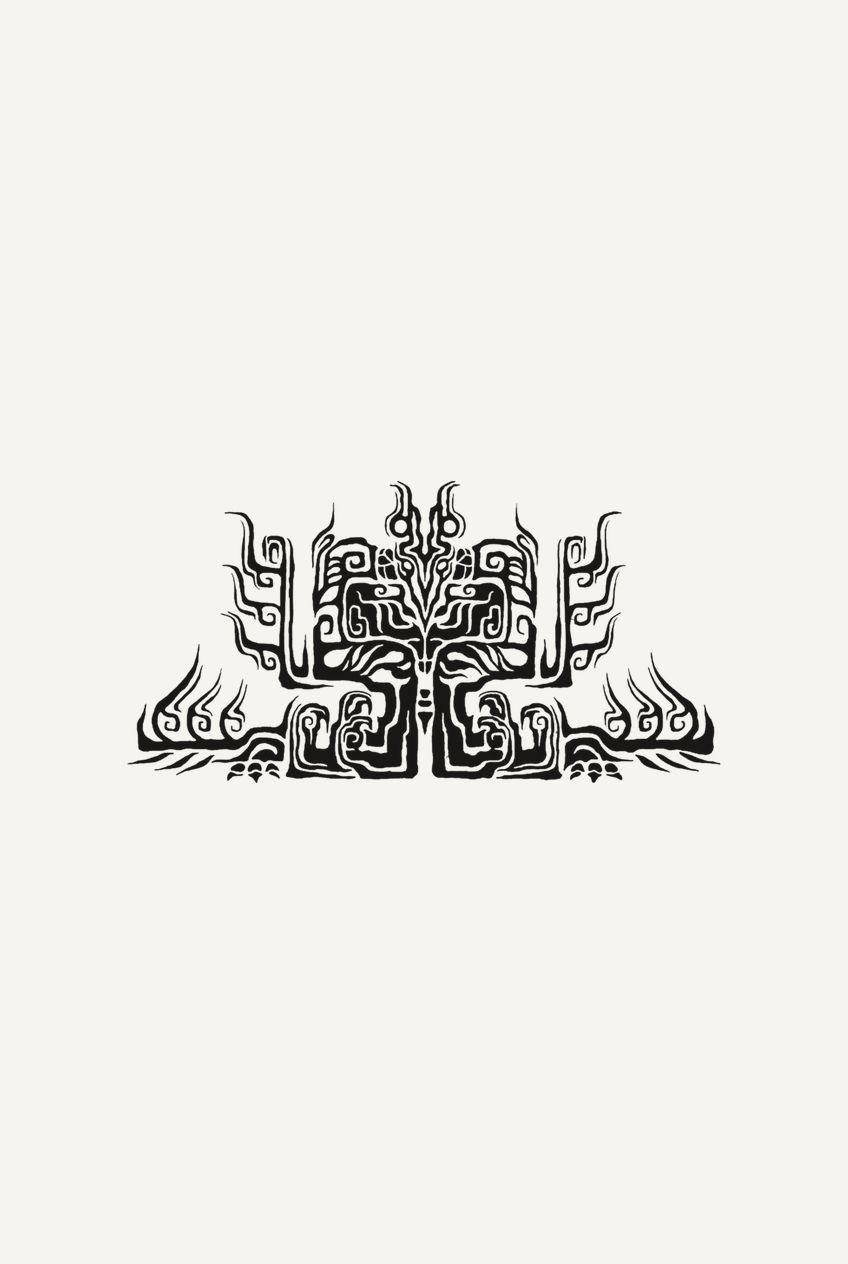
鬿雀 · Qí Què
Also a Man-Eater
系列: 神兽灵禽 · Design #29
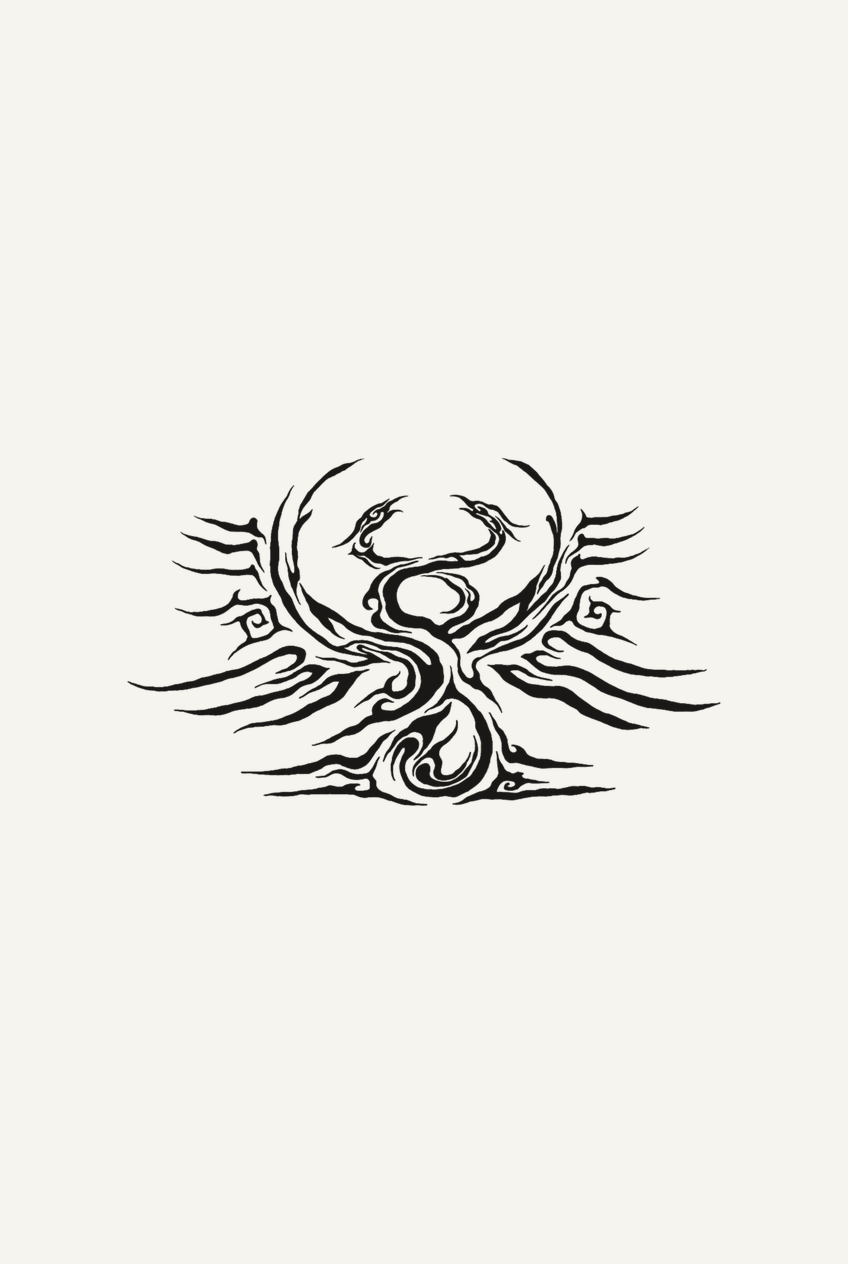
笔法: Fully symmetric banner drawn in bronze-motif grammar: a flame-crested axis, scroll-hook thunderwork spreading both ways, tiger-claw units at the base, feather-flames curling outward · black-grey · mirrored composition · scalable 12–16 cm
形态: 鬿雀青铜纹样式全对称横幅,中轴冠羽如焰,两侧卷钩雷纹展开,下部虎爪单元,焰形羽卷,镜面对称构图
名字
鬿雀(qí què)——条目收在全书最轻的一个字上的鸟:亦食人——*也*吃人。前一行刚写完一头食人的狼,到它这里只分到半句,像往库存单上随手补的一条。整部经典里所有的恐怖,没有一条比这更漫不经心。本设计按经文的语气来画这个威胁:画成纹样——把危险折进青铜纹饰的严格对称里,正如那个「亦」字把一场杀戮折进一份清单里。
*qí què* — the bird whose entire entry ends on its quietest word: 亦食人 — *also* eats people. The line before it has just finished describing a man-eating wolf; this one gets half a clause, as if being added to a stock list. Of all the horrors in the classic, none is delivered more casually. The design draws the threat the way the text delivers it: as ornament — danger folded into the strict symmetry of bronze pattern, the way "also" folds a killing into an inventory.
出处
《山海经·东次四经》(约成书于前 4—前 2 世纪)北号之山条:「有鸟焉,其状如鸡而白首,鼠足而虎爪,其名曰鬿雀,亦食人。」形如鸡而白首,鼠足虎爪;名叫鬿雀;*也*吃人。上一句里的狼形兽是明明白白的食人;这只鸟只是顺带入了档。《楚辞》(约前 3 世纪)在《天问》里追问它:「鯪鱼何所,鬿堆焉处?」——鬿堆在哪里?——足见这半句话的鸟,在古人的想象里盘踞得远比它的篇幅深远。墨线转写:白首以形制记之,本设计为黑灰墨线稿。
The *Shanhaijing*, *Dong Ci Si Jing* chapter (compiled c. 4th–2nd century BC), Beihao Mountain entry: 「有鸟焉,其状如鸡而白首,鼠足而虎爪,其名曰鬿雀,亦食人。」 — shaped like a chicken with a white head, rat-like feet and tiger claws; named Qique; *also* eats people. The beast in the preceding clause — a red-headed wolf — eats people outright; the bird merely joins the category. The *Chu Ci* (Songs of Chu, c. 3rd century BC) asks after it in the *Tian Wen*: 「鯪鱼何所,鬿堆焉处?」 — where does the Qidue dwell? — proof that this bird haunted the ancient imagination far beyond its half-line of prose. Inking note: the white head is honored in form; this design is inked in black-grey.
设计灵感
本版每一处形制决定都有出处可查,逐条对账。① 焰形冠羽的中轴——「白首」,所记的白首画成镜像线顶端一枚浅色冠羽单元:整张脸被化约为一段冠羽,正如经文把它化约为半句话。② 卷钩雷纹的双翼——鸟形被译成青铜语法:卷钩纹自中轴展开,是「纹样作者」说「这是一只鸟」的方式——形被译作纹饰。③ 底部的虎爪单元——「虎爪」,所记的爪画成一对锚定单元:经文里唯一不带限定语给出的身体部件,放在落重的地方。④ 全对称构图——全图的论点:青铜纹饰是加诸「不安稳之物」的秩序——礼器用这套语法收编野性,这里收编的是一只「也」吃人的东西。
Every form decision on this design points to a recorded source, element by element. ① The flame-crested central axis — 白首, the recorded white head drawn as a pale crowned unit at the top of the mirror line: the bird's whole face reduced to a crest, the way the text reduces it to a clause. ② The scroll-hook thunderwork wings — its bird-form translated into bronze grammar: 卷钩纹 spreading from the axis like the pattern-writer's way of saying "a bird," form rendered as ornament. ③ The tiger-claw units at the base — 虎爪, the recorded claws drawn as paired anchor elements: the one part of the anatomy the text gives without qualification, set where the weight lands. ④ The mirrored symmetry — the design's thesis: bronze decoration is order imposed on the unsafe — the same grammar ritual bronzes used to contain the wild, here containing a thing that "also" eats people.
来历
《山海经》里最吓人的词不是一个怪物的名字。是那两笔的「亦」——"also"——而这只鸟是它的主人。按顺序读条目:一头红首鼠目的狼,哭声如豚,食人;紧接着,一口气没换完:有一种鸟,状如鸡,白首,鼠足,虎爪,名叫鬿雀——*也*吃人。不是「吞食行人」,不是「国人皆惧」。它是被归档的,像文书往表格里补第二条危险品,把恐怖压缩成簿记。这部经典里的恐惧通常很响——征兆、洪水、大荒。这里它是一种语气:公事公办的低语,说危险已成常态,一条记录,再无后续。
然而古人放不下它。三个世纪后,《天问》——屈原那份无解问题的清单——停下来问了一句:鬿堆在哪里?半行散文,变成了一桩问天的问题。被轻描淡写归档的威胁,下场地全是这个:文本翻页了,读者没有。
所以纹它,纹的是什么?这是给懂「亦」字手感的人的设计——曾眼睁睁看着庞然之物被折进一个寻常句子里的人:诊断写在脚注里,损失列在「其他」项下。纹鬿雀不是否认事实,是拒绝那个语气:你把危险钉进硬朗的对称线条里,用纹饰给它礼遇,把它从页边挪回正文。轻描淡写处,最重。
The most frightening word in the Shanhaijing is not a monster's name. It is the two-stroke character 亦 — "also" — and the bird owns it. Read the entry in sequence: a wolf with a red head and rat eyes cries like a pig and eats people; then, one breath later: there is a bird, chicken-shaped, white-headed, rat-footed, tiger-clawed, named Qique — *also* eats people. Not "devours travelers." Not "is feared." It is filed the way a clerk adds a second dangerous item to a form, the horror compressed into bookkeeping. Fear in this classic is usually loud — omens, floods, famines. Here it is a tone of voice: the bureaucratic murmur that says the danger is now normal, a line item, nothing further to report.
And yet the ancients could not leave it alone. Three centuries later the *Tian Wen* — Qu Yuan's catalogue of unanswerable questions — pauses to ask where the Qidue dwells. Half a line of prose became one of heaven's unanswered questions. That is the whole tragedy of casually filed threats: the text moves on, the readers do not.
So what does it mean to wear it? This is a design for people who know how "also" feels — who have watched something enormous get folded into an ordinary sentence: the diagnosis delivered as a footnote, the loss listed under "other." Wearing the Qique is refusing the tone, not the fact: you pin the danger down in hard symmetric lines, honor it with ornament, and take it out of the margin. 轻描淡写处,最重。
释义
只分到一个词的威胁,重画成整幅横幅。危险从脚注晋升为画面中心——对称,受礼遇,无法被一眼扫过。
The threat that got one word, redrawn to take a whole banner. Danger promoted from footnote to centerpiece — symmetric, honored, impossible to skim past.
位置
天生的宽幅镜像构图:12—16 厘米横贯后背或胸口,对称在平面上读法最真;10 厘米变体收小臂。中轴务必放平——斜了的镜像会把不安引向错误的方向。
Built wide and mirrored: 12–16 cm across the upper back or chest, the symmetry reading best on a flat plane; a 10 cm variant sits on the forearm. The axis must run level — a tilted mirror doubles the unease in the wrong way.
纹之前
此图只宜墨线。卷钩纹需要锋利的留白——黑让青铜语法保持金属感,灰阶会把纹饰糊成污渍。最小尺寸 10 厘米:再小,卷纹桥接,镜像塌成一团。避开侧腰——那里的摩擦最先增粗细卷纹,而这套纹样必须始终可读为「秩序」。
This design belongs to ink only. The scroll-hook work needs crisp negative space — black keeps the bronze grammar metallic; greyscale turns ornament into smudge. Minimum size 10 cm: below that the scrollwork bridges and the mirror collapses into a blob. Keep it off the waist side — friction there fattens the fine scrolls first, and the pattern must stay legible as order.
本卡每一个汉字都由中文母语者选定并逐笔核对。