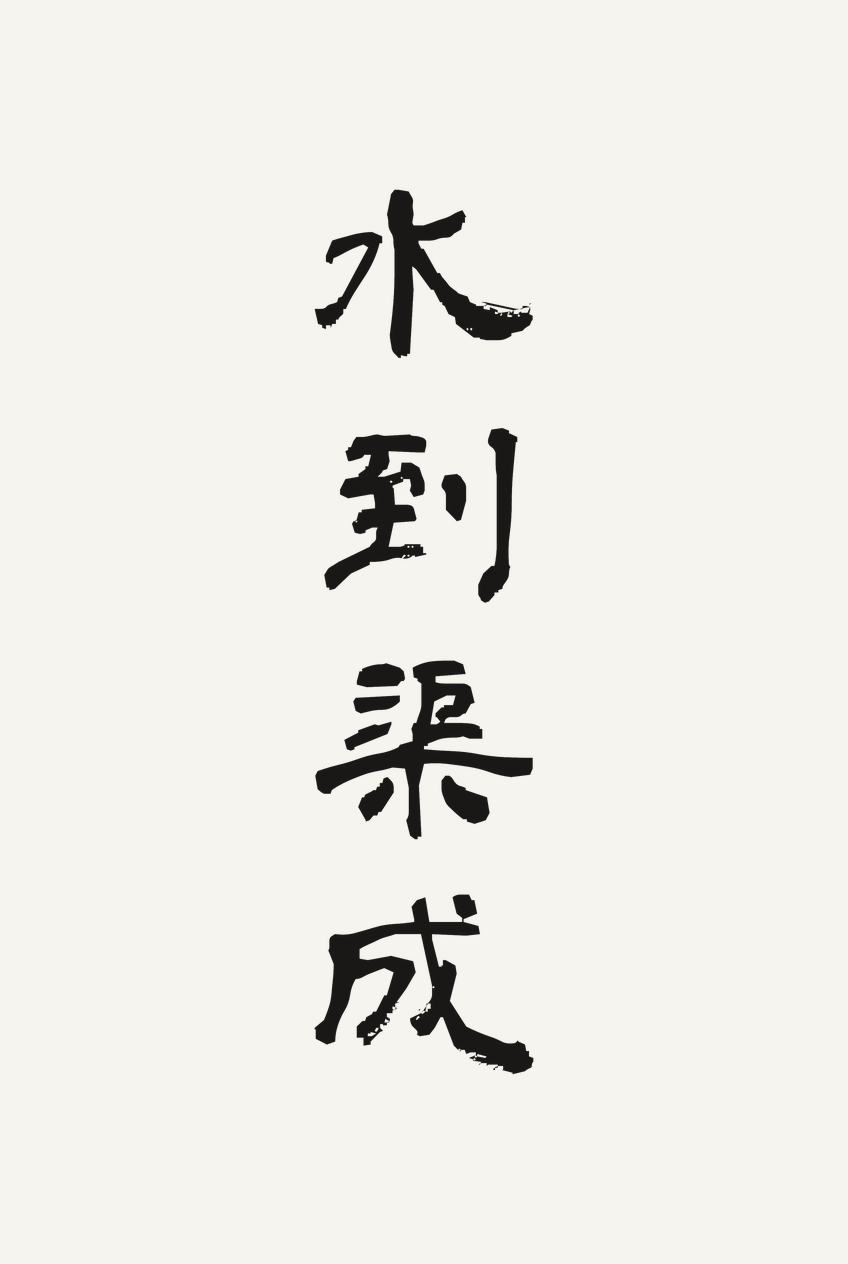
水到渠成 · Shuǐ Dào Qú Chéng
Water Arrives, the Channel Forms
系列: 吉语成语 · Design #15
笔法: four characters, vertical column · clerical script (lishu) · same form 水到渠成 · medium-to-large
形态: 四字竖列大字,隶书
名字
水到渠成——水到了,渠就成。一条穿着谚语外衣的工程学隐喻:雨前先把沟挖好,水流自会收尾。它说的是「预备者」的耐心——提前做完那些不体面的功课,并且拒绝伪造最后那百分之十。纹下它,是允许你相信自己已经做完的那部分。
*Shuǐ dào qú chéng* — when the water arrives, the channel forms. An engineering metaphor wearing a proverb's clothes: dig the ditch before the rain, and the current will do the finishing. It is the patience of people who prepare — who do the unglamorous work in advance and refuse to fake the last ten percent. As a tattoo, it is permission to trust the work you have already done.
出处
苏轼《答秦太虚书》教秦观怎么靠固定开销在贬所活下去:至时别作经画,水到渠成,不须预虑。这个成语是替一个过日子的人记账的直接引语:今天做今天的实事,拒绝预支明天的愁。墨线转写:本设计以传统母题的经典线条造型为底,转写为纹身墨线。
Su Shi, in a letter to Qin Guan (《答秦太虚书》), advising how to survive exile on a fixed budget: 至时别作经画,水到渠成,不须预虑 — "when the time comes, plan again; when water arrives the channel forms — no need to borrow worry." The idiom is a direct quote of a working man's bookkeeping: do today's real work, refuse tomorrow's fake worry. Inking note: this design adapts the classic line construction of the traditional motif and re-inks it as tattoo linework.
设计灵感
本设计的每一处形制决定都有出处可查,逐条对账。① 四字竖列——如信中原句的落法:先陈述,后嘱咐。② 隶书、同形「水到渠成」——「渠」的水旁锚住隐喻;隶书的水平横读作水面找平。③ 中到大尺寸——小臂 12–15 厘米;这句谚语配得上一整条肢体的长度。④ 只用墨——设计的主题就是水;载体本身已经在流动。
Every form decision points to a recorded source, element by element. ① Four characters, one vertical column — the sentence as it falls in the letter: statement, then instruction. ② Clerical script, same form 水到渠成 — the water radical in 渠 anchors the metaphor; lishu's level horizontals read as water finding its own level. ③ Medium-to-large scale — 12–15 cm forearm; the proverb earns a full limb-length run. ④ Black ink only — the design's subject is water; the medium already moves.
来历
成语背后的那封信:苏轼贬到黄州,写信给后辈谈钱。他的建议不是表演旷达,是算术——他把开销分成三十串挂在房梁上,每天早晨取下一串。那四个著名的字就落在这段琐碎的记账中间:钱不够时再作打算——水到渠成,不须预虑。这门语言里被引用最多的耐心成语,出自一个数着米粒过日子的手笔。
这正是短语的妙处与底气:它不是玄学。渠不会自己挖成,水也不靠信心倾泻。能挖的时候挖;水该来的时候来;两者相遇,事就成了。生活里所有真实的等待都是这个形状——考试、康复、书稿、悲恸。把能挖的挖完。剩下的归入物理。
The letter behind the idiom: Su Shi, demoted to Huangzhou, writing to a younger friend about money. His advice was not stoic posture but arithmetic — he had divided his allowance into thirty packets, hung them on a beam, and taken one down each morning. The famous four characters come in the middle of this mundane budgeting: when the money runs short, plan again then — water to, channel formed, no need to pre-worry. The most quoted proverb of patience in the language was written by a man counting his rice.
That is the joke and the strength of the phrase: it is not mysticism. The channel does not dig itself, and the water does not pour by faith. You dig when digging is possible; the water arrives when it arrives; the two meet and the thing completes. Every real waiting in life has this shape — the exam, the recovery, the manuscript, the grief. Do your diggable part. The design files the rest under physics.
释义
给等待中的人——正在为某件时辰不由己的事做准备的人:赶考的、养病的、造任何慢东西的。它画出责任的边界线:水边之前的一切归你;水边之后的一切归水文学。
For the waiters — the ones mid-preparation for something whose timing is not theirs: the applicant, the patient, the builder of anything slow. It marks the boundary line of responsibility: everything up to the water's edge is yours; everything past it is hydrology.
位置
四字,一个平面:小臂内侧(竖列随肢体走)、脊柱、小腿。12–15 厘米读作一条工作箴言;低于 10 厘米「渠」的笔画会挤。
Four characters, one plane: inner forearm (the column follows the limb), spine, calf. 12–15 cm reads as a working motto; below 10 cm the 渠 strokes crowd.
纹之前
四个字就是全部设计。 ② 同形「水到渠成」——此句简繁同形,无可转换。③ 隶书保持平。 那些横就是水位线。④ 10 厘米起。 ⑤ 它是边界,不是摇篮曲。 你那部分没挖,这个纹身就不成立。没有挖功的渠是愿望,不是谚语。
Four characters are the whole design. ② Same form 水到渠成 — the phrase is identical in traditional script; nothing to convert. ③ Clerical script stays level. The horizontals are the water line. ④ Minimum 10 cm. ⑤ It is a boundary, not a lullaby. The tattoo only works if your part is dug. A channel with no digging is a wish, not a proverb.
本卡每一个汉字都由中文母语者选定并逐笔核对。