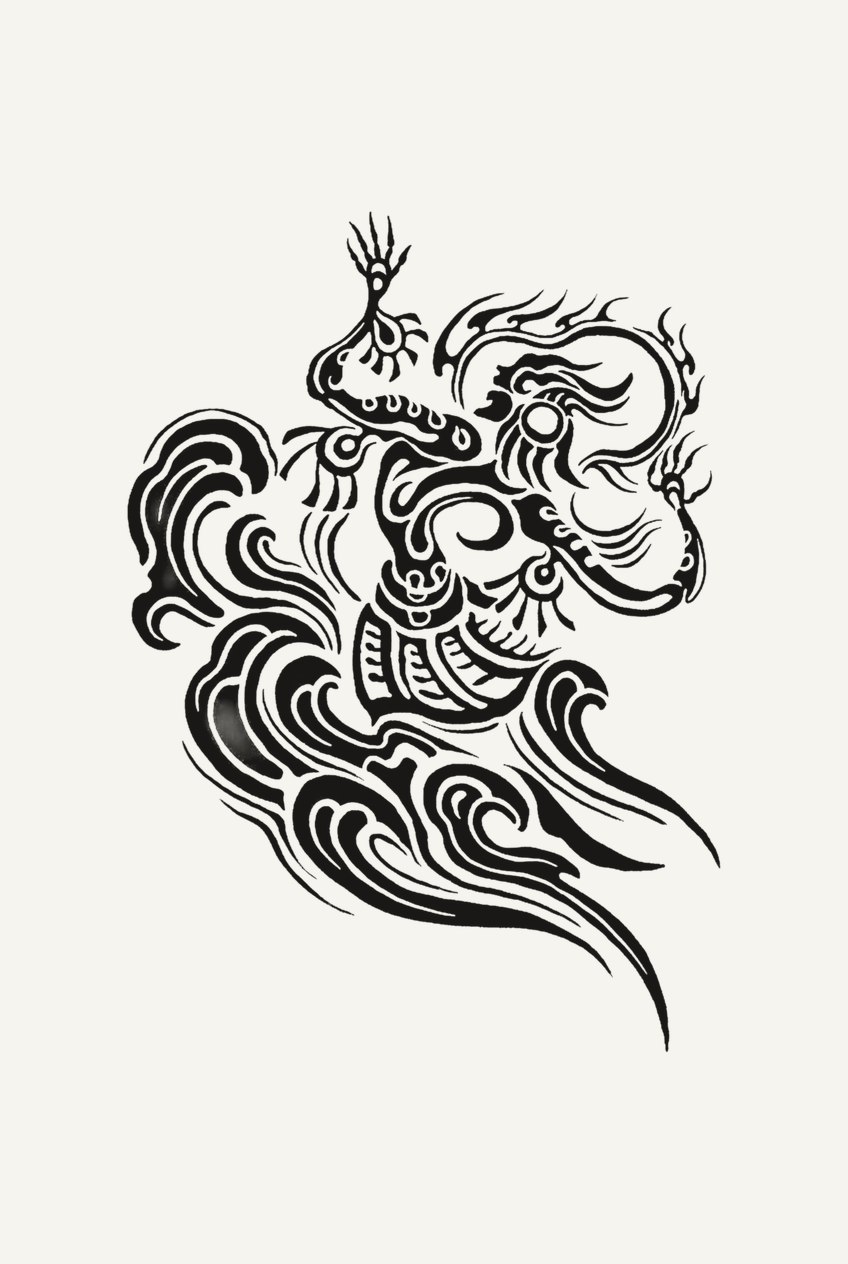
武罗 · Wǔ Luó
The Keeper of the Secret Capital
系列: 神兽灵禽 · Design #37
笔法: Leopard-spotted mountain goddess in dancing pose · bold brushwork · vertical composition · scalable 14–18 cm
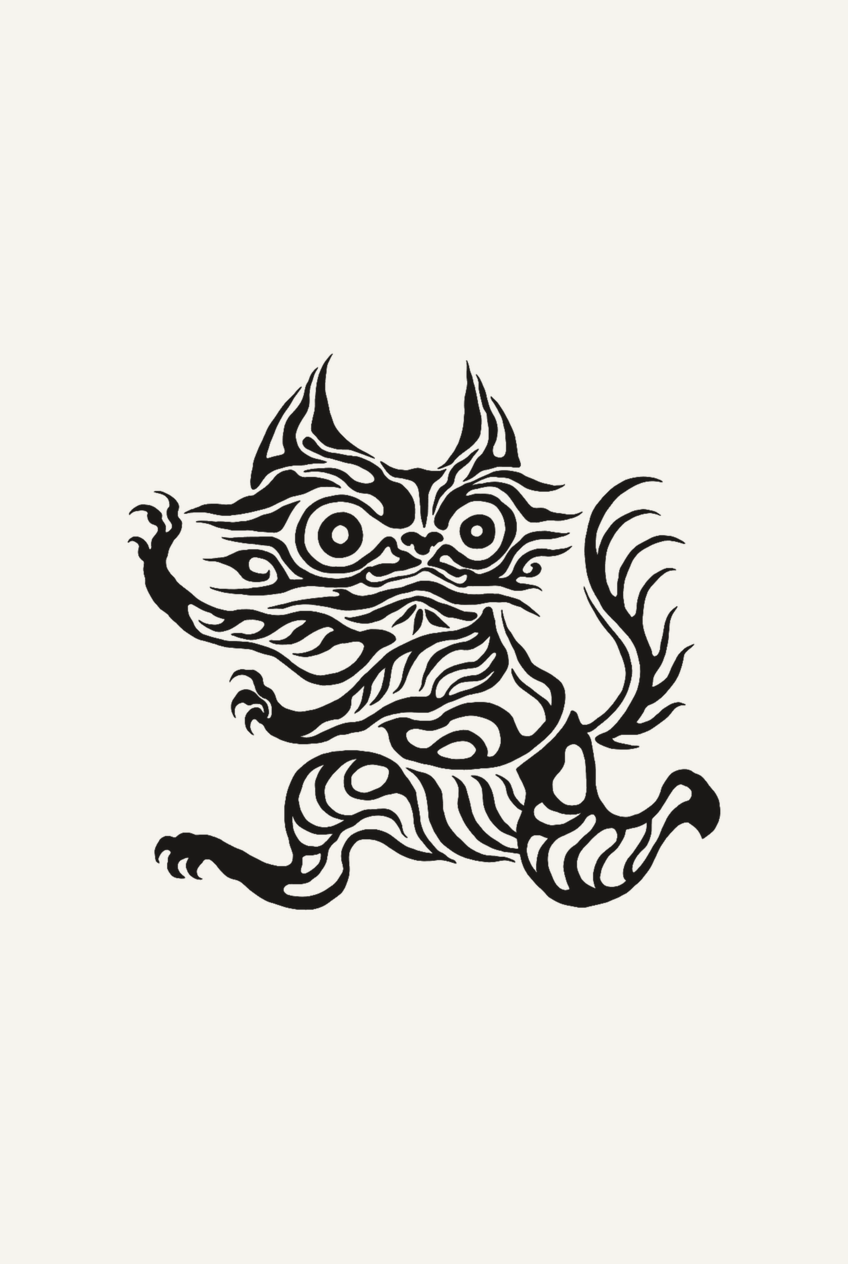
形态: 人面豹文细腰山神,舞姿立像
名字
武罗(wǔ luó)——执掌青要山的神,那座山在《山海经》里被称为帝之密都。经文写出了一个令人不安地优雅的形象:人面,豹纹,细腰,皓齿,耳戴金环——声音如鸣玉相击。一位守护者,同时毫无疑问,是一位美人。
*wǔ luó* — the god who administers Qingyao Mountain, which the *Shanhaijing* calls the secret capital of the Emperor (帝之密都). The text describes a figure of unsettling elegance: a human face, a leopard's spots, a wasp-waist, white teeth, and metal earrings — whose voice sounds like jade chimes. A guardian who is also, unmistakably, a beauty.
出处
《山海经·中次三经》(约成书于前 4—前 2 世纪)青要之山条:「青要之山,实惟帝之密都。……神武罗司之,其状人面而豹文,小要而白齿,而穿耳以鐻,其鸣如鸣玉。是山也,宜女子。」形制参考:《山海经》文本记载;古典图谱中的豹纹山神形象。墨线转写:本设计以传统母题的经典线条造型为底,转写为纹身墨线。
The *Shanhaijing*, *Zhongci San Jing* chapter (compiled c. 4th–2nd century BC), at Qingyao Mountain: 「青要之山,实惟帝之密都。……神武罗司之,其状人面而豹文,小要而白齿,而穿耳以鐻,其鸣如鸣玉。是山也,宜女子。」 — Qingyao Mountain is the Emperor's secret capital; the god Wuluo administers it; its form is human-faced with leopard markings, small-waisted and white-toothed, ears pierced with metal ornaments, its voice like ringing jade; the mountain is favourable to women. Historical form reference: the *Shanhaijing* textual record; classical bestiary depictions of the spotted mountain goddess. Inking note: this design adapts the classic line construction of the traditional motif and re-inks it as tattoo linework.
设计灵感
本版每一处形制决定都有出处可查,逐条对账。① 舞姿——管事者巡行自家山场的姿态,袖与带正在回旋。② 豹纹——「豹文」,斑纹布过肩与胯,野性被做成了装饰。③ 束腰——「小要」,细腰作为结构铰链,承上段流势与下段铺陈。④ 耳饰——「穿耳以鐻」,画作两只利落的金属环,是暖调构图里唯一的冷色重音。
Every form decision on this design points to a recorded source, element by element. ① The dancing stance — the pose of a steward moving through her grounds, sleeves and sash mid-turn. ② The leopard markings — 豹文, spotted patterning drawn across shoulders and hip, the wild made ornamental. ③ The cinched waist — 小要, the wasp-waist held as the design's structural hinge between upper flow and lower sweep. ④ The ear ornaments — 穿耳以鐻, rendered as two crisp metal hoops, the one cold accent in a warm composition.
来历
翻到《中次三经》,山川地理忽然中断,插入了一段近乎宫廷档案的文字:青要之山,实惟帝之密都——「实在是天帝的秘密都城」。不是昆仑山上的正殿;是私邸,是宇宙特意不放进官方地图的地方。而它的管事者是武罗:人面,豹纹,细腰,皓齿,耳戴金环,声音如击玉。
再读一遍这段描述,注意它缺了什么:没有任何怪物元素。书里其他守护者都带威胁展示——九个头、火鬃、盘蛇之躯。武罗得到的是风度。斑纹、腰肢、首饰、鸣玉之声。经文在做一件刻意的事:为天帝最私密的地面,守门人不必可怖。她迷人有分寸,且不可能被贿赂——那种美本身,就是安保系统。
这段经文以下半部书里最安静而激进的一句收尾:是山也,宜女子——「这座山,宜于女子」。至上之神的秘密都城,是一个「对女子特别好」的地方。周边的物产志也一致认同:山中有鸟助孕,有草名荀草,服之肤色变美。学者们早已把青要山读作古代世界罕见的角落——在这里,「女性」不是被管理的范畴,而是整座庄园存在的意义。
由此,武罗的含义再明白不过:优雅即威权。这座山不需要在门口放一只怪兽,因为守山者的沉静本身就是门。作为纹身,她属于那种力量被所有人低估一次——然后永远不会再被低估——的人。
High in the *Zhongci San Jing* chapter, the mountain geography suddenly breaks off into something like a palace record: Qingyao Mountain, 实惟帝之密都 — "in truth the Emperor's secret capital." Not his main court on Kunlun; a private residence, a place the cosmos keeps off the official maps. And its administrator is Wuluo: human-faced, leopard-spotted, wasp-waisted, white-toothed, wearing metal earrings, with a voice like jade being struck.
Read the description again and notice what is missing: nothing monstrous. Every other guardian in the book gets a threat display — nine heads, a mane of fire, a body of coiled serpents. Wuluo gets *style*. The spots, the waist, the jewellery, the chiming voice. The text is doing something deliberate: for the Emperor's most private ground, the gatekeeper is not terrifying. She is charming, precise, and impossible to bribe — the kind of beautiful that is itself a security system.
The passage ends with one of the most quietly radical lines in the whole book: 是山也,宜女子 — "this mountain is favourable to women." The secret capital of the supreme god is a place that is good *for women specifically*. The surrounding pharmacopoeia agrees: a bird here aids childbirth, a herb called xuncao makes the skin beautiful. Scholars have long read Qingyao as a rare pocket of the ancient world where the feminine is not a category to be managed but the whole point of the estate.
That makes Wuluo's meaning unmistakable: grace as authority. The mountain does not need a monster on its gate because the keeper's composure is the gate. As a tattoo, she lands on people whose power everyone underestimates exactly once — and then never again.
释义
优雅即威权:比咆哮更可靠的守护,是沉静。适合力量被人恰好低估一次的那些人。也是女性场域安静的徽章——那座「宜于你」的山。
Grace as authority: composure that guards better than a growl. For the ones whose power people underestimate exactly once. Also a quiet emblem of women's spaces — the mountain that is favourable to you.
位置
舞姿人物需要一个竖直的舞台:14–18 厘米沿大腿外侧或小腿下行,或 12–15 厘米沿脊柱,衣带流向朝下。腰部的铰链要避开膝盖与肘窝的褶线——给回旋留出呼吸的空间。
The dancing figure wants a vertical stage: 14–18 cm down the outer thigh or calf, or 12–15 cm along the spine, sash-flow leading downward. The waist hinge should sit clear of the knee or elbow crease — give the turn room to breathe.
纹之前
斑纹要跟身体走——「豹文」应像真实皮毛一样包住解剖结构,而不是当装饰壁纸平贴。② 细腰是经文正形(「小要」),但要读出力量而非脆弱——是舞者的核心,不是束腰。③ 耳饰是谱系检验(「穿耳以鐻」):两只小的金属环,画得利落。④ 只宜墨线:古典的红褐色调是落针可选项;本转印稿为纯线描。⑤ 不小于 12 厘米——再小脸部与耳环会失去清晰度。高摩擦区(腰带线)的斑纹补色会更早。
The spots follow the body — 豹文 should wrap the anatomy like a real pelt, not sit as decorative wallpaper. ② The wasp-waist is canonical (小要) but should read strong, not fragile — a dancer's core, not a corset. ③ The earrings are the canon check (穿耳以鐻): two small metal hoops, crisply drawn. ④ Ink-only by design: the classical red-brown of the sources is an at-the-needle option; the stencil is pure linework. ⑤ Minimum 12 cm — below that the face and earrings lose definition. Spots on high-friction zones (waistband lines) will need earlier touch-ups.
本卡每一个汉字都由中文母语者选定并逐笔核对。