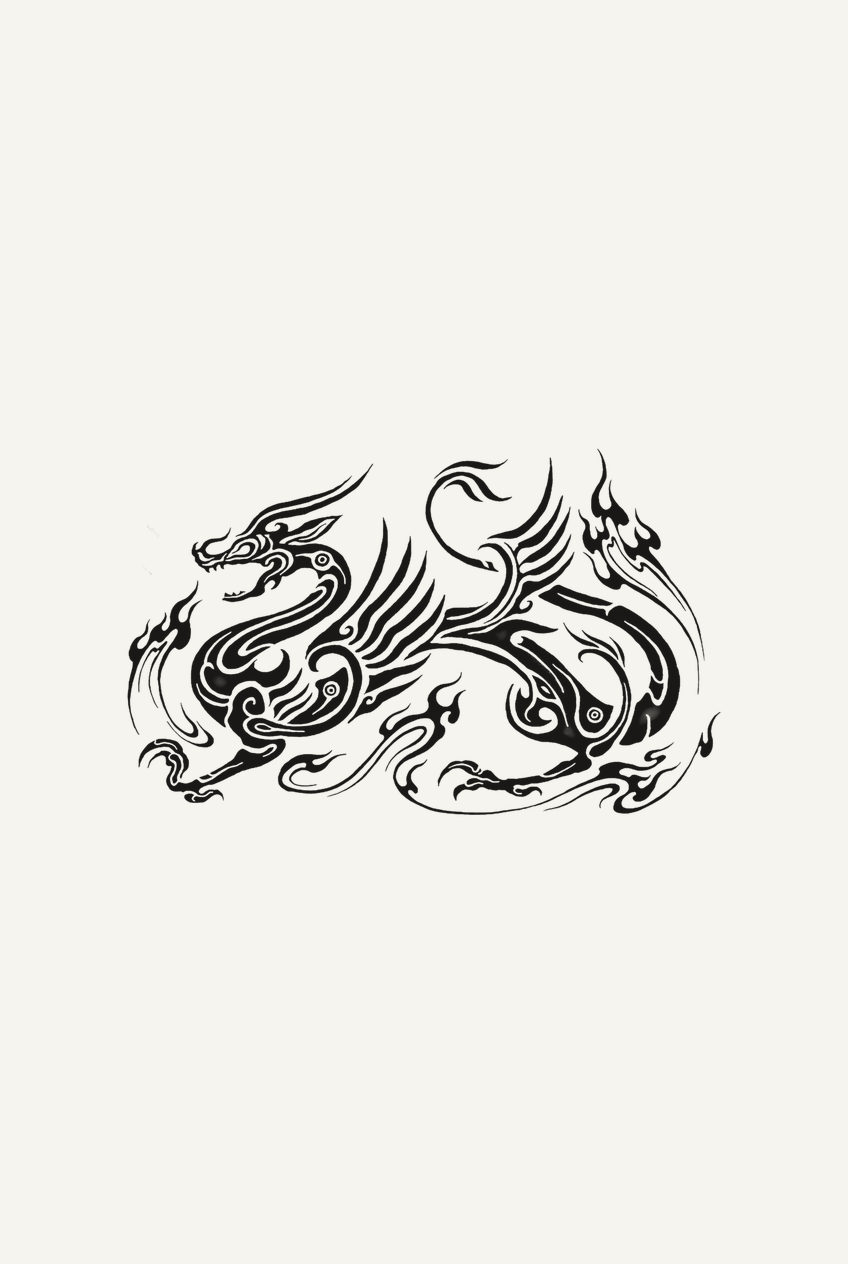
应龙 · Yìng Lóng
The Winged Dragon
系列: 中国龙 · Design #04
笔法: Winged dragon in flight, tail drawing rivers · bold brushwork · vertical or horizontal composition · scalable 15–25 cm
形态: 有翼应龙腾跃主体,尾曳成川,可竖构图或横构图
名字
应龙(yìng lóng)——中国神兽谱系里唯一长翅膀的龙。「应」是回应召唤之意——而这条龙回应了神话里最重要的两次召唤:天地未定时为黄帝而战,洪水滔天时为大禹治水。一条干活的龙。一条干完活,却回不了家的龙。
*yìng lóng* — the Responding Dragon, the only dragon in the Chinese canon that carries wings. The 「应」 in its name means to answer a call — and this dragon answered the two greatest calls in myth: it fought for the Yellow Emperor when the world was being decided, and it answered Yu the Great when the flood had to go. A dragon that works. A dragon that, when the job was done, could not go home.
出处
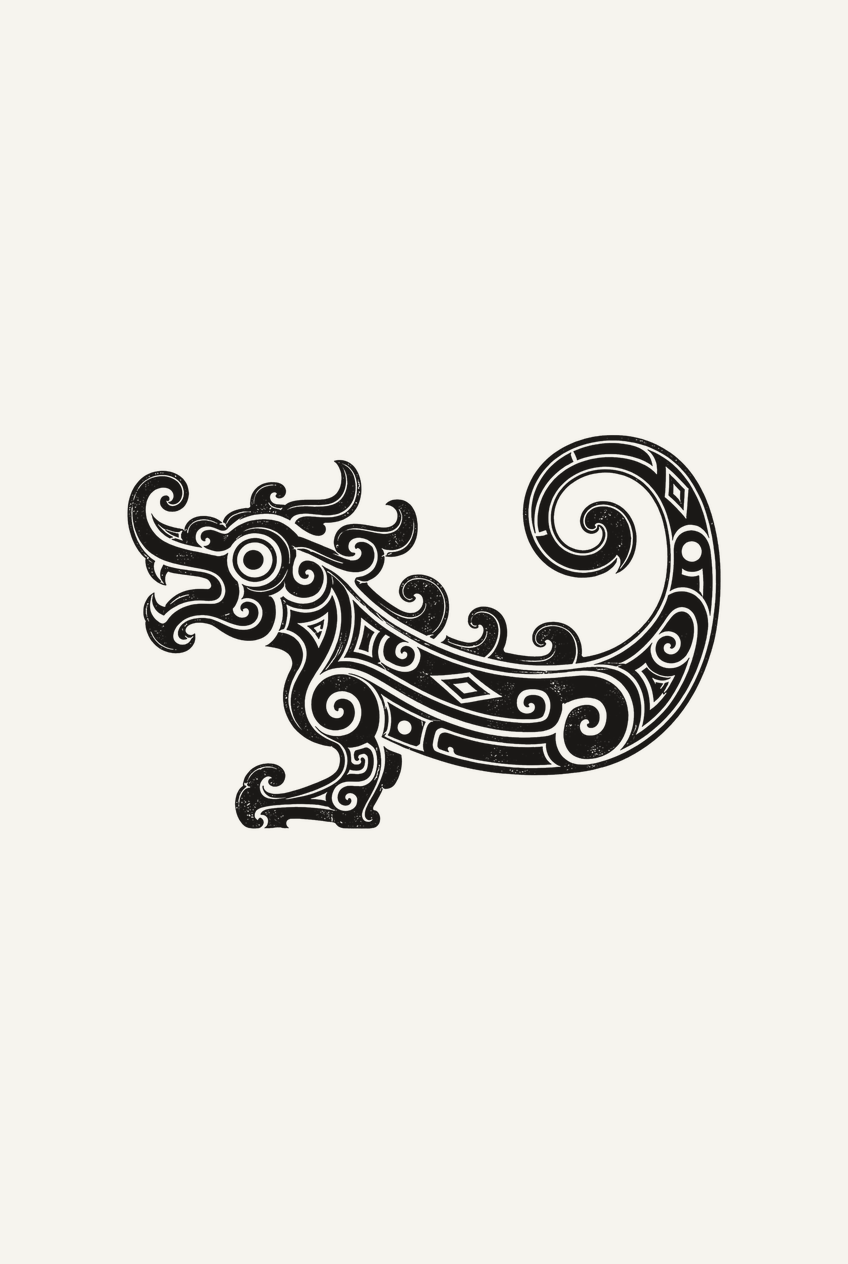
《山海经》(约成书于前 4—前 2 世纪)记:应龙居南极,为黄帝杀蚩尤与夸父,「不得复上,故下数旱」——下界旱灾频仍,人们扮作应龙之形求雨。楚辞一系补全了洪水之事:大禹治水,应龙以尾画地,导川入海(王逸《天问》注)。形制定律「有翼曰应龙」见于汉代辞书《广雅》。有翼龙形见于汉代墓室壁画与画像石。形制参考:汉代墓室艺术的有翼龙与《山海经》文本记载。墨线转写:本设计以传统母题的经典线条造型为底,转写为纹身墨线。
The *Shanhaijing* (Classic of Mountains and Seas, compiled c. 4th–2nd century BC) carries the record: 「大荒东北隅中,有山名曰凶犁土丘。应龙处南极,杀蚩尤与夸父,不得复上,故下数旱」 — having killed Chiyou and Kuaifu for the Yellow Emperor, the dragon could no longer return to heaven and dwelt in the south; when it stayed away, the lands went dry, and people made rain-magic in the shape of the dragon. The *Chu ci* tradition adds the flood: Yu the Great tamed the waters with the yinglong dragging its tail to carve the river channels (Wang Yi's commentary to the *Tianwen*). The form rule 「有翼曰应龙」 — "winged, it is a yinglong" — is fixed in the Han dictionary *Guangya*. Winged dragon forms appear on Han tomb murals and stone reliefs. Historical form reference: winged dragons of Han tomb art and the *Shanhaijing* textual record. Inking note: this design adapts the classic line construction of the traditional motif and re-inks it as tattoo linework.
设计灵感
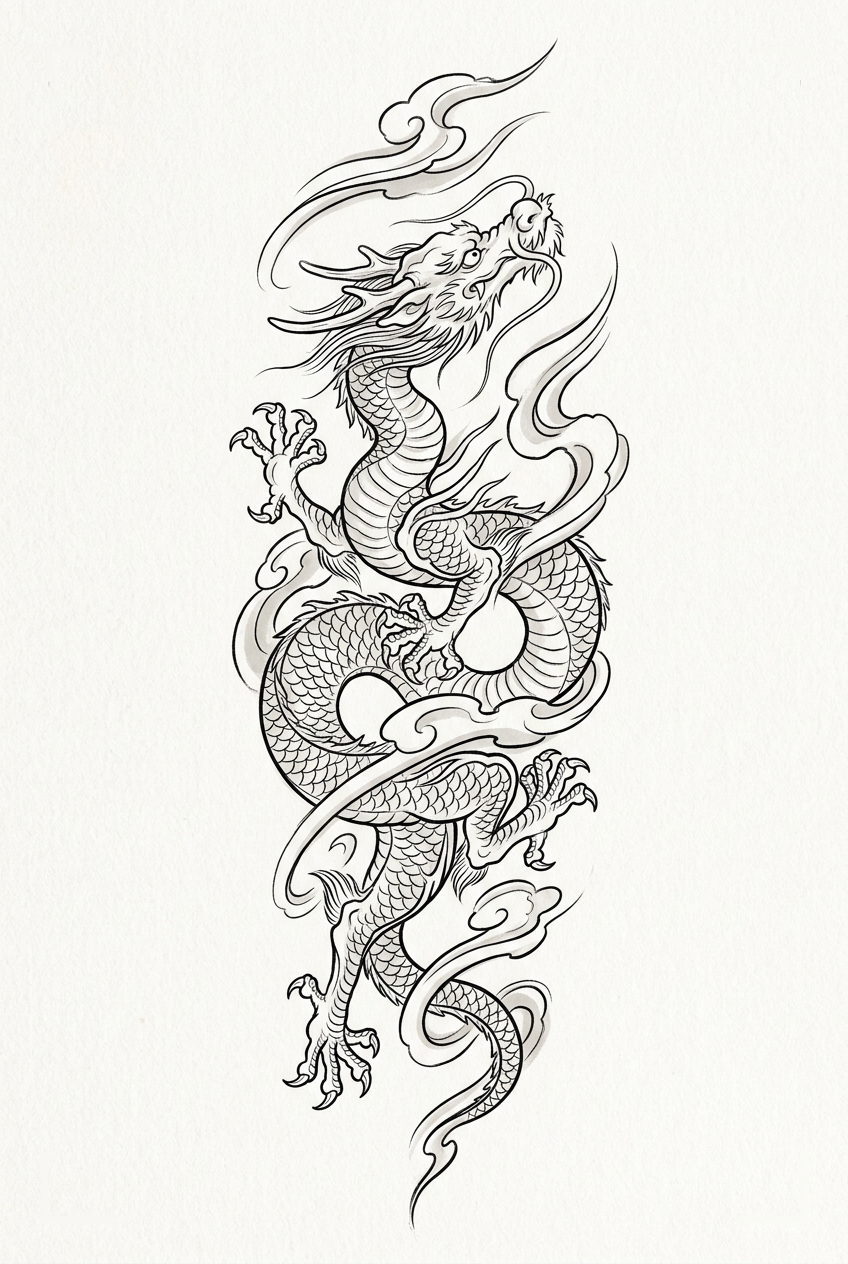
本版每一处形制决定都有出处可查,逐条对账。① 双翼——《广雅》「有翼曰应龙」的定义特征,展翼姿态取汉代墓室壁画升腾之势。② 尾画成川——禹神话里的治水动作:尾线在画面上直接变成河道。③ 蛇形攀升——汉代有翼龙穿云而上的 S 形升龙曲线。④ 战者之口——杀蚩尤的龙张开的颌,把战斗留在脸上。
Every form decision on this design points to a recorded source, element by element. ① The double wings — the defining trait per the *Guangya* rule 「有翼曰应龙」, spread in the climb of Han tomb-mural flight. ② The tail drawing a river — the flood-taming gesture of the Yu legend: the tail line literally becomes the waterway. ③ The serpentine climb — the ascending S-curve of Han winged dragons rising through clouds. ④ The warrior's bite — the open jaw of the dragon that killed Chiyou, the battle kept in the face.
来历
细读《山海经》你会发现,中国的有翼龙有一份履历,而履历是有代价的。第一章:战争。黄帝与蚩尤战于冀州——那场连天气都被武器化的战争,风伯雨师互掷风暴——黄帝召来应龙。应龙蓄水而战,杀蚩尤、诛夸父。天下定了。
第二章才是这张图该纹在身上的原因。应龙把神力耗在了人间,而天上有天上的规矩:它回不去了。它栖居南极,大地立刻察觉——应龙不在的地方,旱灾跟着来。农人扎起应龙形状的偶像,把雨求下来。想想这意味着什么:在中国最古老的天空地理里,先民想象了一位滞留人间的神,自食其力,它的缺席会体现在天气里。不是宝座上的神,是住在楼下的老兵。
然后是第二次召唤。许多代之后洪水滔天,大禹接下了水。《天问》注里保存着旧时每个中国学童都背过的画面:应龙曳尾过处,河道自成。中国的水路——真正养活了这个文明的那些江河——是一条回不了天的龙犁出来的,它在流放里干活。
所以如果你纹它:你纹的不是龙袍上的装饰龙,是有伤、有活的那条。有召必应,赢了要付代价,回不去就向前走,尾巴贴着大地,犁出自己将要游过的那条河。对每个离开故土、在落点处开出河道的人——有翼龙就是你的传记,一笔画成。
Read the *Shanhaijing* closely and you find that China's winged dragon has a resume, and the resume has a cost. Chapter one: the war. When the Yellow Emperor fought Chiyou at Jizhou — the battle where the weather itself was weaponized, wind-lords and rain-masters hurling storms — the Emperor called on the yinglong. The dragon stored up water of its own, fought, and killed Chiyou and the giant Kuaifu. The world was won.
Chapter two is the part that makes the tattoo. The dragon had spent its power in the mortal realm, and heaven has rules: it could not fly back. It settled in the far south, and the land noticed — where the yinglong stayed away, drought followed. Farmers made effigies in the dragon's shape and called the rain down. Think about what that means: the Chinese, in their oldest geography of the sky, imagined a divine being stranded among humans, working for a living, its absence felt in the weather. Not a god on a throne. A veteran who lives downstairs.
Then the second call. Generations later the floods came, and Yu the Great took on the water. The *Tianwen* commentary preserves the image every Chinese schoolchild used to know: the yinglong dragged its tail across the earth, and where the tail passed, the rivers found their channels. China's waterways — the actual rivers that made the civilization possible — were plowed by a grounded dragon, doing the work in exile.
And that is the meaning if you wear it: not the decorative dragon of imperial robes, but the one with scars and a job. It answers when called. It pays for what it wins. It cannot go back, so it goes forward, tail to the ground, carving the river it will swim. For anyone who has left a place that can no longer hold them and built a channel where they landed — the winged dragon is your biography, drawn in one line.
释义
有召必应、赢也要付代价的龙:流放被犁成了灌溉,落地的翅膀仍在飞。适合新的开始、远行、以及一切付出了真实代价的胜利。它是劳动者的龙——受尊敬、有风霜、向前走。
The dragon that answers the call and pays the price: exile turned into irrigation, grounded wings that still carry. For new beginnings, migrations, victories that cost something real. It is the working-class dragon — honored, weathered, moving forward.
位置
完整的腾跃属于后背:20–25 厘米,沿脊柱垂直攀升或横越肩胛,翼在上场,尾河在腰部收出。浓缩版 12–15 厘米环绕小臂外侧,尾线绕臂成川。双翼需要直线跑道——不要绕关节弯它。
The full flight wants the back: a 20–25 cm vertical climb up the spine or across the shoulder blade, wings in the upper field, tail-river running out at the waist. A condensed version, 12–15 cm, wraps the outer forearm with the tail drawing water around the arm. The wing span needs straight runway — do not curve it around joints.
纹之前
翅膀数量是身份测试:一对,永远一对——多翼就出了谱系。② 尾画成川是这张图的签名:请纹身师保持尾线连续、可读,不要散成水花。③ 五爪与四爪:明清帝王龙穿五爪,《山海经》气质的应龙四爪更干净——上转印稿之前定好。④ 只宜墨线:翼内保持纯线描;羽间一点极淡灰晕是落针时的可选项,无需上彩。⑤ 留够尺寸。 背部不小于 15 厘米,小臂不小于 12 厘米——再小翼的结构就塌了。背部属低磨损区,线条可保持多年。
Wing count is the identity test: one pair, always — extra wings take it out of the canon. ② The tail-to-river line is the design's signature; ask your artist to keep it continuous and readable, not dissolved into spray. ③ Five claws versus four: Ming-Qing imperial dragons wear five; a Shanhaijing-spirit dragon reads cleaner with four — decide before the stencil. ④ Ink-only by design: the wings stay pure linework; a whisper of greywash in the feathers is a welcome at-the-needle option, color is not needed. ⑤ Respect the scale. Back version minimum 15 cm, forearm version minimum 12 cm — the wing structure collapses below that. Back pieces sit in low-wear territory and hold their lines for years.
本卡每一个汉字都由中文母语者选定并逐笔核对。