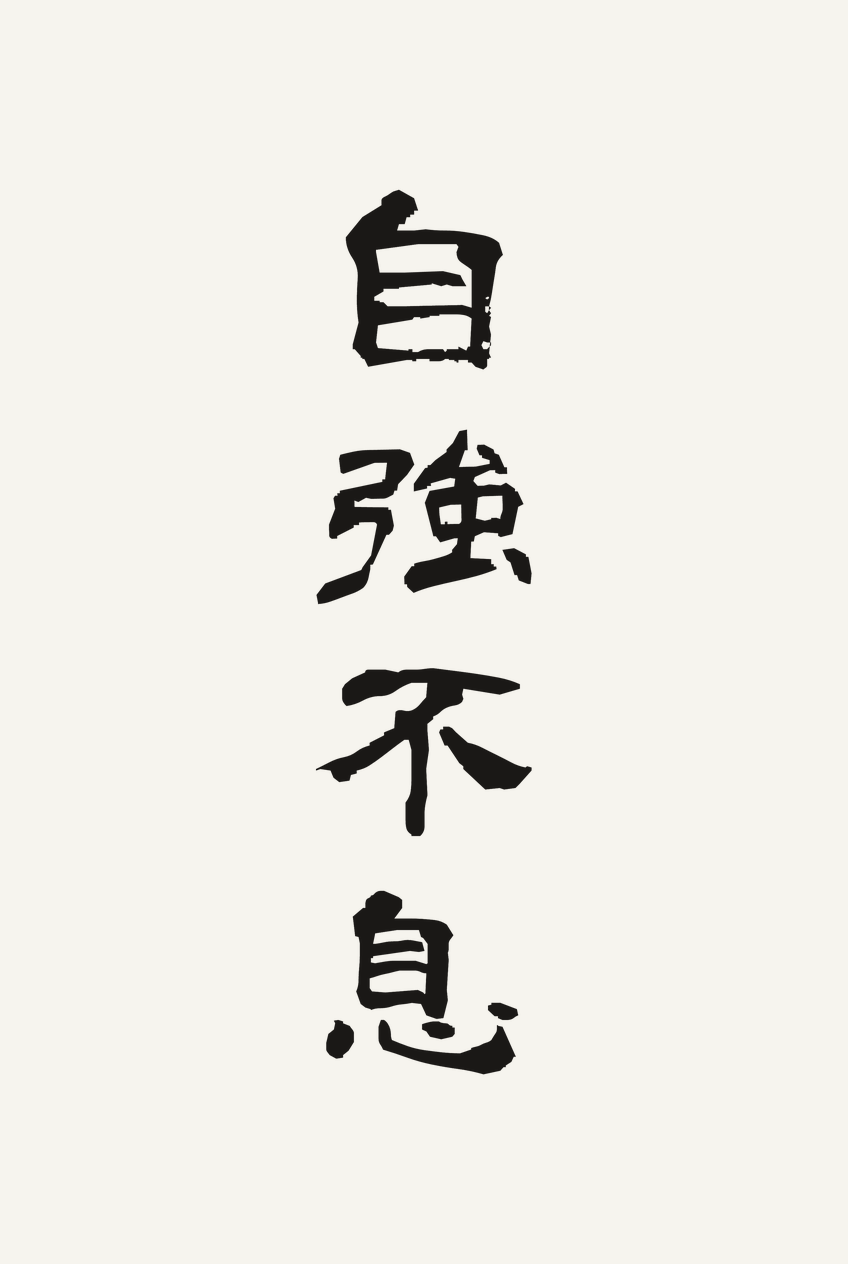
自强不息 · Zì Qiáng Bù Xī
Strengthen Yourself, Never Rest
系列: 吉语成语 · Design #05
笔法: four characters in a single vertical column · clerical script (lishu) · traditional form 自強不息 · medium-to-large
形态: 四字竖列大字,篆书
名字
自强不息——《易经》第一卦乾卦的象辞收束:天行健,君子以自强不息。这是中国典籍里最古老的一句自我纪律,三千年了,从来没有绝版过。
*Zì qiáng bù xī* — strengthen yourself, and do not rest. The closing charge of the Qian hexagram, the very first chapter of the *Book of Changes*: 天行健,君子以自强不息 — "Heaven's motion is vigorous; thus the noble person strengthens himself without pause." It is the oldest self-discipline text in the Chinese canon — three thousand years old, and it has never once gone out of print.
出处
文本出自《周易》第一卦乾卦的《象传》——《周易》是中国最古老的经典,西周 roots(约公元前九世纪),汉代层层注疏。它的姊妹句在第二卦坤卦——厚德载物——1914 年被写进清华大学校训,与它成对。墨线转写:本设计以传统母题的经典线条造型为底,转写为纹身墨线。
The line is the Xiang commentary on hexagram 1 (Qian, "Heaven") of the *Zhouyi* — the *Book of Changes*, the oldest of the Chinese classics, with Western Zhou roots (ca. 9th century BC) and strata of commentary added through the Han. Its companion line on hexagram 2 (Kun, "Earth") — 厚德载物, "with broad virtue carry the world" — pairs with it in the motto of Tsinghua University, written into the school constitution in 1914. Inking note: this design adapts the classic line construction of the traditional motif and re-inks it as tattoo linework.
设计灵感
本设计的每一处形制决定都有出处可查,逐条对账。① 四字一竖列——中国书院与书斋的格言条幅格式。② 隶书、繁形「自強不息」——隶是汉代石经的书体:把国家文本刻进石头、比写它的书吏活得更久的字。每一笔都有分量、日复一日——这句话自己的职业道德,写成了字。③ 中到大尺寸——隶书平缓有分量的笔画,要够长才读得出力量,而不是装饰。④ 只用墨——石头与墨;这句话三千年来所寄身的两种材料。
Every form decision points to a recorded source, element by element. ① Four characters, one vertical column — the motto-strip format of Chinese academies and studios. ② Clerical script, traditional form 自強不息 — lishu is the script of the Han stone classics: the state's texts carved in stone to outlast the scribes who wrote them. Every stroke is weighted and repeated daily — the sentence's own work ethic, in writing. ③ Medium-to-large scale — clerical script's level, weighted strokes need length to read as strength rather than decoration. ④ Black ink only — stone and ink; the two materials the line has lived on for three thousand years.
来历
乾卦是六根不断的线:纯阳,天在运行之象——《象传》把六根线讲成一门自强的功课,按人生排程。潜龙勿用:不被看见,就在暗处长。或跃在渊:试探腾跃,从深处起跳。亢龙有悔:飞得太高的龙有悔——到了顶点,纪律照样成立。自强不息是贯穿线:天不放假,以天为榜样的人也不。
这句话的权威是活出来的。《周易》活得比封它为经的朝代都长;它是秦火之后第一批被找回来的书,是占卜之书长成的哲学之书,是每个中国思想家——儒、道、兵——都必须应答的那一部。自强不息在帝制时代的某个节点从宇宙论走进了个人座右铭,再没回去:到 1914 年,它是一所学校——后来产出近代中国科学家最多的那所——的校训,也依旧是中国父母写给要硬考一场的孩子的四个字。
这句话里没有捷径。它不许诺努力必有回报——只说停下来是唯一注定的输。天的运行就是标准:太阳不跟谁谈判它的轨迹,四季不跳过自己的班。三千年的读者,有人把它当安慰,有人当判决——取决于他们那一年过得怎么样。
The Qian hexagram is six unbroken lines: pure yang, the image of Heaven in motion — and the commentary takes the six lines as a life course in self-strengthening. 潜龙勿用 — the hidden dragon: be unseen, and build. 或跃在渊 — testing the leap: try, from depth. 亢龙有悔 — the dragon that flies too high has regrets: even at the summit, the discipline holds. The charge 自强不息 is the through-line: Heaven does not take days off, and the person who models Heaven does not either.
The text earned its authority by surviving. The *Book of Changes* outlived the dynasties that canonized it; it was the first book buried Qin books were recovered from, the diviner's manual that became a philosopher's text, and the one classic every Chinese thinker — Confucian, Daoist, military — had to answer to. 自强不息 crossed from cosmology into personal motto somewhere in the imperial era and never went back: by 1914 it was the motto of the school that would produce modern China's scientists, and it remains the four characters Chinese parents write for a child facing an exam the hard way.
The sentence has no shortcut in it. It does not promise that effort is rewarded — only that stopping is the one guaranteed loss. Heaven's motion is the standard: the sun does not negotiate its circuit, the seasons do not skip a turn. Three thousand years of readers have taken that as either comfort or verdict, depending on the year they were having.
释义
一条没有终点的纪律,取自唯一从不停摆的钟。给漫长的重建——伤后、失后、被拿走一切的那年之后。它不是鸡血:是日程表。天的运行每日不辍、不见光、不缺勤——照着做的人,不再向天空要许可。
The discipline that has no finish line, taken from the only clock that never stops. This is a design for the long rebuilding — after the injury, the loss, the year that took everything. Not motivation: a schedule. Heaven's motion is daily, unglamorous and complete, and the person who copies it stops asking the sky for permission.
位置
这一列适合身体的直立面:先脊柱与小臂内侧,次小腿外侧。篆书匀称的线重要一块平整的肌肉面——肢体收细太急的地方读不出它的好。列高 12 厘米起;绕线般的弧曲要有余地保持节奏。
The column suits the body's upright planes: spine and inner forearm first, outer calf second. Seal script's even line weight wants a flat, muscular plane — it reads strongest where the limb does not taper sharply. Minimum 12 cm column height; the wound-wire curves need room to hold their rhythm.
纹之前
六爻之意,四字之文。 这一列是乾卦的浓缩——别让师傅在字间加装饰;素,才是要点。② 繁体「自強不息」。 隶书带着石经的语域;简体强会把设计所讲的古老切断。③ 隶书贵平。 它的力量在日复一日的横平笔画——不飞白、不渐淡。④ 列高 12 厘米起。 ⑤ 这是日程表,不是口号。 天不缺勤——如果你不打算天天到场,这句话会看着你。
Six lines of meaning, four characters of text. The column is the Qian hexagram condensed — do not let a studio add ornament between the characters; the plainness is the point. ② Traditional form 自強不息. The clerical script carries the stone-classic register; simplified 强 would break the antiquity the design is speaking in. ③ Clerical script is weighted. Its power is the level, daily-repeated stroke — no brush flourishes, no fading. ④ Column height 12 cm minimum. ⑤ It is a schedule, not a slogan. Heaven does not skip; if you are not prepared to show up daily, the sentence will be watching.
本卡每一个汉字都由中文母语者选定并逐笔核对。