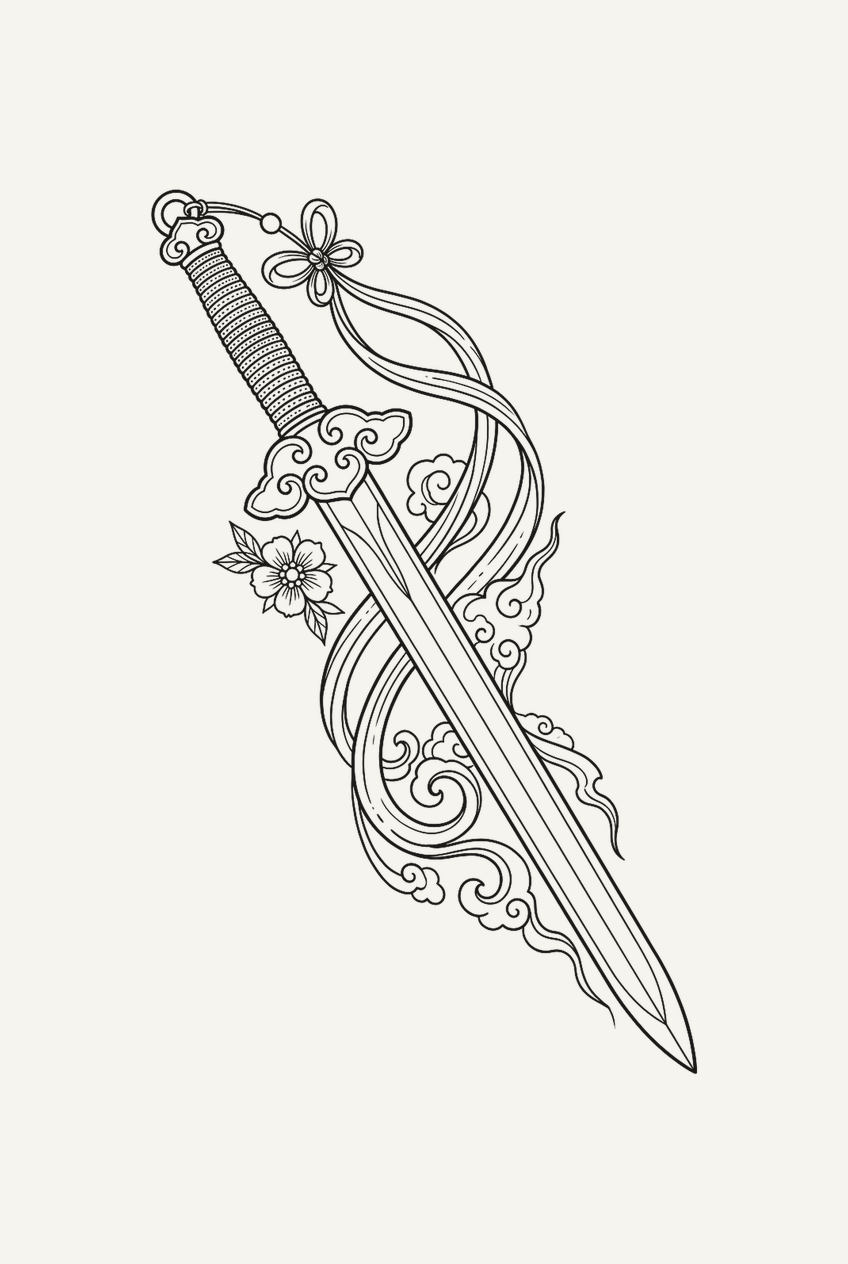
宝剑 · Bǎo Jiàn
The Immortal's Sword
Series: Feng Shui Charms · Design #01
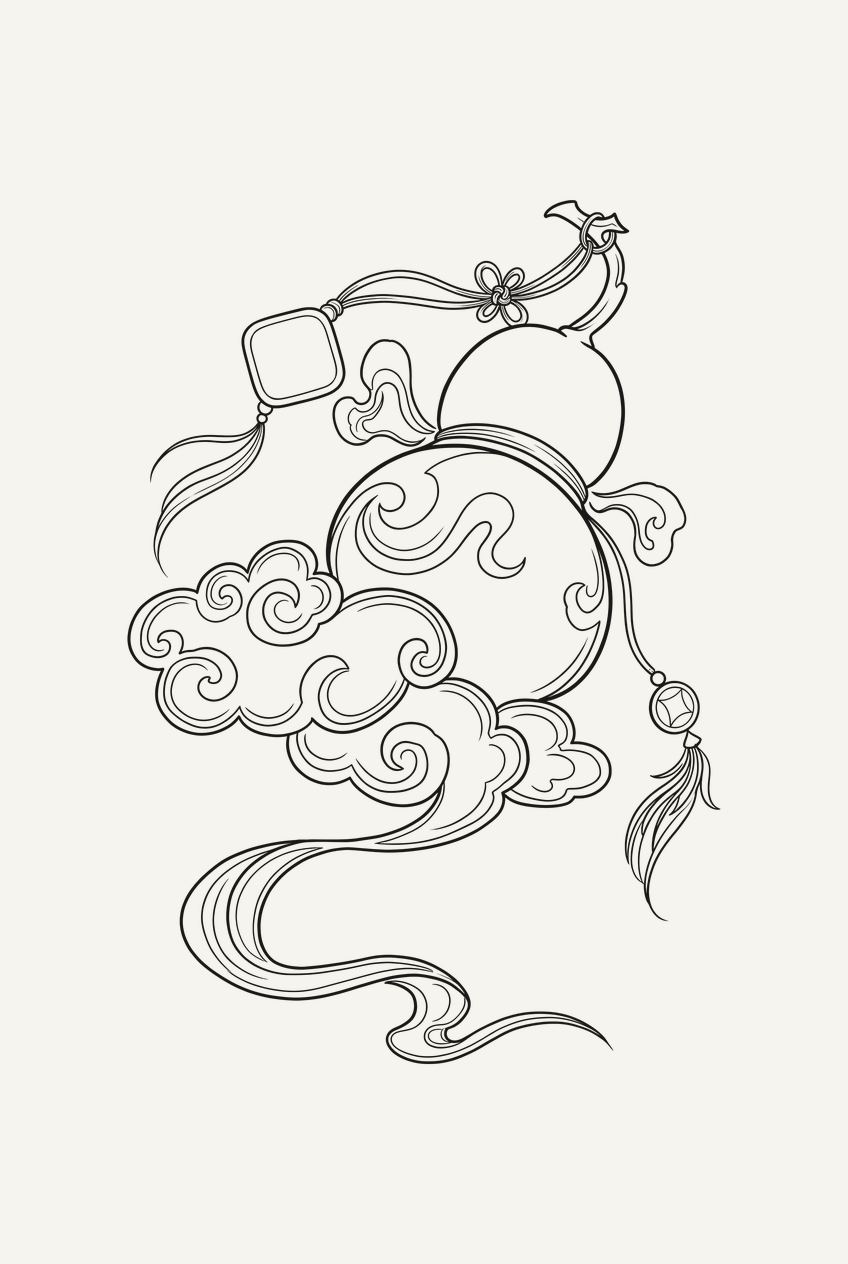
Style: diagonal sword with swirling silk ribbons · bold line · medium-to-large
Form: 图案
The Name
*Bǎo jiàn* — the precious sword, the emblem of Lü Dongbin, the most human of the Eight Immortals. In the pattern language called 暗八仙 — the "hidden Eight Immortals" — the immortals themselves are never shown; only their implements are, each standing in for its bearer. The sword stands for the immortal who carried it through the mortal world: not to fight, but to cut — worries, obsessions, the things that cling. This design is that sword, laid diagonally with its silk cords still swirling from the journey.
宝剑——吕洞宾的法器,八仙里最像人的那一位的佩剑。在叫作「暗八仙」的纹样语言里,八仙本人从不露面,露面的只有他们的法器,每件法器代指一位仙人。这柄剑代指的,是背着它走人间的那位神仙:不为争斗,只为斩——斩烦恼、斩执念、斩一切缠人的东西。本设计就是这柄剑,斜贯纸面,丝绦还带着赶路的余卷。
Source & Provenance
The motif is the sword of the Eight-Implemens pattern (暗八仙纹, the "hidden Eight Immortals"): since the Ming Jiajing reign, when the court's devotion to Daoism carried the Eight Immortals into every household, their implements became a fixed decorative set — woven into silk, painted on porcelain, cast in metalwork, carved into lacquer and architectural woodwork. Each implement names its immortal; the sword names Lü Dongbin (吕洞宾), the Patriarch of the Pure Yang (纯阳), whose legendary blade 纯阳剑 is the emblem of cutting through affliction — the ritual verse has it that at the immortals' birthday gathering, "the sword flashes its spirit, and demons and goblins tremble." Inking note: this design adapts the classic line construction of the traditional motif and re-inks it as tattoo linework.
母题是「暗八仙纹」中的剑:自明嘉靖年间起,宫廷崇道把八仙送进千家万户,八件法器组成固定的装饰组——织进丝织、画上陶瓷、铸入金工、雕进漆器与建筑木雕。每件法器点一位仙人之名,剑点的是吕洞宾——纯阳真人,其传说中的佩剑「纯阳剑」是斩断烦恼的符号,八仙庆寿的赞词里说它「剑现灵光魑魅惊」。墨线转写:本设计以传统母题的经典线条造型为底,转写为纹身墨线。
Design Inspiration
Every form decision points to a recorded source, element by element. ① The diagonal sword — the implement as the woodcut and embroidery tradition lays it: blade sweeping across the frame, guard shaped as a ruyi cloud-head, grip bound in cord. ② The butterfly-knot tassels — in the woven versions every implement is tied with silk cords; the knots are the signature that says "charm, not weapon." ③ The swirling ribbon scrolls — the textile convention that carries all eight implements: motion drawn as curls, so a still object reads as traveling. ④ Black ink only — the set descends from woodblock printing and silhouette weaving, where the strength is line and void, not color.
本设计的每一处形制决定都有出处可查,逐条对账。① 斜贯的剑——木刻与织绣传统里法器的摆放:剑身斜过画面,剑格作如意云头,剑柄缠绳。② 蝴蝶结绦穗——织锦版本里每件法器都系着丝绦;结是「护身符而非兵器」的记号。③ 卷涡丝绦——承载整组八宝纹的织绣语汇:动感画成卷涡,让静物读出赶路的行色。④ 只用墨——这套纹样承自木刻版画与剪影织造,力量在线与留白,不在颜色。
The Story
Of all the Eight Immortals, Lü Dongbin is the one people felt they knew. A scholar of the Tang by birth, he met an innkeeper who turned out to be the immortal Zhongli Quan, who cooked a pillow for him — in the dream the pillow offered, Lü lived an entire life: glory, rank, ruin, disgrace — and woke before the millet had finished cooking. He followed the immortal anyway, and was tested ten times before his teacher trusted him. The last temptation, some tellings say, was the hardest: not gold, not women, but the sight of ghosts — and he did not flinch, because his sword was for them.
That sword — 纯阳, "Pure Yang" — was never a soldier's blade. In the legends it cuts what cannot be touched: the thousand worries, the ten thousand entanglements, the things that ride home with you and will not get off. The people kept him close: three times drunk at Yueyang Tower, walking the roads with the sword slung on his back, the immortal who would talk to anyone — even the dog that bit him, giving rise to the proverb every household knows.
By the Ming, his sword had a second life: the immortals themselves stepped out of the picture, and their implements stayed. Woven into birthday banners and wedding quilts, painted on the porcelain that marked every milestone, carved over doorways — the set was called 暗八仙, the hidden immortals: present without appearing. And the sword among them kept its one job. Not war. It hung in the pattern to say: what rides with this person, their home, their journey — let it cut nothing but what should be cut.
八仙里,吕洞宾是人人都觉得自己认识的一位。传说他本是唐代书生,在客栈遇见店主人竟是仙人钟离权——钟离权为他煮了一个枕头:枕上入梦,他活完了整整一世,荣华、功名、倾覆、流落——醒来时黄粱尚未煮熟。他还是跟着仙人走了,而老师试探了他十次才肯传道。几种讲法里,最后一试最难:不是黄金,不是美色,而是亲眼撞见鬼魅——他没有退缩,因为他的剑就是为他们备的。
那柄剑——纯阳——从来不是行伍的刀。在传说里它斩的是摸不着的东西:千般烦恼、万种纠缠、跟着你回家赖着不走的那些。百姓把他留得很近:三醉岳阳楼,背剑走长路,愿意和任何人说话——连咬他的狗都不恼,留下那句家家户户都懂的歇后语。
到了明代,他的剑有了第二重生命:八仙本人退出了画面,法器留了下来。织进寿幛与嫁被,画在纪念每一桩大事的瓷器上,雕在门楣上方——这套纹样叫暗八仙:不露面而同在。其中那柄剑,始终只做一件事。不是战争。它挂在纹样里,说的是:此人的行囊、此人的家、此人的旅途——只许斩该斩的。
What It Means
A blade carried in peace, for cutting what clings. The Eight Immortals' sword is a traveler's charm — carried, never drawn. For anyone mid-cut: the habit being quit, the thread being let go of, the noise being put down. It does not promise the cutting is easy. It promises company on the road.
一柄在太平年月里背负的剑,斩的是缠人之物。八仙的剑是行旅的护符——背着,从不拔。给正在斩断什么的人:在戒的瘾、在放下的线、在收拾的声音。它不许诺斩断是容易的。它许诺的是路上有人同行。
Where It Sits
The motif is built to travel with a limb: the diagonal reads best on the outer forearm or along the calf, blade running with the muscle line. The shoulder blade takes it well laid flat; a vertical spine placement gives the ribbons a full fall. Medium-to-large — the ribbon scrolls need room to curl; squeezed small, they read as knots instead of wind.
母题天生跟着肢体走:斜势在外臂外侧或小腿沿肌肉线最顺。肩胛平铺亦可;脊柱竖置能让丝绦完整垂落。中到大——卷涡要有回旋的余地;挤小了,卷涡读成死结,而不是风。
Before You Ink
The knots are the point. The butterfly-knot tassels are what mark this as a charm carried by an immortal, not a blade carried by a fighter — do not let a studio "realism pass" strip them. ② The guard is a cloud. The ruyi cloud-head guard is the motif's oldest signature; a straight crossguard turns it into a different sword. ③ Only ink. The set lives in woodblock line and void — black and grey, bold line, no color needed. ④ Give the ribbons room. Below 12 cm the scrolls clog; the design needs its wind. ⑤ It cuts one way. This is a charm for cutting what clings to you — not a mark for cutting at others. Make sure the sentence is yours to wear.
结不能省。 蝴蝶结绦穗标记的是「仙人背的护符」而非「武人佩的刀」——别让师傅的「写实化」把它修掉。② 剑格是云。 如意云头剑格是这组纹样最老的记号;换成直剑格,就成了另一柄剑。③ 只用墨。 这套纹样活在木刻的线与留白里——黑灰、粗线,不必上色。④ 给丝绦留余地。 小于 12 厘米卷涡会糊;这件设计需要它的风。⑤ 它只斩一个方向。 这是斩「缠着你的东西」的护符——不是斩人的记号。这句话是不是你的,想清楚再落针。
Every character on this card was selected and checked stroke by stroke by a native reader of Chinese.