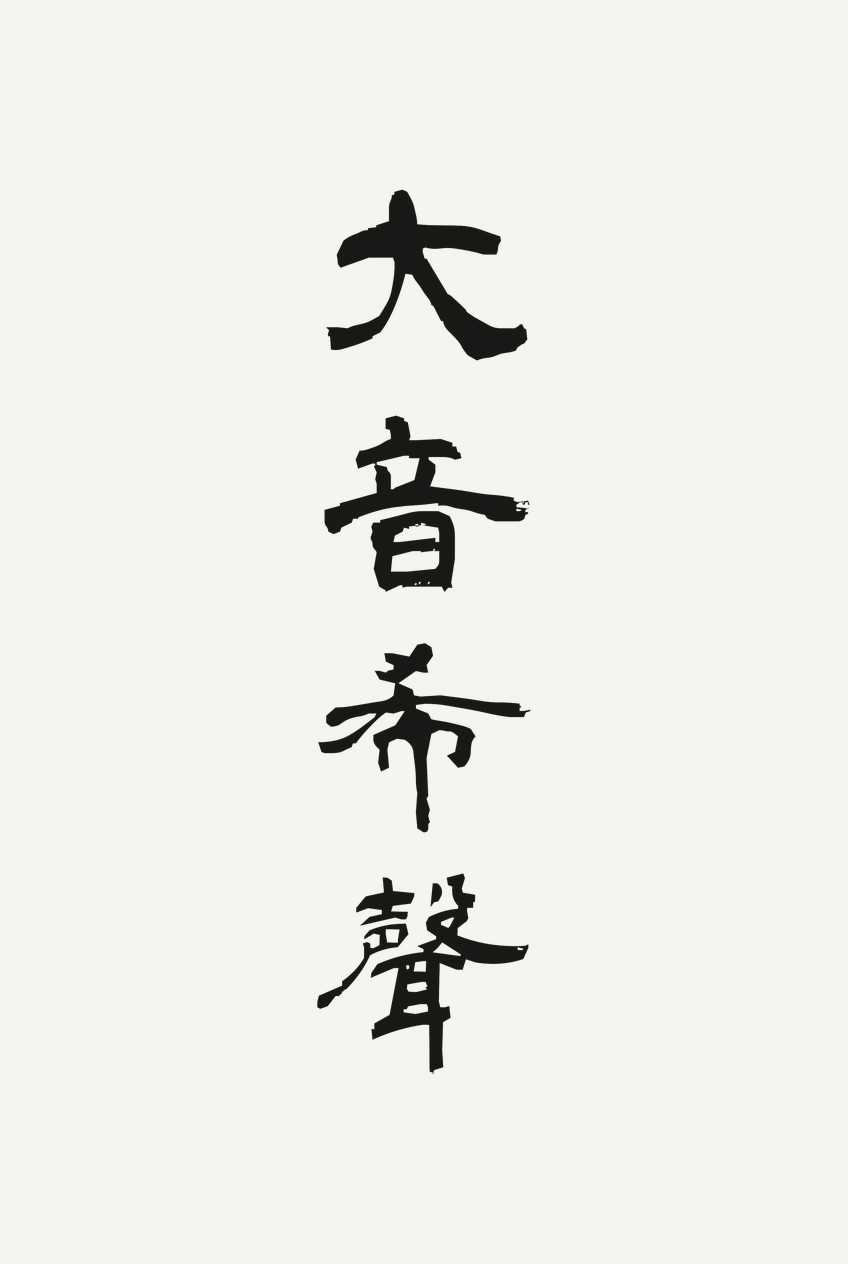
大音希声 · Dà Yīn Xī Shēng
The Great Sound Is Scarce of Sound
Series: Auspicious Idioms · Design #24
Style: four characters, vertical column · clerical script (lishu) · traditional form 大音希聲 · medium
Form: 文字
The Name
The greatest sound is scarcely sound at all. Laozi's chapter forty-one lists the paradoxes of the great: great perfection looks flawed, great eloquence seems inarticulate — and greatest of all, 大音希聲, the largest music falls below the threshold of hearing. Not silence-as-absence; sound so complete it has nothing left to prove. As a tattoo it marks a life that stopped broadcasting: the work is the signal now.
最大的声音,几乎听不见。老子第四十一章列举「大」的悖论:大成若缺,大辩若讷——而在其上,大音希聲,最大的音乐落在听觉阈值之下。不是缺席的沉默;是完整到没有东西需要再证明的声音。纹上它,标记的是一种停止广播的生活:作品本身就是信号了。
Source & Provenance
Daodejing 41, original text: 大音希聲,大象無形 — "the great sound is scarce of sound; the great image has no form." The four characters are the original scripture itself — no later distillation. Context: 明道若昧,進道若退 — the way forward looks like retreat. Inking note: this design adapts the classic line construction of the traditional motif and re-inks it as tattoo linework.
《道德经》第四十一章原文:大音希聲,大象無形——「最大的声音听不见,最大的形象没有形状。」上下文:明道若昧,進道若退——前进的路看起来像后退。四字就是经文本身,没有后起的蒸馏。墨线转写:本设计以传统母题的经典线条造型为底,转写为纹身墨线。
Design Inspiration
Every form decision points to a recorded source, element by element. ① Four characters, one vertical column — the giant (大) opens, the sound (音) thins (希), the sound-fade (聲) closes it. ② Clerical script, traditional form 大音希聲 — even weight, no crescendo: the script itself refuses climax. ③ Medium scale — 12–14 cm. ④ Black ink only — the design's thesis in one line: no color, no flourish, no noise.
本设计的每一处形制决定都有出处可查,逐条对账。① 四字竖列——大(大)张开,音(音)变稀(希),声的余息(聲)收尾。② 隶书、繁形「大音希聲」——分量均匀、没有渐强:书体自己拒绝了高潮。③ 中尺寸——12–14 厘米。④ 只用墨——设计论点写在一行里:没有颜色,没有花饰,没有噪音。
The Story
Chapter forty-one is Laozi's joke about reception: he opens with 上士闻道,勤而行之 — the best student hears the Dao and starts practicing; 中士闻道,若存若亡 — the average one hears it and half-believes; 下士闻道,大笑之 — the worst one laughs out loud. 不笑不足以為道 — if they didn't laugh, it wouldn't be the Dao. Then the paradox list, ending in the sound below hearing. The chapter is a filter: it sorts its own readers, and the four characters worn on skin are the same filter made permanent. People who need loudness will read the tattoo as nothing. That reading is correct, and it is the feature.
John Cage entered a fully anechoic chamber and still heard two sounds — his nerves and his blood — and concluded that silence does not exist; there is only sound we have not agreed to attend to. He had, unknowingly, footnoted Laozi. The great sound was playing the whole time.
第四十一章是老子关于「接收」的玩笑:开头是上士闻道,勤而行之——上士听了就开始练;中士闻道,若存若亡——中士听了半信半疑;下士闻道,大笑之——下士大声笑出来。不笑不足以為道——他们不笑,那就不是道了。然后是悖论清单,收在听不见的声音上。这一章是一个过滤器:它筛选自己的读者,纹在皮肤上的四个字就是同一个过滤器的永久版。需要喧哗的人会把这纹身读成「没什么」。那个读法是对的,而且正是设计意图。
约翰·凯奇走进完全消声的房间,仍然听见两种声音——他的神经和他的血——于是结论:寂静不存在;只有我们尚未同意去听的声音。他无意间给老子做了注脚。大音一直在播。
What It Means
For the ones who have quit performing — the musician who stopped chasing the drop, the writer who killed the perfect opening line, the professional whose best work is invisible by design. It is not shyness; it is scale.
给已经停止表演的人——不再追副歌的乐手、杀掉了完美开头的作者、最好的作品按设计就不可见的职业者。这不是害羞;这是量级。
Where It Sits
Four characters, one plane: inner forearm best, spine, sternum for the vertical. 12–14 cm legible; below 9 cm the 聲 density clogs.
四字,一个平面:小臂内侧最佳,脊柱、胸骨竖排次之。12–14 厘米可读;低于 9 厘米「聲」的密度会糊。
Before You Ink
Four characters are the whole design. ② Traditional form 大音希聲. ③ Clerical script, even weight — no crescendo. ④ Minimum 9 cm for 聲's density. ⑤ Quiet is not the goal; the work is. Laozi's great sound is great first and scarce of sound second. If the tattoo becomes an excuse to say less and do less, it has inverted its own doctrine.
四个字就是全部设计。 ② 繁形「大音希聲」。 ③ 隶书、分量均匀——没有渐强。④ 9 厘米起,「聲」的密度才立得住。⑤ 安静不是目标,作品才是。 老子的大音先是「大」,然后才「希声」。如果纹身变成了少说少做的借口,它把自己的义理倒了过来。
Every character on this card was selected and checked stroke by stroke by a native reader of Chinese.