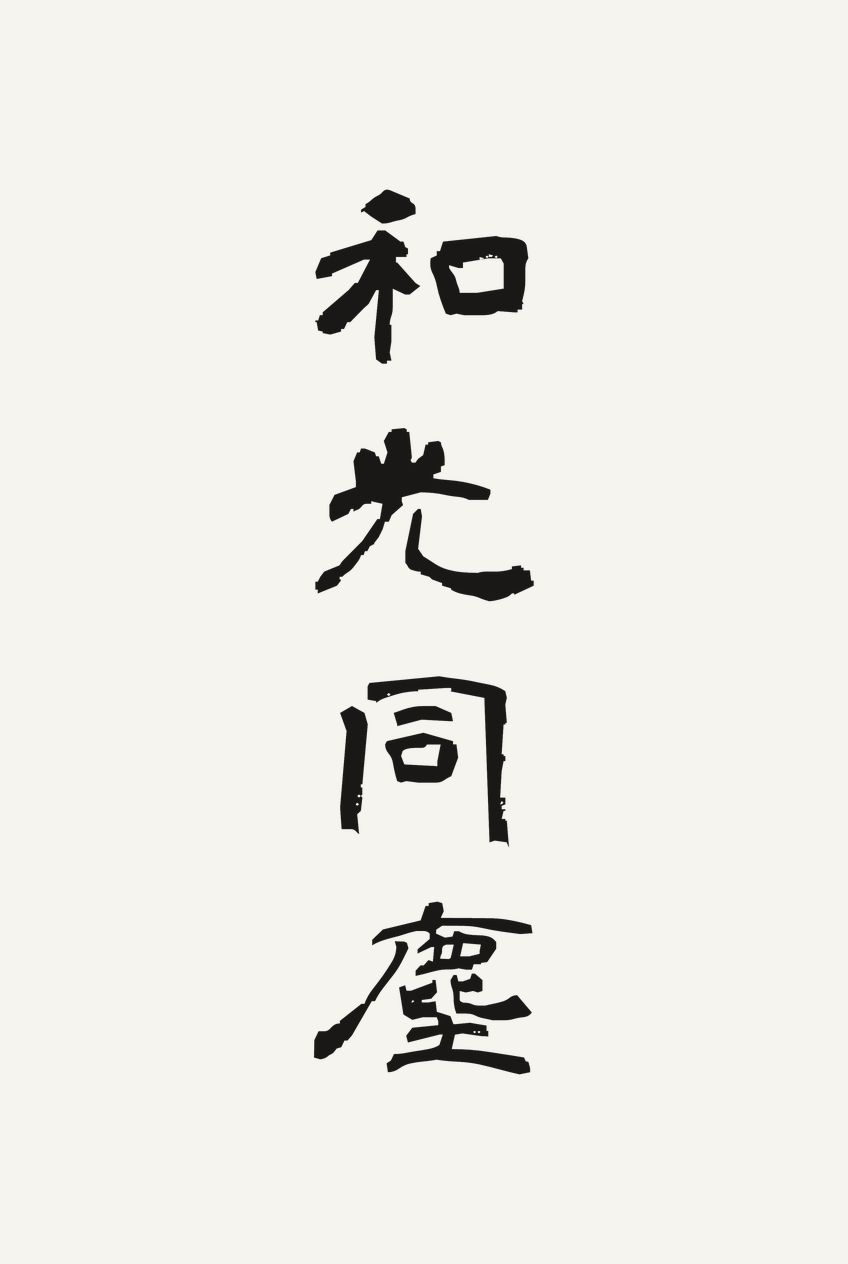
和光同尘 · Hé Guāng Tóng Chén
Soften the Light, Share the Dust
Series: Auspicious Idioms · Design #25
Style: four characters, vertical column · clerical script (lishu) · traditional form 和光同塵 · medium
Form: 文字
The Name
Soften your light; share the dust. Laozi's instruction for the accomplished: dim the brilliance on purpose, stand at the same ground level as everyone else — not concealment, but dialing down. A light that cannot be dimmed must eventually be extinguished; a light that can modulate lasts. As a tattoo it is the graduate-level reading of humility: not thinking less of yourself, but showing less of yourself on schedule.
把光调柔;与尘同在。老子给「有成者」的指令:故意把光芒调暗,站到与所有人同样的地面高度——不是隐藏,是调音。不能调暗的光最终会被熄灭;能调制的光才能长久。纹上它,是谦逊的进阶读法:不是把自己想得更低,而是按场合把自己显示得更少。
Source & Provenance
Daodejing 4 and 56, original text: 和其光,同其塵 — "blend the light; equalize the dust"; chapter 56 continues with the famous 挫其銳,解其紛 (blunt the sharpness; untangle the knots). The four-character compound 和光同塵 is the scripture's own distillation, fixed by early commentaries. Inking note: this design adapts the classic line construction of the traditional motif and re-inks it as tattoo linework.
《道德经》第四、五十六章原文:和其光,同其塵——「调和它的光,同齐它的尘」;五十六章接着是著名的挫其銳,解其紛(挫掉锐气,解开纷结)。四字复合「和光同塵」是经文自己的蒸馏,早期注疏定型。墨线转写:本设计以传统母题的经典线条造型为底,转写为纹身墨线。
Design Inspiration
Every form decision points to a recorded source, element by element. ① Four characters, one vertical column — light (光) harmonized above, dust (塵 — deer running into dust) settled below. ② Clerical script, traditional form 和光同塵 — 塵's deer over earth is the densest glyph; the level script keeps the whole column grounded. ③ Medium scale — 12–14 cm. ④ Black ink only — light and dust are both rendered in one grey.
本设计的每一处形制决定都有出处可查,逐条对账。① 四字竖列——光(光)在上被调和,尘(塵——鹿群奔起扬土)在下落定。② 隶书、繁形「和光同塵」——「塵」的鹿上加土是最密的一个字;平正的书体让整列都踏在地面上。③ 中尺寸——12–14 厘米。④ 只用墨——光和尘本来就该是同一种灰。
The Story
Chapter fifty-six is Laozi's manual for the sage who must live among people: those who know do not talk; those who talk do not know. Then the operations: blunt the sharpness, untangle the knots, soften the glare, share the dust. This is not a hermit's protocol — it is a working professional's. The point is not to hide competence but to remove its spikiness: the brilliant colleague everyone defers to and no one confides in has sharp edges; the brilliant colleague who asks how your weekend was has learned to modulate.
The character 塵 carries the image in miniature: a herd of deer, and the dust they raise. Light that never touches ground never illuminates anything. 和光同尘 is light that chose to descend — deliberately, reversibly, with the dimmer switch in your own hand.
第五十六章是老子给「必须与人群共处的圣人」的手册:知者不言,言者不知。然后是操作项:挫其锐,解其纷,和其光,同其尘。这不是隐士规程——是职业人的。要点不是藏起能力,是拔掉能力的刺:那位人人让着、却无人交心的天才同事带着锐角;那位会问你周末过得怎样的天才同事学会了调制。
「塵」字把这个意象微缩在内:一群鹿,和它们扬起的土。从不接触地面的光从不照亮任何东西。和光同尘是选择降落的光——主动地、可逆地,调光开关在自己手里。
What It Means
For the newly promoted, the visibly gifted, the ones whose competence makes rooms go quiet. It is a survival protocol with an aesthetic: be the light, not the glare.
给新晋升的、天赋显眼的、能力让房间安静下来的人。它是一份带着美学的生存协议:做光,不做刺眼。
Where It Sits
Four characters, one plane: inner forearm best, spine, outer thigh. 12–14 cm legible; below 9 cm the 塵 density clogs.
四字,一个平面:小臂内侧最佳,脊柱、大腿外侧次之。12–14 厘米可读;低于 9 厘米「塵」的密度会糊。
Before You Ink
Four characters are the whole design. ② Traditional form 和光同塵. ③ Clerical script, level weight — the dimming is in the evenness. ④ Minimum 9 cm for 塵's density. ⑤ Modulation, not disappearance. Laozi says soften the light, not extinguish it. If you use the tattoo to justify hiding, you have misread your own arm.
四个字就是全部设计。 ② 繁形「和光同塵」。 ③ 隶书、体量平正——调暗藏在均匀里。④ 9 厘米起,「塵」的密度才立得住。⑤ 调制,不是消失。 老子说把光调柔,没说把光熄灭。如果你拿这个纹身当藏起来的理由,你读错了自己的手臂。
Every character on this card was selected and checked stroke by stroke by a native reader of Chinese.