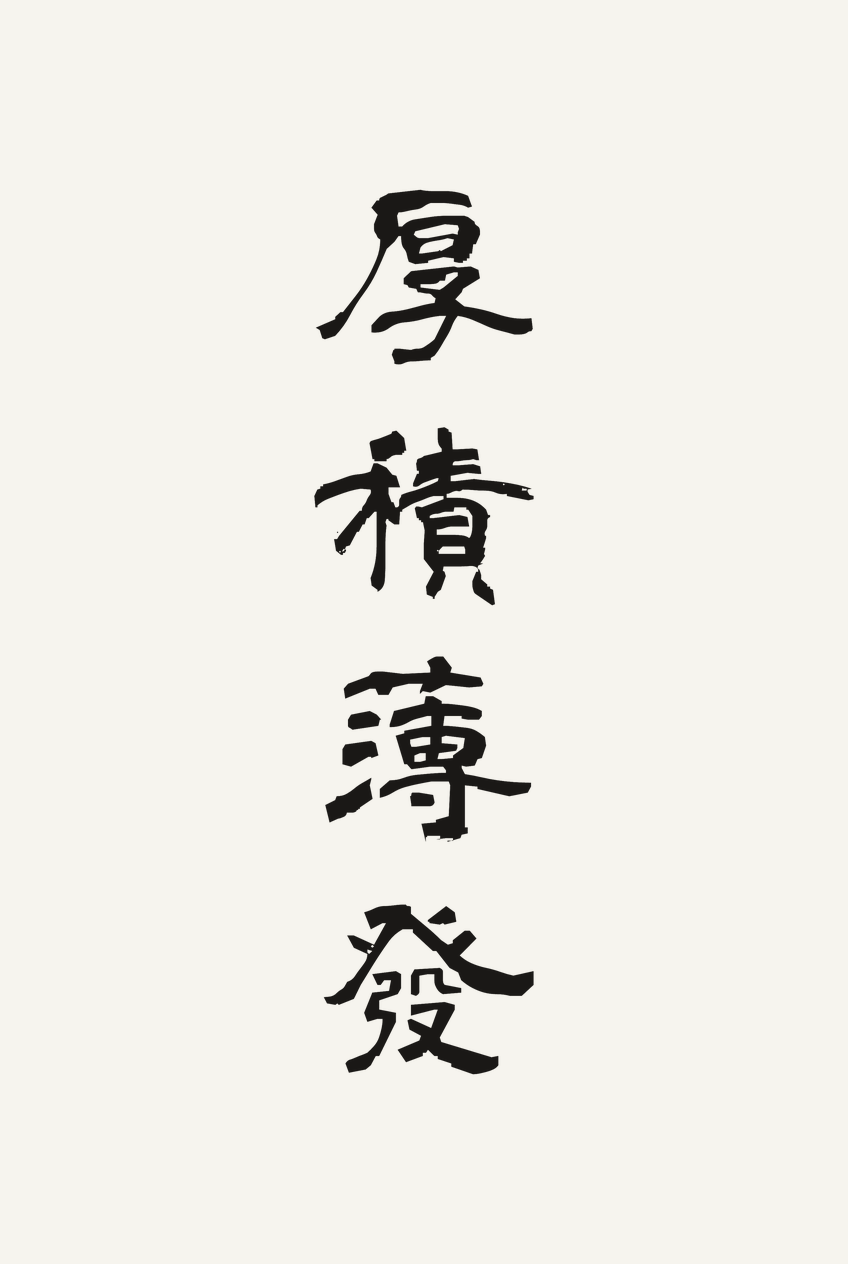
厚积薄发 · Hòu Jī Bó Fā
Store Deeply, Release Thinly
Series: Auspicious Idioms · Design #29
Style: four characters, vertical column · clerical script (lishu, traditional form 厚積薄發) · medium
Form: 文字
The Name
Su Shi, essayist and farmer-by-correspondence, sent a friend a piece of farming advice that doubled as a philosophy of career: land forced to yield two harvests a year gives out within a few years; land left to recover, planted sparsely, feeds people for generations. Then the principle, in his own words: 博觀而約取,厚積而薄發 — read widely, take sparingly; store deeply, release thinly.
苏轼——文章家,也是书信里的农人——给朋友送去一段种田的建议,顺便交付了一种职业哲学:被逼着一年出两季粮的地,几年就废;养过来的地,种得稀,几代人吃不完。然后是原理,用他自己的话说:博觀而約取,厚積而薄發——看得多,取得少;存得厚,放得薄。
Source & Provenance
Su Shi, "On Farming, Sent to Zhang Hu" (稼說送張琥, c. 1069): 博觀而約取,厚積而薄發 — the original text; the tattoo drops the conjunction 而, as the fixed idiom does. Doctrine and wording both Su Shi's. Inking note: this design adapts the classic line construction of the traditional motif and re-inks it as tattoo linework.
苏轼《稼说送张琥》(约 1069 年):博觀而約取,厚積而薄發——原文实录;纹身按定型成语省去连词「而」。义理与措辞都是苏轼的。墨线转写:本设计以传统母题的经典线条造型为底,转写为纹身墨线。
Design Inspiration
Every form decision points to a recorded source, element by element. ① Four characters, one vertical column — a loading order: 厚 accumulates on top, 薄 pays out below. ② Clerical script, traditional form 厚積薄發 — the level strokes store pressure; the single flick of 發 releases it. ③ Medium scale — 12–14 cm. ④ Black ink only — the field is one ink; the harvest is what varies.
本设计的每一处形制决定都有出处可查,逐条对账。① 四字竖列——装填次序:厚在上面积累,薄在下面支出。② 隶书、繁形「厚積薄發」——平正的笔画在蓄压,「發」那一笔捺是放出去。③ 中等尺寸——12–14 厘米。④ 只用墨——田只有一种墨,收成才有变化。
The Story
The essay is about farming and is not about farming. Su Shi's friend was a career official in a court that rewarded the flashy; Su Shi told him the greener grass is exhaustible, and the boring field is the trust fund. The prediction held in the author's own life too — he was exiled three times for saying unfashionable true things, and every exile produced the writing he is remembered by. Deep storage pays out on a schedule the shallow field cannot see.
这篇文章讲种田,也不是讲种田。苏轼的朋友是个朝廷里吃亏的官员,朝廷奖赏的是好看的那类东西;苏轼告诉他,鲜的草是消耗品,无聊的田才是信托。这个判断在作者自己身上也兑现了——他因为说不合时宜的真话被贬三次,而每一次流放都产出了他后来被记住的那些文字。厚积的支出表,薄的地看不见。
What It Means
For the long apprenticeship: the degree after the degree, the craft years no audience applauds. It licenses patience as a strategy, not a temperament.
给漫长的学徒期:学位之后的学位,没有观众鼓掌的手艺年头。它把耐心授权为一种战略,而不是一种性格。
Where It Sits
Four characters, one column: inner forearm best, spine, outer thigh; 12–14 cm; below 9 cm the 積 density clogs.
四字竖列:小臂内侧最佳,脊柱、大腿外侧;12–14 厘米;低于 9 厘米「積」的密度会糊。
Before You Ink
Four characters are the whole design. ② Traditional form 厚積薄發. ③ Minimum 9 cm. ④ The ratio is the point — store at 厚, spend at 薄; a tattoo of pure accumulation is a warehouse, not a strategy. ⑤ It only pays if you actually kept storing — the ink is the receipt, not the savings.
四个字就是全部设计。 ② 繁形「厚積薄發」。 ③ 9 厘米起。 ④ 比例就是要点——按厚来存,按薄来花;只进不出的纹身是仓库,不是战略。⑤ 前提是你真的还在存——墨是收据,不是存款。
Every character on this card was selected and checked stroke by stroke by a native reader of Chinese.