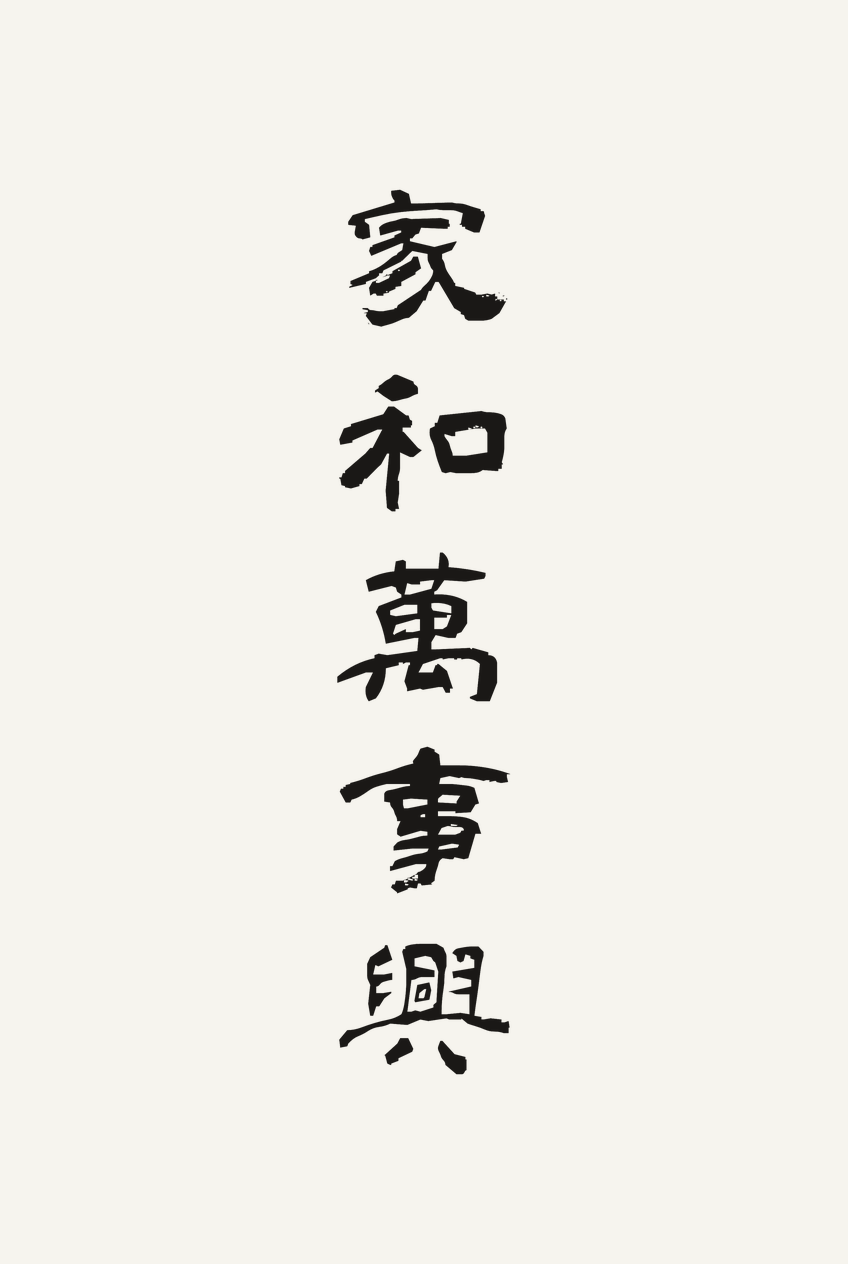
家和萬事興 · Jiā Hé Wàn Shì Xīng
A Home in Harmony, and Everything Rises
Series: Auspicious Idioms · Design #36
Style: five characters, vertical column · clerical script (lishu, traditional form 家和萬事興) · medium
Form: 文字
The Name
Five characters carrying a full theory of how things work: when a home is in harmony (家和), ten thousand affairs (萬事) rise of themselves (興). The doctrine has a classical root — *Analects, Xue Er*: 禮之用,和為貴 — "in the practice of courtesy, harmony is the standard." The five-character proverb itself is folk wisdom, in common circulation through the Ming and Qing; it is stated here as such, without inventing a single first source.
五个字背着一套完整的运行理论:家里和了(家和),万事自己就往上走(萬事興)。义理有经典的根——《论语·学而》:「禮之用,和為貴。」五字俗谚本身是民间智慧,明清以来通行;此处如实标注,不编造单一首证。
Source & Provenance
Doctrine rooted in *Analects, Xue Er* (有子): 禮之用,和為貴 — "harmony is what courtesy is for." The five-character proverb is folk, Ming–Qing circulation, no single first attestation — stated as such. Inking note: this design adapts the classic line construction of the traditional motif and re-inks it as tattoo linework.
义理根在《论语·学而》(有子):「禮之用,和為貴。」五字俗谚属民间,明清通行,无单一文献首证——如实标注。墨线转写:本设计以传统母题的经典线条造型为底,转写为纹身墨线。
Design Inspiration
Every form decision points to a recorded source, element by element. ① Five characters, one vertical column — the extra length is the point: the saying literally takes longer to read than four-character idioms, because 万事 takes longer to happen. ② Clerical script, traditional form 家和萬事興 — 興, the rising character, gets the fullest strokes at the bottom: the column ends climbing. ③ Medium scale — 11–14 cm. ④ Black ink only — the proverb is load-bearing; it does not need paint.
本设计的每一处形制决定都有出处可查,逐条对账。① 五字竖列——多出来的一格就是要点:这句话读起来比四字成语长,因为万事本来就需要更长时间。② 隶书、繁形「家和萬事興」——「興」是上升的字,笔画在底部收得最满:整列读到最后是向上走的。③ 中等尺寸——11–14 厘米。④ 只用墨——这句谚语是承重墙,不需要刷漆。
The Story
It is the least romantic sentence ever written about family, and the most useful. It does not promise love, or happiness, or even warmth — it makes a structural claim: get the harmony right, and the ten thousand affairs handle themselves. Anyone who has watched a household disagree about money, or a family business split over pride, knows the claim is empirically true and empirically hard. The proverb doesn't romanticize the work; it just states the return, the way a farmer states the weather.
这是关于家庭写得最不浪漫、也最有用的一句话。它不许诺爱,不许诺幸福,甚至连温暖都不许——它只做一个结构性论断:把和摆正,一万件事自己会理顺。见过一个家庭为钱争执、一门生意为意气拆伙的人都知道,这个论断在经验上为真,也在经验上难。这句谚语不为这份工作镀金,它只陈述回报,像农人陈述天气。
What It Means
For the ones building something that has to outlast a single mood — a household, a partnership, a name. Harmony first is not softness; it is sequence.
给在造某种要活得比一时情绪更久的东西的人——一个家,一份合伙,一个姓氏。和为先不是软,是次序。
Where It Sits
Inner forearm, spine, side of the ribcage; 11–14 cm; below 8 cm the 興 strokes merge.
小臂内侧、脊柱、肋侧;11–14 厘米;低于 8 厘米「興」的笔画会并死。
Before You Ink
Five characters are the whole design. ② Traditional form 家和萬事興. ③ Minimum 8 cm. ④ 興 ends the column on purpose — rising last, it is the punchline; do not let the artist shrink it to fit. ⑤ Longest of the five-character sayings — plan the body real estate accordingly.
五个字就是全部设计。 ② 繁形「家和萬事興」。 ③ 8 厘米起。 ④ 「興」收尾是有意的——最后上升,是全句的落点;别让纹身师为凑尺寸把它缩小。⑤ 五字句里最长的一件——提前规划好身体的位置。
Every character on this card was selected and checked stroke by stroke by a native reader of Chinese.