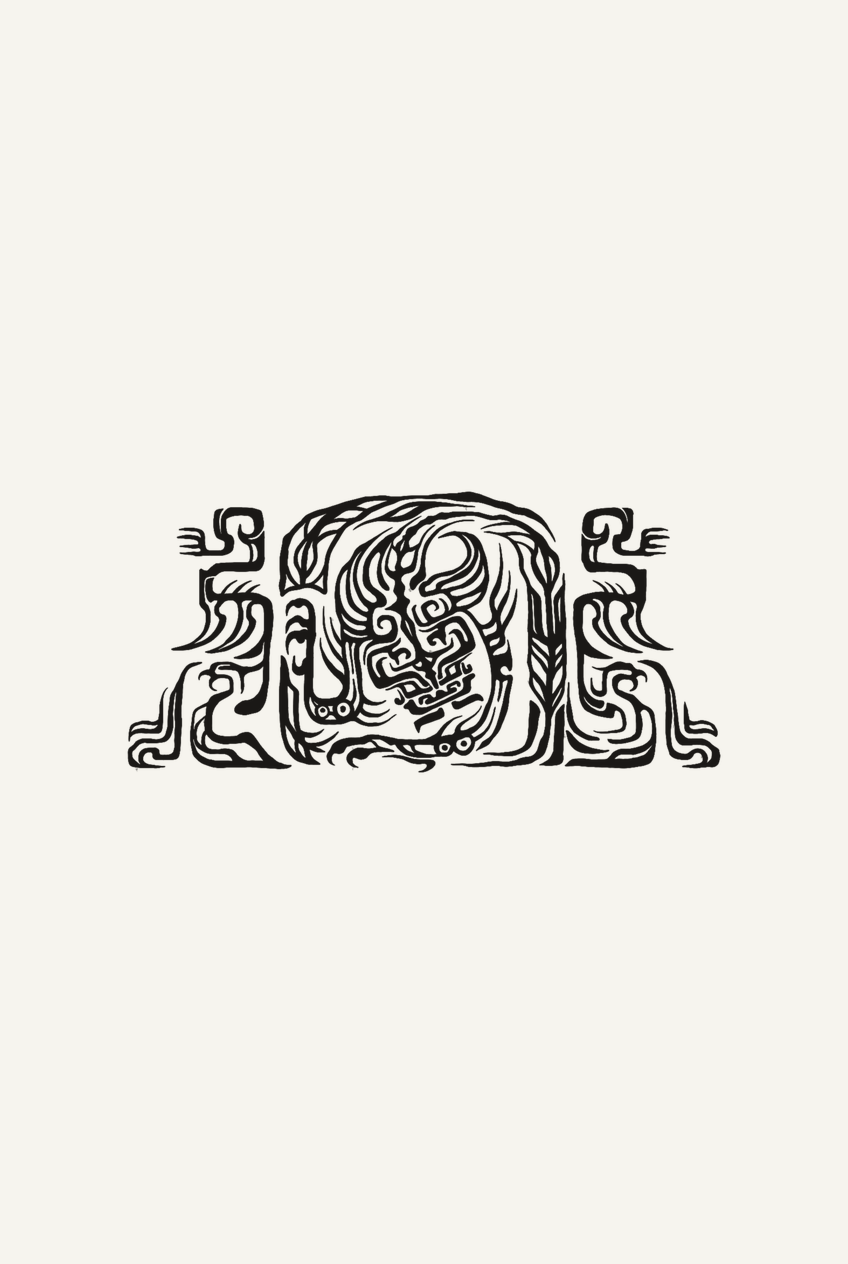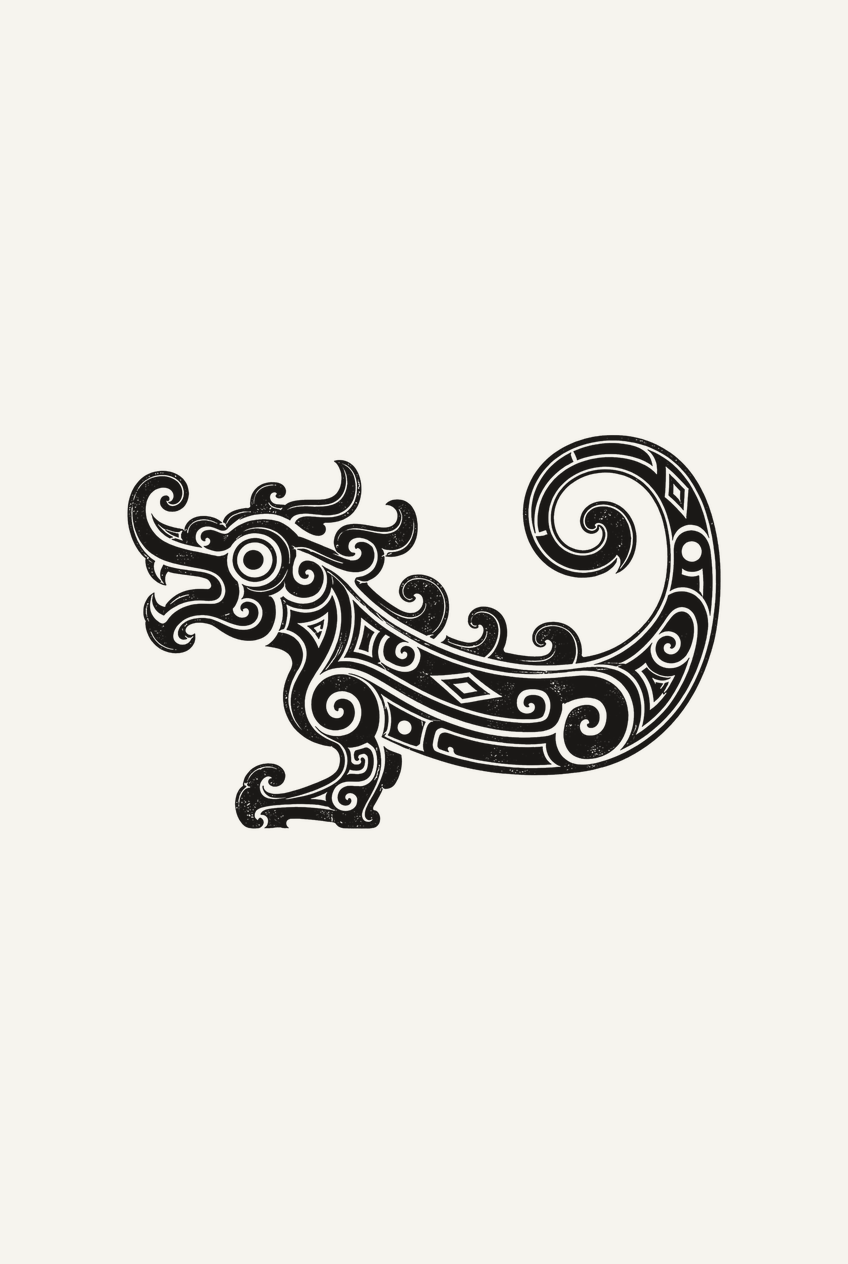
夔龙 · Kuí Lóng
The One-Footed Dragon
Series: Dragons of China · Design #07
Style: archaic bronze kui-dragon silhouette · filled black profile · side-facing single band
Form: 图案
The Name
*Kuí lóng* — the kui dragon, the oldest dragon on this site. Not the coiling emperor of Ming ceilings or the storm-bringer of temple walls, but the dragon of the Chinese Bronze Age: a thin, angular profile with open jaws, a curling tail, and — famously — one leg. It lived on ritual bronzes for over a thousand years, and when Song-dynasty antiquarians catalogued those vessels a millennium later, they gave this figure its name: 夔龙纹, "kui-dragon pattern." This design is that catalogued figure, filled in solid black the way the bronzes carried it in negative.
夔龙——全站最老的一条龙。不是明清藻井里盘绕的帝龙,也不是宫墙上呼风唤雨的龙,而是中国青铜时代的龙:一道细瘦方折的侧影,张着口,卷着尾,最著名的是——只有一条腿。它在礼器青铜上住了一千多年;一千年后宋人编录那些器物,给这道纹样定了名:夔龙纹。本设计就是那道被定名的纹,按青铜上的负空间填成实黑。
Source & Provenance
The creature has a text: the *Classic of Mountains and Seas* (山海经·大荒东经) records the kui as a one-legged storm beast of the eastern sea — "its light like the sun and moon, its sound like thunder." The *pattern* has objects: kui profiles wind across Shang and Western Zhou ritual bronzes from roughly the thirteenth century BC — you can read them today on vessels in every major collection. The *name for the pattern* has a date: Song-dynasty antiquarian catalogs (the *Archaeological Catalogues of the Xuanhe Era*, 宣和博古图, 1120s) fixed 夔龙纹 as the term for these one-legged profiles, and scholars have argued ever since about whether the ancient bronzes intended one leg at all — the leg may simply have been cropped by the band's edge. Inking note: this design adapts the classic line construction of the traditional motif and re-inks it as tattoo linework.
神有文字:《山海经·大荒东经》记夔是东海一足的雷兽——「其光如日月,其声如雷」。纹有器物:约公元前十三世纪起,夔形侧影缠绕商与西周的礼器青铜——今天在任何重要馆藏的器身上都能读到。而纹样的名字有年代:宋人金石学著录(宣和博古图,1120 年代)把这类一足侧影定名为「夔龙纹」,此后学界争论至今——青铜上的夔究竟是不是真想画一条腿,可能只是纹饰带边缘把腿裁掉了。墨线转写:本设计以传统母题的经典线条造型为底,转写为纹身墨线。
Design Inspiration
Every form decision points to a recorded source, element by element. ① The filled-black silhouette — the bronzes show kui as dark ground against light field; the design carries that negative-space logic into ink. ② The angular profile — square bends, not curves: bronze-casting geometry, distinct from every post-Han dragon on this site. ③ The single leg — kept, per the Song-catalogued convention and the 山海经 text; the scholarly doubt is part of the story, not an error to fix. ④ The curled tail and gaping jaw — the two features every catalogued kui shares.
本设计的每一处形制决定都有出处可查,逐条对账。① 填黑剪影——青铜上夔是暗地衬亮场;设计把这套负空间逻辑带进墨线。② 方折侧影——方转角,非圆曲线:铸范几何,与全站汉以后的所有龙都不同。③ 独足——按宋人定名与《山海经》文本保留;学界「其实可能只是裁边」的疑问是故事的一部分,不是要修的错。④ 卷尾与张口——著录夔纹共有的两征。
The Story
Three thousand years ago, a bronze founder in the Shang capital drew a dragon that makes no sense as an animal: one leg, a body like a folded ribbon, jaws open around nothing. Then he cast it in the margins of a ritual vessel, and his colleagues repeated it for a thousand years, until the Western Zhou gave way and the kui faded from the foundries.
The beast had a biography before it had a pattern. The *Classic of Mountains and Seas* says the kui lived in the Flowing Wave Mountain of the eastern sea, shone like sun and moon, roared like thunder — and that the Yellow Emperor took its hide to make a drum, whose sound carried five hundred *li*. One leg, divine voice. When Song scholars a millennium and a half later sat down with their catalogues of ancient bronzes and needed a name for the angular one-legged profiles on the Shang vessels, they reached for that storm beast and wrote 夔龙纹 — and the Bronze Age silhouette acquired a myth to match.
The honest footnote is part of the story: modern archaeology has quietly suggested the kui may never have been one-legged at all. The dragon bands on many bronzes are cropped mid-body by the vessel's register lines — the "single leg" may be a framing artifact, repeated for centuries because founders copied founders. A name fixed by a Song catalog, a doubt raised by a modern lens, and a question no one can answer: that is the kui. It wears uncertainty the way it wears its one leg — lightly, and without losing stride.
三千年前,商都的一位铸工画了一条作为动物完全不成立的龙:一条腿,身躯像折起的缎带,张口咬着空气。然后他把它铸进一件礼器的边饰,同行们照搬了一千年,直到西周落幕,夔在铸范里淡出。
这只兽先有传记,后有纹样。《山海经》说夔住在东海流波山,光如日月,声如雷——黄帝取它的皮蒙鼓,鼓声传五百里。一足,神声。一千五百年后,宋人金石学家对着商周器物图录,要给那些方折的一足侧影起名,伸手够到了那头雷兽,写下「夔龙纹」——青铜时代的剪影从此配上了神话。
诚实的脚注也是故事的一部分:现代考古悄悄提示,夔也许根本不是独足。许多青铜上的夔纹躯体被纹饰带的界线拦腰裁断——「一条腿」可能只是构图裁切,而铸工抄铸工,一抄几百年。一个宋人定下的名字,一个现代目光提起的疑问,一个无人能回答的问题:这就是夔。它背负不确定的样子,就像背负那条独腿——轻,而且不失步态。
What It Means
To be old enough that your origins are debated. The kui doesn't explain itself — a thousand years of bronzes, a myth of thunder, a Song catalog, and a modern doubt, all at once. For people whose story is layered rather than single-file: the family with two homelands, the craft with a lost source, the self assembled from texts nobody fully agrees on. One leg is enough to stand on when your voice carries five hundred li.
老到出身成谜。夔不解释自己——一千年青铜、一段雷的神话、一部宋人图录、一桩现代疑案,同时都在它身上。给故事分层而非单线的人:有两个故乡的家,有失传源头的手艺,由几部谁也无法完全说拢的文本拼起来的自己。声传五百里的话,一条腿站得够稳。
Where It Sits
The bronze band wants a long, flat stage: the inner forearm, the spine, or across the collarbone — anywhere the horizontal profile can run like a vessel frieze. 12–18 cm lengthwise. It also pairs with 蟠龙/团龙 from this series (same black-weight line) along a limb: kui band on the forearm, coiled dragon on the shoulder. The filled black sits best on the outer arm or calf, where shadow gives the silhouette depth.
青铜纹带要一条长而平的台:小臂内侧、脊柱沿线、或横过锁骨——侧影横陈如器腹纹带的地方。纵向 12–18 厘米。也可与本系列蟠龙/团龙(同黑度线)沿一条肢体排布:前臂夔纹带、肩头蟠龙。填黑剪影落在大臂外侧或小腿最好——阴影给剪影加深度。
Before You Ink
It faces sideways. The kui is a profile beast — insist on the side view; a front-facing kui is a modern invention. ② Solid black, not outline. The bronze logic is negative space; a hollow kui becomes generic line-art. ③ One leg stays one. If your artist "corrects" it to four, the 山海经 leaves the design. ④ Only ink. This is a bronze form — black-grey only. ⑤ Minimum size. 10 cm length; the square bends blur below that. High-wear spots (hands, feet) chew the filled black — keep it on sheltered planes.
它是侧影。 夔是侧视的兽——坚持侧面构图;正面的夔是现代发明。② 实黑,非空心。 青铜的逻辑是负空间;空心的夔就沦为普通线稿。③ 独足保持独足。 纹身师若「好心」补成四足,《山海经》就从设计里退场了。④ 只用墨。 这是青铜之形——只宜黑灰。⑤ 最小尺寸。 纵长 10 厘米起;再小,方折的转角会糊。高磨损位(手足)啃实黑——留在有遮蔽的面上。
Every character on this card was selected and checked stroke by stroke by a native reader of Chinese.