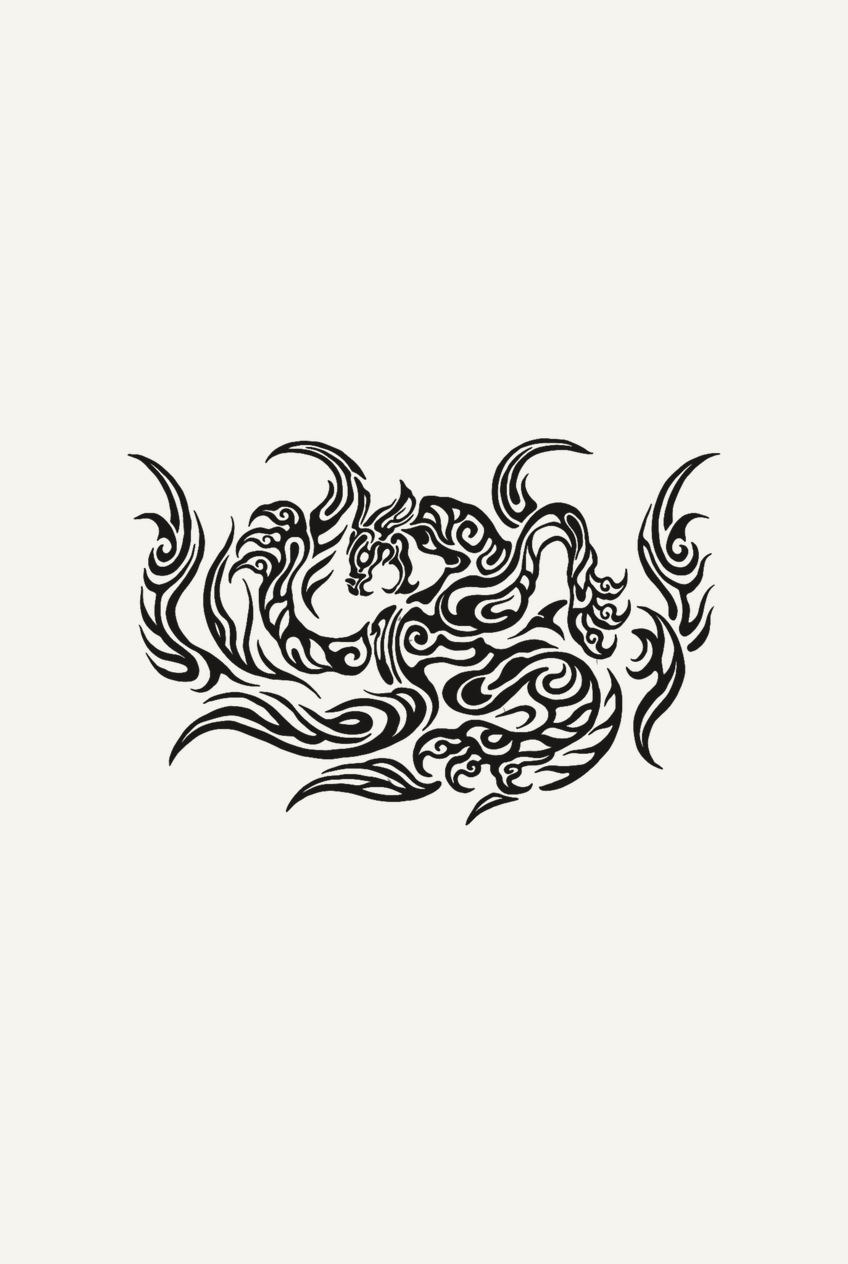
陆吾 · Lù Wú
The Warden of Kunlun
Series: Mythical Beasts & Sacred Animals · Design #09
Style: Tiger-bodied, nine-tailed, human-faced guardian with tiger claws · black-grey · vertical or coiled composition · scalable 12–18 cm
Form: 图案
The Name
*lù wú* — Luwu, the keeper of the most important address in Chinese myth. Beneath the axis mountain Kunlun stands the earthly seat of the Supreme Deity — 帝之下都, "the Deity's lower capital" — and Luwu is its warden. Tiger body, nine tails, human face, tiger claws. The text gives it rank: it administers nine departments of heaven and the seasons of the deity's gardens. This is not a monster at the gate. It is the head of the celestial civil service.
陆吾(lù wú)——中国神话里最重要地址的守卫者。轴心之山昆仑之下,是天帝在人间的行宫——「帝之下都」——而陆吾是它的总管。虎身、九尾、人面、虎爪。经文给它定了品级:司天之九部及帝之囿时。这不是守门的一只兽,这是天庭吏治的长官。
Source & Provenance
The *Shanhaijing*, *Xici San Jing* chapter (compiled c. 4th–2nd century BC), opening Kunlun: 「昆仑之丘,是实惟帝之下都,神陆吾司之。其神状虎身而九尾,人面而虎爪;是神也,司天之九部及帝之囿时。」 — Kunlun is the Deity's lower capital; the god Luwu administers it, tiger-bodied and nine-tailed, human-faced with tiger claws, in charge of the nine departments of heaven and the timing of the divine parks. Historical form reference: the *Shanhaijing* textual record; tiger guardians and nine-tailed beasts of Warring States and Han art. Inking note: this design adapts the classic line construction of the traditional motif and re-inks it as tattoo linework.
《山海经·西次三经》(约成书于前 4—前 2 世纪)开昆仑条:「昆仑之丘,是实惟帝之下都,神陆吾司之。其神状虎身而九尾,人面而虎爪;是神也,司天之九部及帝之囿时。」形制参考:《山海经》文本记载;战国与汉代艺术中的虎形守护与九尾神兽。墨线转写:本设计以传统母题的经典线条造型为底,转写为纹身墨线。
Design Inspiration
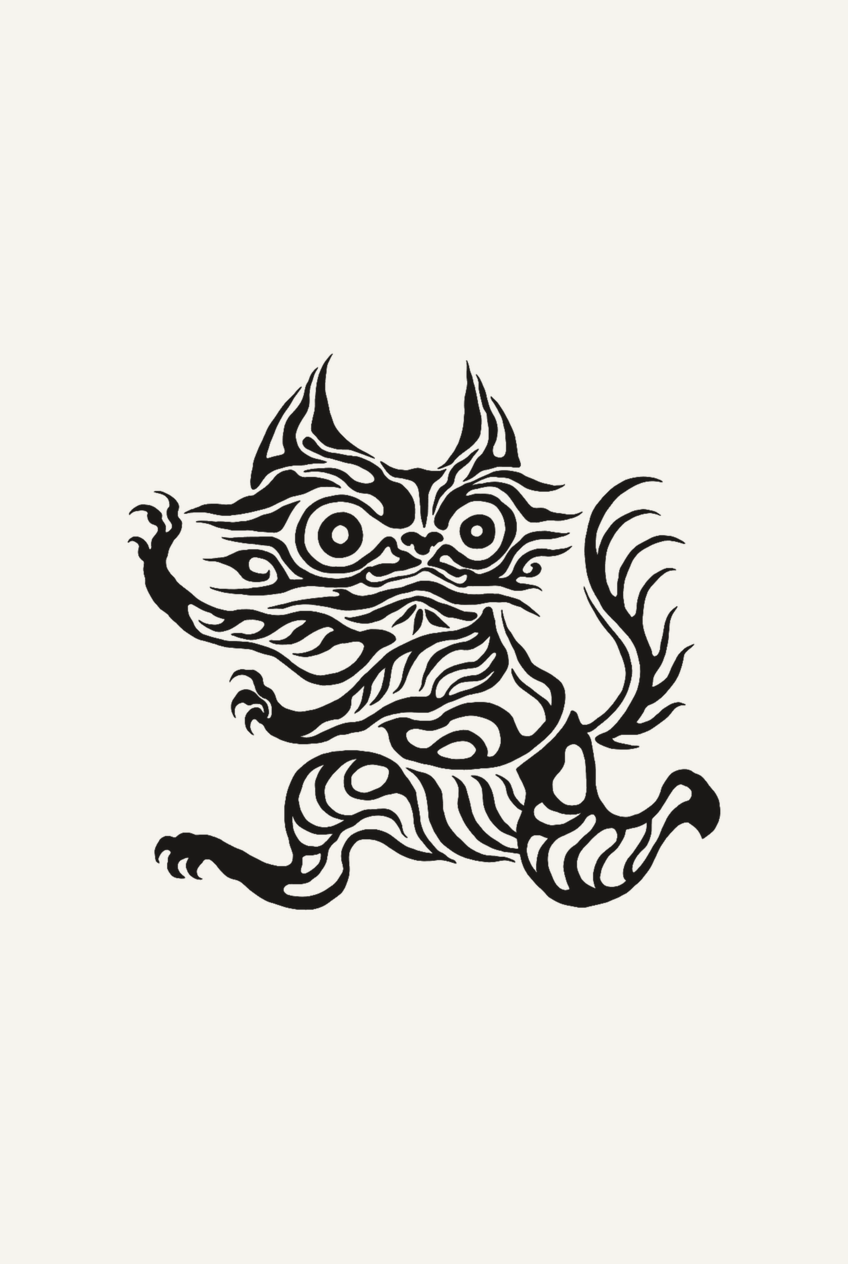
Every form decision on this design points to a recorded source, element by element. ① The tiger body — 虎身, the guardian's frame, weight settled on clawed forepaws. ② The nine tails — 九尾, fanned in a deliberate arc, the rank insignia of the text. ③ The human face — 人面, level and unhurried, the administrator's gaze. ④ The tiger claws — 虎爪, planted, the detail the text bothers to name twice.
本版每一处形制决定都有出处可查,逐条对账。① 虎身——「虎身」,守护者的骨架,重量稳稳落在带爪的前肢上。② 九尾——「九尾」,刻意展开成扇形,经文里的品级仪仗。③ 人面——「人面」,平视、不急,管事者的目光。④ 虎爪——「虎爪」,踏地生根——经文特意点到两次的细节。
The Story
Every mythology has its heaven. Ancient China went one further and gave heaven a filing system. The *Shanhaijing* opens the entry for Kunlun — the mountain at the center of the world — with a bureaucratic formula that is somehow more chilling than any monster: 是实惟帝之下都 — "this is the lower capital of the Deity." Not a dwelling. A capital. The gods ran an administration, and the administration had an address.
And an administrator. 神陆吾司之 — the god Luwu is in charge. The description that follows reads like an org chart drawn by a tiger: tiger body (security), nine tails (the nine departments it manages, some say — the number is the rank), human face (judgment), tiger claws (enforcement). Its portfolio: the nine departments of heaven and the seasonal schedule of the deity's gardens. Read it plainly: Luwu decides when the gods' grounds open. It is heaven's chief of staff, drawn as a nine-tailed tiger, and the text never once calls it frightening — because power that is legitimate does not need to announce itself.
The nine tails are the design's crown, and they belong to a serious lineage: nine-tailed beasts run deep in Chinese records, from the fox of later legend back to the omen-beasts of the Shanhaijing world. Nine in Chinese numerology is the terminal digit — completeness, the whole set. A tiger with nine tails is a tiger that has nothing missing: every faculty, every season, every territory covered. The Chinese drew rank as multiplication.
As a tattoo it is for the person who runs the room without needing to stand on the table. The operator who holds the schedule, the one whose word quietly becomes the plan, the guardian who manages rather than roars. The claws are visible and the face is calm — both are true at once, and both are you. Nine tails, one address: everything within its keeping is in order.
每个神话都有自己的天堂。古代中国人更进一步——给天堂建了官僚制。《山海经》写昆仑——世界中央之山——的条目,开篇是一句比任何怪兽都更有威压感的公文腔:是实惟帝之下都。不是居所,是都城。神明在治理,治理就有衙门。
而衙门有主官。「神陆吾司之」——神陆吾总管。接下来的描述像一张由虎绘制的组织架构图:虎身(安保),九尾(所司九部,一说九即其品级),人面(裁断),虎爪(执行)。它的职权范围:天之九部,及帝之囿时。直白地读:天帝园囿何时开,陆吾说了算。它是天庭的幕僚长,画成一只九尾虎——而经文从头到尾没说它可怕,因为正当的权力从不自我宣告。
九尾是这张图的王冠,而且出身极正经:九尾之兽在中国记载里脉络极深,从后世传说的狐,一路回到《山海经》世界的瑞兽。九在中国数字学里是终数——完备、全数。九尾之虎是没有缺件的虎:每一项职能、每一个时令、每一片疆域都有人管。中国人画品级的方式是乘法。
所以它属于那种不必站上桌面就能镇住全场的人。掌握日程的操盘者,开口即成计划的那一位,以管理代替咆哮的守护者。爪子露着,脸是平静的——两者同时为真,两者都是你。九尾,一个地址:凡在它名下的,皆有条不紊。
What It Means
Legitimate authority, total coverage. Nine tails for nine departments: the completeness of someone who has the whole system in hand. For operators, protectors, and quiet chiefs — the one whose order is not loud but holds.
正当的权威,全域的覆盖。九尾对应九部:把整个系统握在手里的人的完备。适合操盘者、守护者、安静的长官——那种不靠声量的秩序,却人人遵守。
Where It Sits
Built to sit centered: 14–18 cm on the chest or the upper back, facing forward, tails fanned symmetric beneath. A coiled variant, 12 cm, packs into the shoulder — body spiraled, tails wrapping the arm. The face needs calm skin: keep it away from joints and stretch zones.
天生的正位构图:14–18 厘米置于胸口或上背,正面朝前,九尾在下方对称展开。盘身变体 12 厘米收进肩头——身盘起,尾绕臂。人脸需要平静的皮肤:避开关节与拉伸区。
Before You Ink
Count the tails before the stencil goes on — nine, no more, no less; it is the rank. ② The face should read human first, tiger second: keep the jaw structured and the eyes level. ③ Symmetry is the composition — a fan of tails that is not balanced reads as a mistake from across the room. ④ Grey by design: this guardian suits black-grey work — dense striped texture reads best in pure ink; soft wash in the tails is a welcome at-the-needle option; a full-color version exists in tradition but changes the register. ⑤ Respect the scale. Chest or back version minimum 14 cm so the face holds its composure; the shoulder coil minimum 10 cm. Chest placements stretch with age — ask for slightly heavier line weight to survive it.
上转印稿之前数尾巴——九条,不多不少,那就是品级。② 脸要先读出「人」,再读出「虎」:下颌要有结构,目光要平。③ 对称就是构图——尾扇不平衡,隔一间屋子都看得出是失误。④ 灰调为本:这位守护者天然适合黑灰——密的条纹肌理以纯墨呈现最佳;尾部柔晕是落针时的可选项;传统里有全彩版本,但气质会变。⑤ 留够尺寸。 胸背版不小于 14 厘米,脸的从容才撑得住;肩头盘身不小于 10 厘米。胸口会随岁月拉伸——请纹身师把线重稍稍加一档。
Every character on this card was selected and checked stroke by stroke by a native reader of Chinese.