上官婉儿 · Shàngguān Wǎn'ér
the Red Plum Mark
Series: Inked in History · Design #01
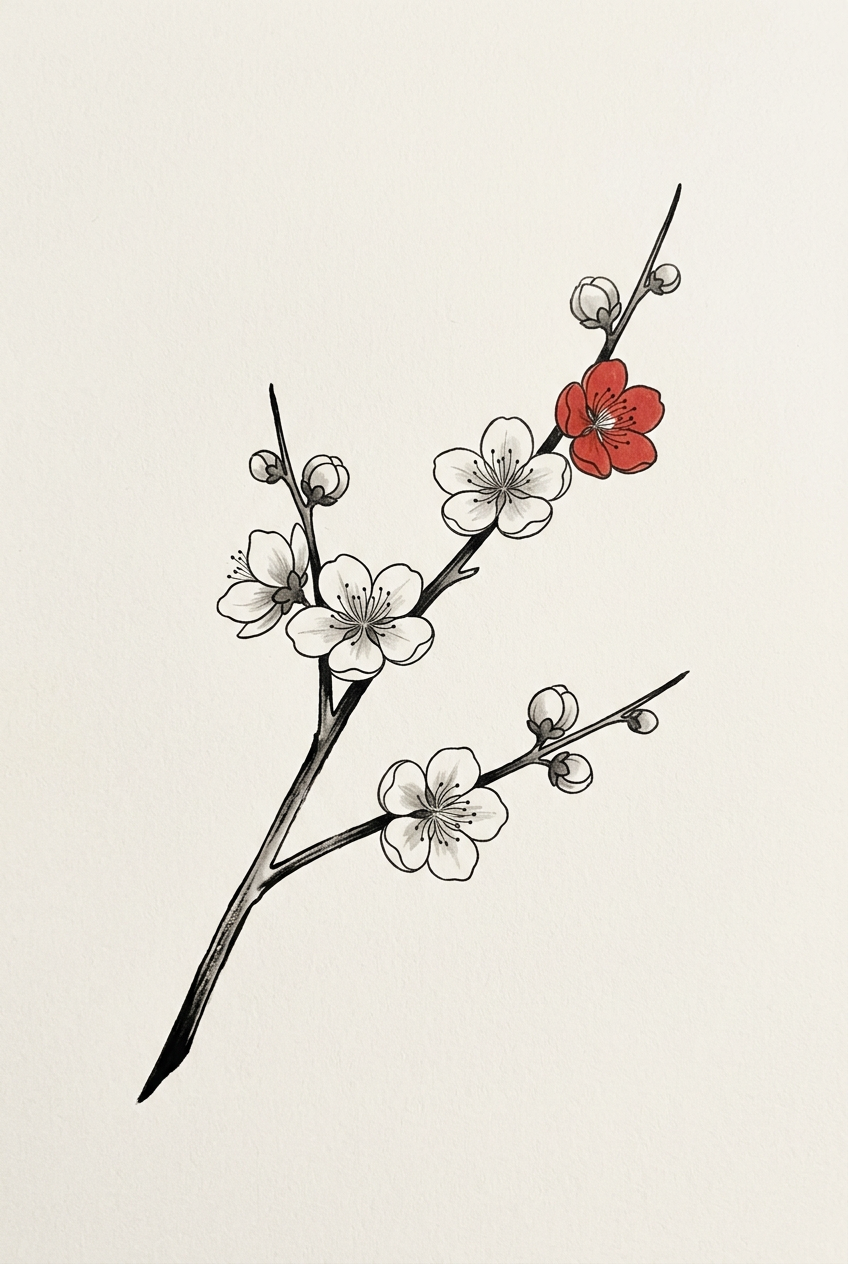
Style: single red-plum sprig · fine-line · one blossom carries the red · small-to-medium
Form: 图案
The Name
*Shàngguān Wǎn'ér* (664–710 AD) — poet, granddaughter of an executed chancellor, the most trusted pen of Empress Wu Zetian, and the woman the court called 巾帼宰相, "the female chancellor." And *hóngméi zhuāng*, "red plum makeup" — the forehead ornament she invented to cover a punishment tattooed onto her face. One is the person. The other is what she did with the worst thing that ever happened to her — the punishment that bloomed.
上官婉儿(664–710)——祖父宰相获罪被诛,她从掖庭的奴婢做到武则天手下最重要的女官,宫中人称「巾帼宰相」。「红梅妆」是她发明的:一朵红梅,盖住脸上那枚刑罚刺青。名字背后是她这个人;妆容背后,是她处置命运砸下来的最坏一件事的本事——那朵花,是刑罚开出来的。
Source & Provenance
The punishment is official history: *Old Book of Tang, "Biography of Shangguan Zhaorong"* (compiled 945 AD) — "Wan'er defied an edict and stood condemned to death; Wu Zetian, cherishing her talent, spared her life but had her face tattooed" (黥, the punitive facial ink). The red plums are legend, and the legend is Tang: Duan Chengshi's *Youyang Zazu* (c. 863) traces the court fashion of forehead ornaments (花子) back to Shangguan Zhaorong — worn, he says, to conceal the mark. Thirty-two of her poems survive in the *Complete Tang Poems*. Her tomb was excavated near Xianyang in 2013; the epitaph shows Princess Taiping sponsoring her burial in grief — while a thousand years of official history had painted her as a schemer. Honest layering: the facial tattoo is in the histories; the plum blossom is court legend. Both are true enough to wear.
黥面一事,正史有载:《旧唐书·上官昭容传》(945 年成书)——「婉儿忤旨当诛,则天惜其才不杀,但黥其面而已」。红梅一事,出自唐人笔记:段成式《酉阳杂俎》(约 863 年)记唐代额饰「花子」之风,起于上官昭容——为掩墨迹而制。她的诗存三十二首,收入《全唐诗》。2013 年其墓在咸阳出土,墓志是太平公主含悲营葬的实证——而此前一千年,官修史书一直在往她的名声上泼脏水。来路要分清:黥面是史笔,红梅是传说;一个见于正史,一个有唐人作证,都经得起讲。
Design Inspiration
Every form decision on this design points to a recorded source, element by element. ① The facial-ink event — *Old Book of Tang, Biography of Shangguan Zhaorong* (compiled 945): spared for her talent, but tattooed. ② The red-plum layer — Tang court legend recorded in Duan Chengshi's *Youyang Zazu* (c. 863), tracing the hua-zi forehead fashion to her; kept honestly separate from the histories. ③ The five-petal count — the same plum rule as the standalone 梅 design. ④ The single red accent — the color is in the historical name itself: hongmei zhuang, "red plum makeup." ⑤ The branch itself is ours — the makeup was a single blossom at the brow; the sprig is this design's own framing, and the one red blossom on it is the makeup. Ledger states which layer is which.
本版每一处形制决定都有出处可查,逐条对账。① 黥面本事——《旧唐书·上官昭容传》(945 年成书):惜才不杀,黥面而已。② 红梅层——唐人段成式《酉阳杂俎》(约 863 年)记额饰「花子」之风起于她,系宫廷传说,如实分层。③ 五瓣之数——与「梅」单卡同一规矩。④ 一点朱红——颜色就在历史名字里:红梅妆。⑤ 枝是创作——妆容本体是眉心一朵;一枝是本设计的构图承载,枝上那朵红的,就是那朵妆。虚实分层,对账如上。
The Story
In Tang China, a tattoo was not self-expression. It was the law's signature — inked into your face so every stranger could read your crime at a glance. Shangguan Wan'er was born the year that system touched her family: her grandfather, Chancellor Shangguan Yi, drafted an edict the emperor came to regret, and in 664 the entire clan paid for it. Wan'er, an infant, and her mother were sent to the 掖庭 — the palace compound that housed servants and convicts — as slaves. Her mother taught her to read there. At fourteen the girl was brought before Empress Wu Zetian and ordered to compose, on the spot, with no draft. What came out of her brush freed her: from slave to secretary of the most feared ruler alive.
She became the empire's pen — edicts, decrees, and the judgment of poetry: the records say she "weighed the talents of the realm" (称量天下士). And then, one day, she "defied an edict." The histories go quiet on what she did. The sentence was death; Wu Zetian commuted it to 黥 — a criminal mark inked permanently into the face. And what she did next is why this design exists: instead of powdering over the mark in shame, she inked a red plum blossom over it. The court lost its mind. Women copied it within a season. 红梅妆 swept the Tang palace — a punitive brand turned into the most desired beauty mark of the century, redesigned by the punished woman herself.
This is also the most tattooer move in Chinese history. Chinese punitive tattooing runs from 黥刑 all the way to the words pricked into Yue Fei's back (精忠报国 — a sibling design in this series): marks that power put on your skin. Wan'er's answer was authorship — *you gave me a mark; I decide what it is*. She died in the coup of 710, killed by the future Emperor Xuanzong; the histories then called her scheming. Her tomb says otherwise. The plums, as far as anyone can tell, won.
在唐代,往脸上刺墨不是潮流,是刑罚——墨刺进皮肉,一辈子洗不掉,走到哪儿,罪名跟到哪儿。上官婉儿出生那年,这规矩正好落到她家:祖父上官仪替皇帝起草了一份诏书,皇帝事后反悔,麟德元年(664)全族问罪。婉儿还在襁褓里,就随母亲郑氏没入掖庭为奴。她是在宫牢里识的字——母亲教的。十四岁那年,她被带到武则天面前,当场命题作文,不许起草,提笔便成。那一笔写出了她的生路:从掖庭的奴婢,一步做到天下最有权势的女人的机要秘书。
此后她就是朝廷的笔杆子——诏令制诰出自她手,天下诗文也归她评定,史称「称量天下士」。后来有一天,她「忤旨」了。忤了什么旨,史书讳莫如深。判的是死刑;武则天爱才,改判黥面——一枚刺进脸里、终身带走的罪记。换作旁人,多半是拿脂粉把墨迹遮到死。她不。她提笔在墨迹上画了一朵红梅。满宫看呆了。不出一个季度,宫女人人仿效,红梅妆风行唐宫——刑罚烙印成了那个世纪最抢手的美人记,而重新设计它的,正是受刑的那个人自己。
这也是中国历史上最「纹身」的一次作为。从黥刑到岳飞背上的「精忠报国」(本系列姊妹卡),中国刺字传统里的墨,从来是权力强加给人的。婉儿给出的回应却是:墨是你们给的,它是什么,我说了算。她死于 710 年的政变,动手的是日后的唐玄宗;官史随后给她定了「弄权」的评语,她的墓志说的却是另一番话。至于那朵红梅——如今看来,是它赢了。
What It Means
Taking the mark someone else gave you, and deciding for yourself what it becomes. Not covering up — authorship. This is a design for scars, for old mistakes, for the years nobody asks about; for anyone rebuilding a face for the world on their own terms. And it is simply elegance under a death sentence, twice over: she wrote her finest work inside the palace that enslaved her.
别人给的印记,由自己定它是什么。不是遮掩,是改写。有疤的人、走过弯路的人、不愿被人问起某几年的人,都合适;正在按自己的样子重新活一遍的人,更合适。她这一生被「判决」过不止一次,而她最漂亮的应对,恰恰都写在奴役过她的宫墙之内。
Where It Sits
The original was on the face — between the brows, on the forehead — and you can honor that directly: a 1–2 cm five-petal plum at the temple, above the brow, or behind the ear reads instantly to anyone who knows the story. If the face is too public a place, the comfortable equivalents: the nape (2–3 cm), collarbone, inner wrist, or a small sprig along the upper arm. Fine-line black, or one red accent if your artist works in color.
这妆本来长在脸上——两眉之间、额头之上——想致敬原位也可以:太阳穴、眉骨上方或耳后一朵 1–2 厘米的五瓣梅,知情的人一眼便懂。不想纹脸,后颈(2–3 厘米)、锁骨、手腕内侧,或大臂外侧一枝小红梅,都是好去处。黑灰细线即可;纹身师擅长彩色的话,添一点红更点题。
Before You Ink
Know your layers. The facial punishment is in the official histories; the red plum over it is Tang court legend, recorded in a ninth-century miscellany. Tell it as story, not citation — the story is better anyway. ② Five petals, not six (the same rule as the standalone 梅 design). ③ Don't confuse this with the *other* plum-makeup legend — Princess Shouyang of the Southern Dynasties, on whose forehead a petal allegedly fell. Wan'er's plums cover a mark; Shouyang's petal is just luck. Different story, different face. ④ This is a biography, not a blessing. It reads as "I decided what this mark means." Make sure that sentence is yours to wear. ④ One red only. The plum mark carries the single accent of red — everything else stays black-grey; more red reads costume, not legend. ⑤ Advanced work. Face and five-petal mark need at least 8 cm on flat skin (shoulder blade, outer arm); fine facial linework settles poorly on curved skin.
分清虚实。 黥面载于正史,红梅出于唐人笔记,是宫廷传说。跟人讲就当故事讲,不必抬出处——何况故事本身更好听。② 五瓣,不是六瓣(与「梅」字卡同一条规矩)。③ 别跟另一个梅花妆传说弄混——南朝寿阳公主,花瓣落在额上而成妆。婉儿的梅底下压着墨记,寿阳的花只是碰巧;两个故事,两样人生。④ 这张卡纹的是一个人的传记,不是一句吉利话。它在说:"这印记是什么,我说了算。"这句话是不是你的,想清楚再落针。④ 只点一处红。 红梅印记是设计里唯一的红——其余一律黑灰;红多就不是传说,是戏服。⑤ 高阶作品。 面部与五瓣印记不小于 8 厘米、落在平整肌面(肩胛、上臂外侧);曲面上的细线难服帖。
Every character on this card was selected and checked stroke by stroke by a native reader of Chinese.