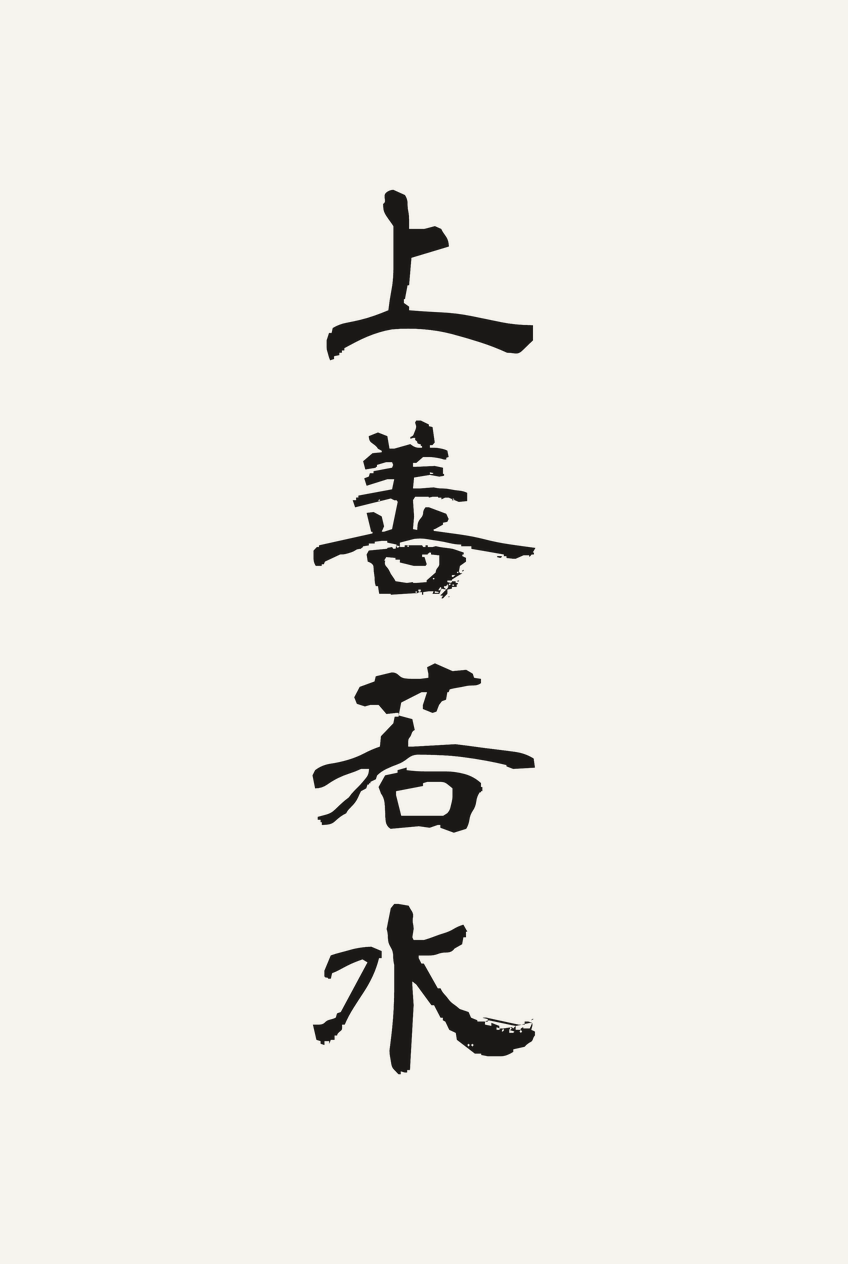
上善若水 · Shàng Shàn Ruò Shuǐ
The Highest Good Is Like Water
Series: Auspicious Idioms · Design #04
Style: four characters in a single vertical column · clerical script (lishu) · medium-to-large
Form: 文字
The Name
*Shàng shàn ruò shuǐ* — the highest good is like water. The opening teaching of chapter eight of the *Daodejing*, the most translated book after the Bible: 上善若水。水善利万物而不争 — "the highest good is like water; water benefits the ten thousand things and does not contend." Laozi needed one image for the best kind of person, and he did not pick the mountain or the oak. He picked the thing that flows to the lowest place and keeps everything alive on the way.
上善若水——《道德经》第八章的开篇教诲,《道德经》是译本数量仅次于《圣经》的书:上善若水。水善利万物而不争。老子要为一个「最好的人」找一幅像,他没有选山,没有选树。他选了那个流向最低处、一路上养活万物的东西。
Source & Provenance
The line is *Daodejing* chapter 8 (Laozi, ca. 4th century BC), in the received Wang Bi text and the older Mawangdui silk manuscripts alike — one of the chapter-eight lines stable across all transmitted versions. The full passage sets out water's seven likenesses of the good (居善地,心善渊…), and ends: 夫唯不争,故无尤 — "because it does not contend, it is beyond blame." Inking note: this design adapts the classic line construction of the traditional motif and re-inks it as tattoo linework.
文本出自《道德经》第八章(老子,约公元前四世纪),通行王弼本与更早的马王堆帛书本一致——这是第八章里所有传世版本都稳定的句子。全段铺开水与善的七种相像(居善地,心善渊……),收尾一句:夫唯不争,故无尤——因为不争,所以无可指摘。墨线转写:本设计以传统母题的经典线条造型为底,转写为纹身墨线。
Design Inspiration
Every form decision points to a recorded source, element by element. ① Four characters, one vertical column — the classic hanging format for this exact text: it is the most-hung idiom in Chinese teahouses and studios after 宁静致远. ② Clerical script (lishu) — the level, unhurried strokes of Han steles are water's own virtue drawn as writing: 不争 rendered as a line that never hurries. The wave-flourish at each stroke's end is the only ripple allowed. ③ Medium-to-large scale — the column rides a limb's length the way water rides a gradient: it needs fall to read. ④ Black ink only — ink is water's own medium; the design keeps the material honest.
本设计的每一处形制决定都有出处可查,逐条对账。① 四字一竖列——这段文本最经典的悬挂格式:它是继宁静致远之后,中国茶馆与书斋里挂得最多的成语。② 隶书——汉代碑刻平缓从容的笔画,正是「不争」写成的字:一条从不着急的线,收笔处的波磔是唯一被允许的涟漪。③ 中到大尺寸——这一列要借着肢体的长度走,像水借着坡度走:得有落差,才读得出流。④ 只用墨——墨本来就是水的媒介;设计对材料诚实。
The Story
Chapter eight is Laozi's answer to a question every ambitious age asks: what is the best kind of person? The age Laozi lived in gave its own answer loudly — the strong, the victorious, the men whose names were on the bronze. Laozi pointed the other way, and down: water. It seeks the low ground everyone else avoids. It yields to every obstacle and arrives anyway. It does the unglamorous work — feeding crops, floating boats, carving canyons — and never signs the work.
The seven likenesses that follow are a philosophy in miniature: 居善地 — in dwelling, be like water choosing the low place; 心善渊 — in mind, be like the deep pool; 与善仁 — in giving, be like water's generosity; 言善信 — in speech, be like the water level, truer than any oath. The passage is why Chinese statesmen from the Tang chancellors to the modern era have kept these four characters near their desks — a standing correction to ambition.
There is a harder reading, too, and it is the one that makes the line live: water is soft, and water wins. Nothing on earth is softer; nothing cuts the Grand Canyon. 不争 — without contending — is not surrender; it is the only strategy that never exhausts itself. The person who understands this stops fighting for credit and starts collecting gravity.
第八章是老子对每个野心时代都在问的问题的回答:什么样的人是最好的?老子身处的时代回答得震天响——强者、胜者、名字铸在青铜上的那些人。老子指向另一边,并且向下:水。它去往所有人避之不及的洼地。它对每个障碍退让,却照样抵达。它干着不体面的活——灌庄稼、浮舟船、切峡谷——从不署名。
接下来的七种相像是一部微缩哲学:居善地——居,学水择低;心善渊——心,学渊之深;与善仁——施,学水之慷慨;言善信——言,学水位之信,比任何誓言都准。这段话就是为什么从唐代宰相到现代,中国的人都把四个字放在案头——给野心的一副常备矫正器。
还有一层更硬的读法,也正是这句话活着的原因:水至软,水却赢。世上没有比水更软的东西,也没有什么切得过科罗拉多大峡谷。不争不是投降;是唯一不自我耗竭的战略。读懂这一点的人,不再争功,开始积攒重力。
What It Means
Strength that does not announce itself; usefulness without contention. The design is for people whose effectiveness runs quiet — the fixer, the carrier, the one who holds the team together and never needs the podium. Water is not humble because it is weak. Water is humble because it can afford to be.
不自报家门的力量;不争之用。给那些把事办成却不出声的人——修补者、承重者、把队伍黏在一起却从不需要讲台的人。水谦下,不是因为弱。水谦下,是因为它输得起,也就赢得久。
Where It Sits
The column follows the long muscles: inner forearm and spine are native, outer calf works. The clerical script's level, weighted strokes want a flat, slightly padded plane — ribcage side takes it beautifully. Minimum 12 cm column height; the wave-beat between characters is the design's current.
这一列沿着长肌走:小臂内侧与脊柱是原产地,小腿外侧亦可。隶书铺平的笔势要一块平整、略有肉的面——肋侧非常好。列高 12 厘米起;字与字之间的波磔起伏,就是这件设计的水流。
Before You Ink
Order is meaning. 上善若水 reads top to bottom; the sentence collapses if reordered. ② The script is the argument. Clerical script for water's level patience — its strokes stay level-weighted and calm; a brush-style rewrite turns the teaching into a splash. ③ Black ink only. Grey wash softens the stroke contrast this script depends on. ④ Give it fall. Under 12 cm the column reads as a stamp. ⑤ It is a discipline, not a mood. 不争 is the hardest sentence in the passage — wear it if you mean to practice it.
语序即意义。 上善若水自上而下读;重排即断句。② 书体就是论证。 写水用隶书的水平面——笔画横平沉稳;改成毛笔飞白,教诲就成了水花。③ 只用墨。 灰晕会软化这个书体赖以成立的笔画对比。④ 给落差。 低于 12 厘米,一列字读成印章。⑤ 这是功课,不是氛围。 不争是全段最难的句子——打算照着做,再落针。
Every character on this card was selected and checked stroke by stroke by a native reader of Chinese.