酸与 · Suān Yǔ
The Fear That Flies Ahead
Series: Mythical Beasts & Sacred Animals · Design #25
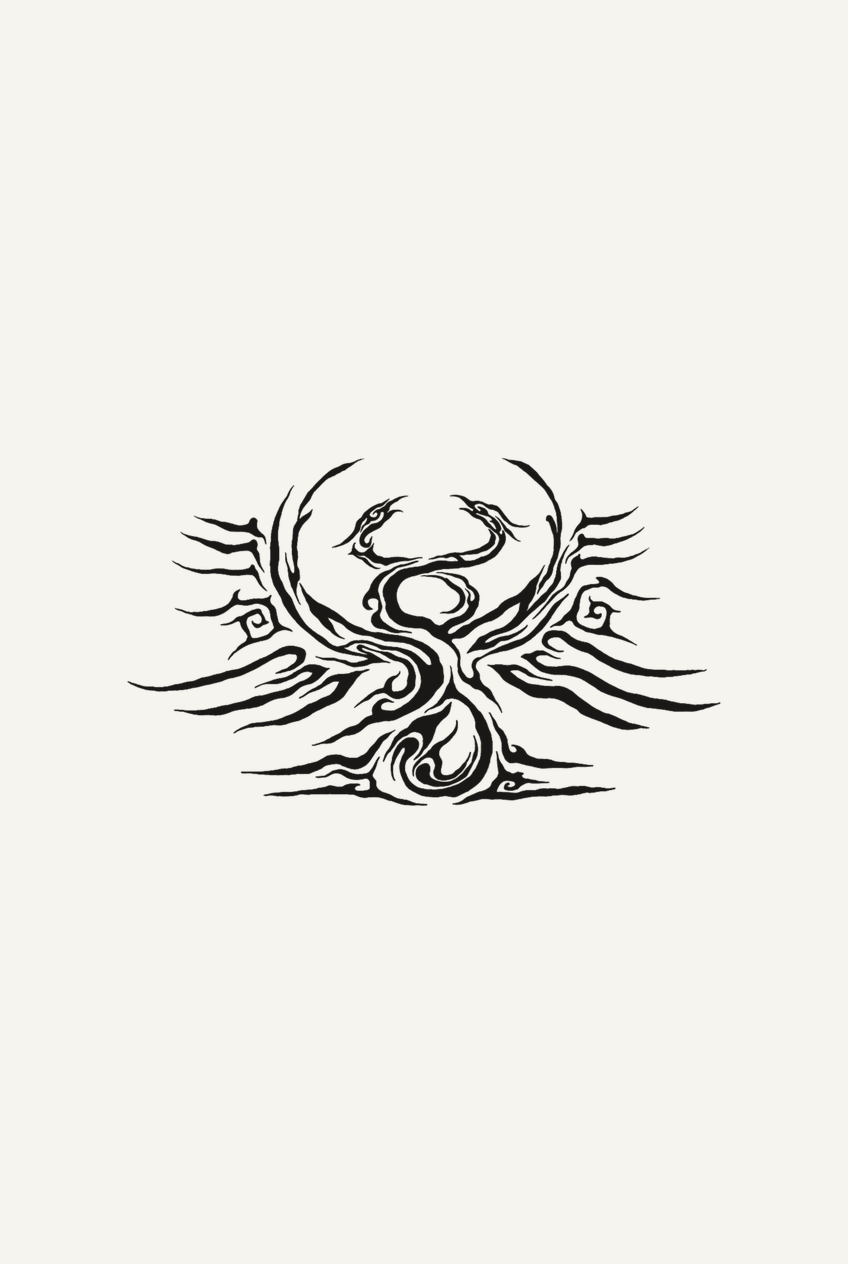
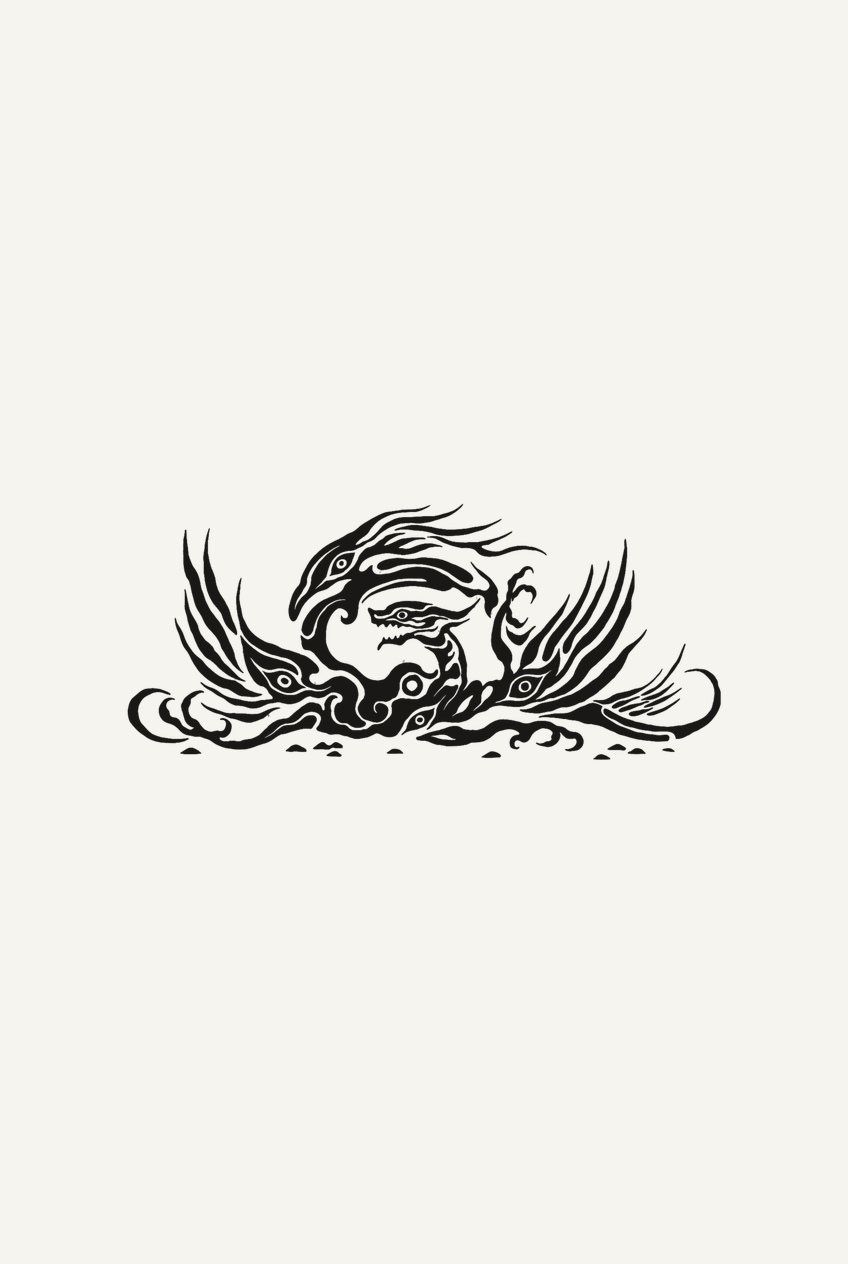
Style: Serpent-headed bird with open jaw, two enormous spread wings of layered plumes with eye motifs, wavy flame body and tail, mounds along the ground line · black-grey · landscape composition · scalable 14–18 cm
Form: 图案
The Name
*suān yǔ* — the four-winged, six-eyed serpent-bird of Jing Mountain, whose arrival the classic states without decoration: 见则其邑有恐 — when it appears, the town is gripped by fear. Not drought, not flood, not plague: 恐, the emotion itself. The Shanhaijing has many omens of disaster; this is its one omen of dread — the disaster that happens entirely inside people, arriving on wings before anything has actually gone wrong.
酸与(suān yǔ)——景山的四翼六目蛇鸟,经典记载它的现世不加任何修饰:见则其邑有恐——它一出现,满城陷入恐惧。不是旱,不是涝,不是瘟疫:恐,情绪本身。《山海经》里灾难的征兆很多;这是唯一一只「恐惧」本身的征兆——一场完全发生在人心里面的灾,抢先翅膀一步抵达。
Source & Provenance
The *Shanhaijing*, *Bei Shan Jing* chapter (compiled c. 4th–2nd century BC), Jing Mountain entry: 「有鸟焉,其状如蛇而四翼、六目、三足,名曰酸与,其鸣自詨,见则其邑有恐。」 — shaped like a serpent with four wings, six eyes, three legs; named Suan Yu, calling its own name; its appearance marks a town seized by fear. The text lists no remedy and no ritual: the classic does not prescribe against a mood. Inking note: this design adapts the recorded anatomy and re-inks it as tattoo linework.
《山海经·北山经》(约成书于前 4—前 2 世纪)景山条:「有鸟焉,其状如蛇而四翼、六目、三足,名曰酸与,其鸣自詨,见则其邑有恐。」状如蛇,四翼六目三足;鸣声像喊自己的名字;现世则满城惶恐。经文没开药方也没记祭法:经典从不对一种情绪开方。墨线转写:本设计以经文所记的形制,转写为纹身墨线。
Design Inspiration
Every form decision on this design points to a recorded source, element by element. ① The serpent head with open jaw — 其状如蛇, the recorded snake-form kept front and center, jaw open mid-call: its cry is its name, and the design lets you see the shout. ② The layered wings with eye motifs — 四翼、六目, the recorded counts taken seriously: four wings fanned wide, the six eyes distributed across the feather-tiers — a creature that watches from every layer of the air. ③ The wavy flame body and tail — the flight path drawn as undulating ribbon-fire: fear moves in waves, not lines. ④ The mounds along the ground — 其邑, the town's own earthworks at the bottom of the frame, small and still beneath the wingspan: what dread looks like from above.
本版每一处形制决定都有出处可查,逐条对账。① 开颌蛇首——「其状如蛇」,记载的蛇形居中正对,颌张开在鸣叫的半途:它的叫声就是自己的名字,图让你看见那声喊。② 带羽眼的层叠双翼——「四翼、六目」,记载的数目认真执行:四翼大张,六目分配在羽层之间——一只从空气的每一层往下看的兽。③ 焰浪身尾——飞行轨迹画成起伏的火带:恐惧是波动的,不走直线。④ 地面土丘散点——「其邑」,城邑自己的夯土留在画面底部,小而静,卧在翼展之下:从上面看下去的惶恐,是这个样子。
The Story
Consider the precision of the curse. The classic's great omens ruin kingdoms — 大水, 大旱, 大穰. Suan Yu's omen is one character smaller: its 邑, its town, catches 恐. Fear with city limits. The classic understood, twenty-three centuries early, that panic is a localized phenomenon: it does not need a flood to ruin a harvest — a rumor with wings will do. And so it imagined the rumor as a bird: six eyes (watching), four wings (spreading), a voice that names itself (rumors always do), and three legs — unstable, never standing still.
And note what the classic does not do: it never tells you to kill it, avoid it, or appease it. Other omens come with rites; this one comes with nothing — because you cannot sacrifice your way out of an emotion. The only defense the record implies is recognition: know what it looks like. Name it before it lands. The bird's cry is 自詨 — it announces itself. Fear always does; the failure is in the town that refuses to hear its own name being called.
So what does it mean to wear it? This is a design for the person who has studied their own dread closely enough to draw its anatomy — the racer before the start gun, the speaker before the curtain, anyone who has learned that fear, seen clearly, is just altitude. The six eyes are your vigilance now, pointed where you choose. 见恐者,先于恐。
品一品这个诅咒的精度。经典里的大兆毁国——大水,大旱,大穰。酸与的兆小一号:它的「邑」,它的城,染上「恐」。恐惧是有城市边界的。经典在两千三百年前就懂了:恐慌是一种局域现象——毁掉收成不需要洪水,一只长翅膀的谣言就够。于是它把谣言想象成鸟:六只眼(监视),四张翼(扩散),一副喊自己名字的嗓音(谣言从来如此),三条腿——站不稳,也从来不停。
再注意经典*没有*做什么:它从没叫你杀它、躲它、祭它。别的征兆配有祭法;这一条什么都不配——因为你没法靠献祭从一种情绪里赎身。记载里隐含的唯一防御是辨认:知道它长什么样。在它落地之前先叫出它的名字。这鸟鸣声「自詨」——它自己会报名字。恐惧从来都报名;失败的是那座不肯听自己名字被喊出的城。
所以纹它,纹的是什么?这是给那种把自己的恐惧研究到能画出解剖图的人的设计——发令枪前的赛手,开幕前的讲者,任何明白「恐惧被看清之后只是海拔」的人。那六只眼,现在是你的警觉,指向由你选。见恐者,先于恐。
What It Means
Dread, anatomized and outrun. The omen bird worn by the one who reads omens: six eyes of vigilance, four wings of spread, and the town below — safe, because it looked up first.
被解剖、被甩在身后的惶恐。征兆之鸟,戴在读征兆的人身上:六眼为警觉,四翼为传播,而底下的城——安然无恙,因为它先抬了头。
Where It Sits
Built horizontal and airborne: 14–16 cm across the upper back or chest, wings spanning the shoulder blades; a 12 cm variant flies along the forearm. The six eye motifs are the design's radar — keep all six legible; the count is the vigilance.
天生的横幅凌空构图:14—16 厘米横贯上背或胸口,双翼铺开肩胛;12 厘米变体沿小臂飞行。六枚羽眼是全图的雷达——六枚都要可读;数目就是警觉本身。
Before You Ink
This design belongs to ink only. Its unease is built from symmetry — black line holds the mirror exact; greyscale would soften the stare. Minimum size 10 cm: below that the layered plume-eyes merge and the count is lost. Keep it off the inner arm and the hip — those zones blur the small eye-rings first, and an uncountable vigilance is just pattern.
此图只宜墨线。它的不安由对称铸成——黑线让镜像分毫不差;灰阶会让注视变钝。最小尺寸 10 厘米:再小,层叠羽眼黏连,数目就丢了。避开臂内与胯——这两个区域最先糊掉的是小小的眼环,而数不清的警觉只是花纹。
Every character on this card was selected and checked stroke by stroke by a native reader of Chinese.