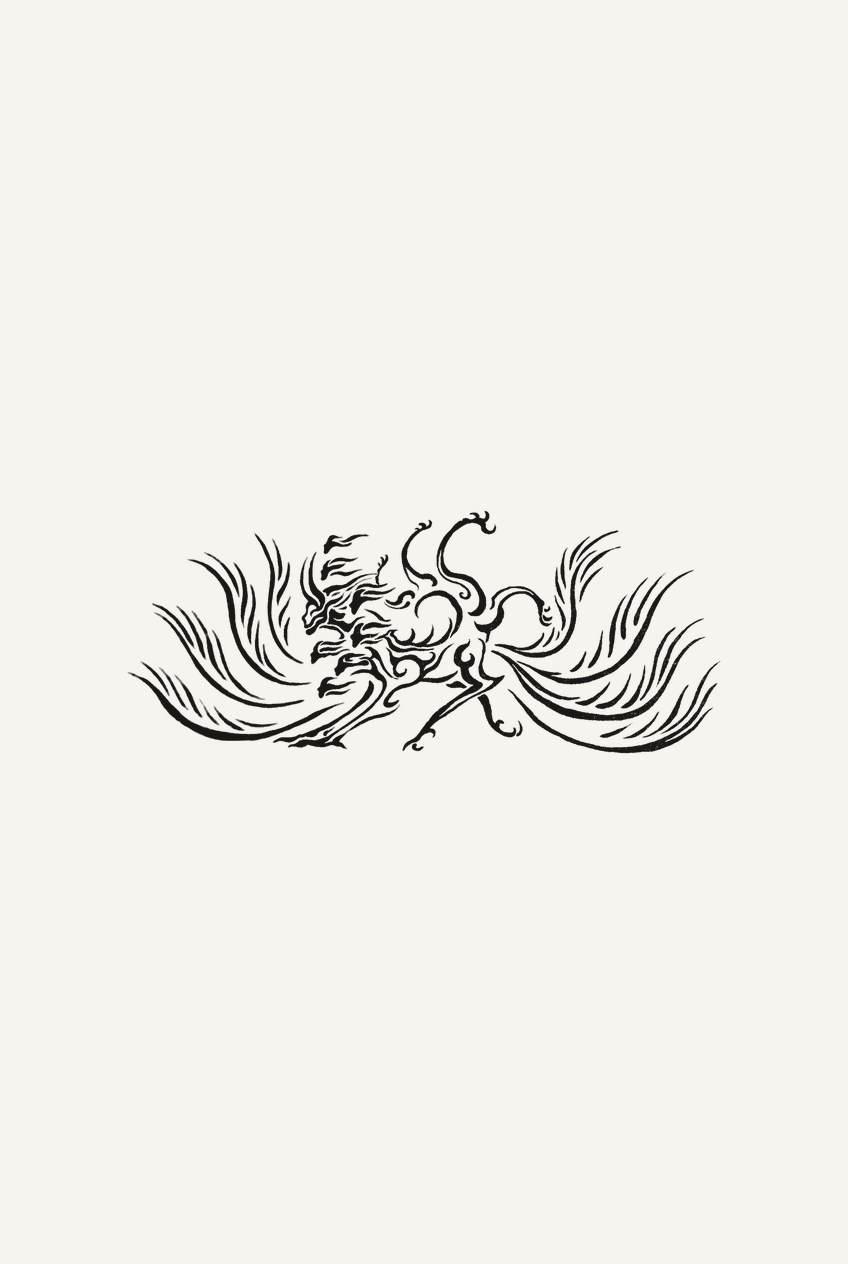
天吴 · Tiān Wú
The Water Duke of Eight Heads
Series: Mythical Beasts & Sacred Animals · Design #34
Style: Eight-headed river god in a running band · bold brushwork · horizontal composition · scalable 14–20 cm
Form: 图案
The Name
*tiān wú* — Tianwu, the Water Duke. The old word *tiān* here means "great" — the Great Wu, clan-god of the river folk, promoted by the *Shanhaijing* to warden of all waters. Its body is a procession: eight heads, each with a human face; eight legs; eight tails. Not a monster multiplied but a god who is everywhere the water is — every current, every ford, every flood, at once.
天吴(tiān wú)——水伯。「天」在古语里就是「大」:伟大的吴,江河之民的氏族神,被《山海经》擢升为众水之守。它的身体是一支行进的队伍:八颗头,每颗都是一张人脸;八条腿;八条尾。不是怪物被复制了八份,而是一位神明同时存在于水所在的每一个地方——每道水流、每个渡口、每场洪水。
Source & Provenance
The *Shanhaijing*, *Haiwai Dong Jing* chapter (compiled c. 4th–2nd century BC), at Chaoyang Valley: 「朝阳之谷,神曰天吴,是为水伯。在𧈫𧈫北两水间。其为兽也,八首人面,八足八尾,皆青黄。」 — in Chaoyang Valley dwells the god Tianwu, the Water Duke; its form is eight heads with human faces, eight legs, eight tails, all blue-and-gold. A parallel record in the *Da Huang Dong Jing* chapter gives eight heads, a tiger's body, ten tails. Historical form reference: the *Shanhaijing* textual record; Warring States and Han depictions of composite water gods. Inking note: this design adapts the classic line construction of the traditional motif and re-inks it as tattoo linework.
《山海经·海外东经》(约成书于前 4—前 2 世纪)朝阳之谷条:「朝阳之谷,神曰天吴,是为水伯。在𧈫𧈫北两水间。其为兽也,八首人面,八足八尾,皆青黄。」《大荒东经》另载其形「八首人面,虎身十尾」。形制参考:《山海经》文本记载;战国与汉代艺术中的复合水神形象。墨线转写:本设计以传统母题的经典线条造型为底,转写为纹身墨线。
Design Inspiration
Every form decision on this design points to a recorded source, element by element. ① The band of eight faces — 八首人面, heads set in a running line, each face calm, no two looking the same way. ② The eight tails streaming — 八尾, drawn as one continuous wave-train, the river's own rhythm given a body. ③ The eight legs in flight — 八足, doubled strides so the god is always mid-crossing. ④ The blue-gold note — 皆青黄, kept for the needle: this re-inking is pure black linework, with the canonical colour left as an at-the-needle option.
本版每一处形制决定都有出处可查,逐条对账。① 八首一线——「八首人面」,头颅排成行进的队列,每张脸都平静,朝向各不相同。② 八尾成涛——「八尾」,画作一列连绵的波浪,把河的节奏给了身体。③ 八足齐奔——「八足」,步态加倍,神明永远处在渡水的中途。④ 青黄之色——「皆青黄」,留给落针:本版为纯墨线转写,经文色码作为落针可选项。
The Story
Most gods of the *Shanhaijing* rule a mountain or guard a gate. Tianwu rules the thing that cannot be gated: water. The text is almost bureaucratic about it — 神曰天吴,是为水伯 — "the god called Tianwu; he is the Duke of Water." A dukedom of rivers. And then, in the flat voice the book uses for miracles, it gives the body count: eight heads with human faces, eight legs, eight tails, all in blue and gold.
Think about what an eightfold body means when the subject is water. A single god walks one bank at a time. But a flood does not arrive politely, one village after another — it arrives everywhere at once. So the Water Duke is drawn as a procession: eight faces reading eight currents, eight tails beating eight rhythms, eight legs carrying him across eight crossings in the same moment. Multiplicity here is not horror. It is coverage. The ancients drew a being that could keep its promise everywhere it was worshipped at once.
There is an older, wilder variant in the same book — tiger's body, ten tails — and scholars read in Tianwu the totem of the Wu river-folk, whose name the character *wu* still carries. "Great Wu": the ancestor so great he became the river. When the Yellow River's floods decided harvest and hunger, a god with a face at every reach of the current was not superstition. It was a map of who was watching.
As a tattoo, this is for the person who is never only in one place at once for the people they love — the one holding eight threads: family, work, friends, the group chat at 2 a.m., all of it, all the time. Eight heads, eight tails: nothing slips.
《山海经》里的大多数神守一座山、把一道门。天吴守的是无法设门的东西:水。经文的语气近乎公事公办——神曰天吴,是为水伯。一个以江河为封地的爵位。然后,用这本书谈论奇迹时惯有的平淡语气,它报出了身体的数目:八首人面,八足八尾,通体青黄。
想一想,当主题是水时,一个八倍的身躯意味着什么。单数的神一次只能走一处河岸。但洪水从不按礼貌的顺序一个村子一个村子地来——它同时抵达所有地方。所以水伯被画成一支行进的队伍:八张脸读着八条水脉,八条尾打着八个节拍,八条腿在同一瞬间渡过八处渡口。这里的复数不是恐怖,是覆盖。古人画出了一个能同时在所有崇拜他的地方兑现承诺的神。
同一本书里还有更古老狂野的变体——虎身十尾——学者在天吴身上读出了吴地江河之民的图腾,「吴」这个字至今仍承载着那个族名。「大吴」:伟大到成为河流本身的祖先。当黄河的洪水决定着丰收与饥馑,一位在水脉每一处都有面孔的神并不是迷信。那是一张「谁在看守」的地图。
作为纹身,它属于那种永远无法只出现在一个地方的人——为所爱之人同时握着八条线的人:家人、工作、朋友、凌晨两点的群消息,所有这些,一直在同时进行。八首八尾:什么都漏不掉。
What It Means
The god of everywhere-at-once: multiply-threaded devotion, the guardian whose coverage never has a gap. Also the emblem of everyone who carries many lives in one body and refuses to let any of them drop.
同时无处不在的神:多线并行的守护,没有空档的覆盖。也是所有「一身承担多重人生、且一件都不肯放下」之人的徽章。
Where It Sits
The procession wants a run of skin: 15–20 cm across the upper back or along the outer thigh, heads leading in the direction of travel. A tighter read — 12–14 cm — works across the sternum or the outer forearm, where the wave-train of tails can wrap slightly with the limb. Horizontal by nature: this god crosses, it does not climb.
队伍需要一条皮肤跑道:15–20 厘米横贯上背,或沿大腿外侧行进,头朝行进方向。更紧凑的读法——12–14 厘米——可横过胸口或小臂外侧,让尾部的波列随肢体轻微环绕。横构图是它的天性:这位神是渡水的,不是攀爬的。
Before You Ink
Count the heads. Eight faces is the canon — 八首人面; fewer heads turns the Water Duke into a generic river beast. Small, calm faces age better than expressive ones. ② The tails must read as one continuous wave-train, not eight separate ropes — ask your artist to let them cross and merge. ③ Ink-only by design: the canonical 皆青黄 (blue-and-gold) is an at-the-needle colour option; this stencil is pure linework. ④ Minimum 12 cm — below that the eight faces merge into texture. ⑤ This design carries strong horizontal flow; avoid placing it across a joint that bends against the current-line, or the faces will fold when you move.
数清头数。八首人面是经文正形——少了头颅,水伯就成了泛泛的河兽。小而平静的脸比表情丰富的脸更耐老。② 八尾必须读成一条连续的波列,而不是八根分开的绳子——请纹身师让它们交叉、汇合。③ 只宜墨线:经文的「皆青黄」是落针可选色;本转印稿为纯线描。④ 不小于 12 厘米——再小八张脸会糊成纹理。⑤ 这件设计的横向流势很强;避免跨过与水流线反向弯折的关节,否则一动,八张脸就会跟着折叠。
Every character on this card was selected and checked stroke by stroke by a native reader of Chinese.