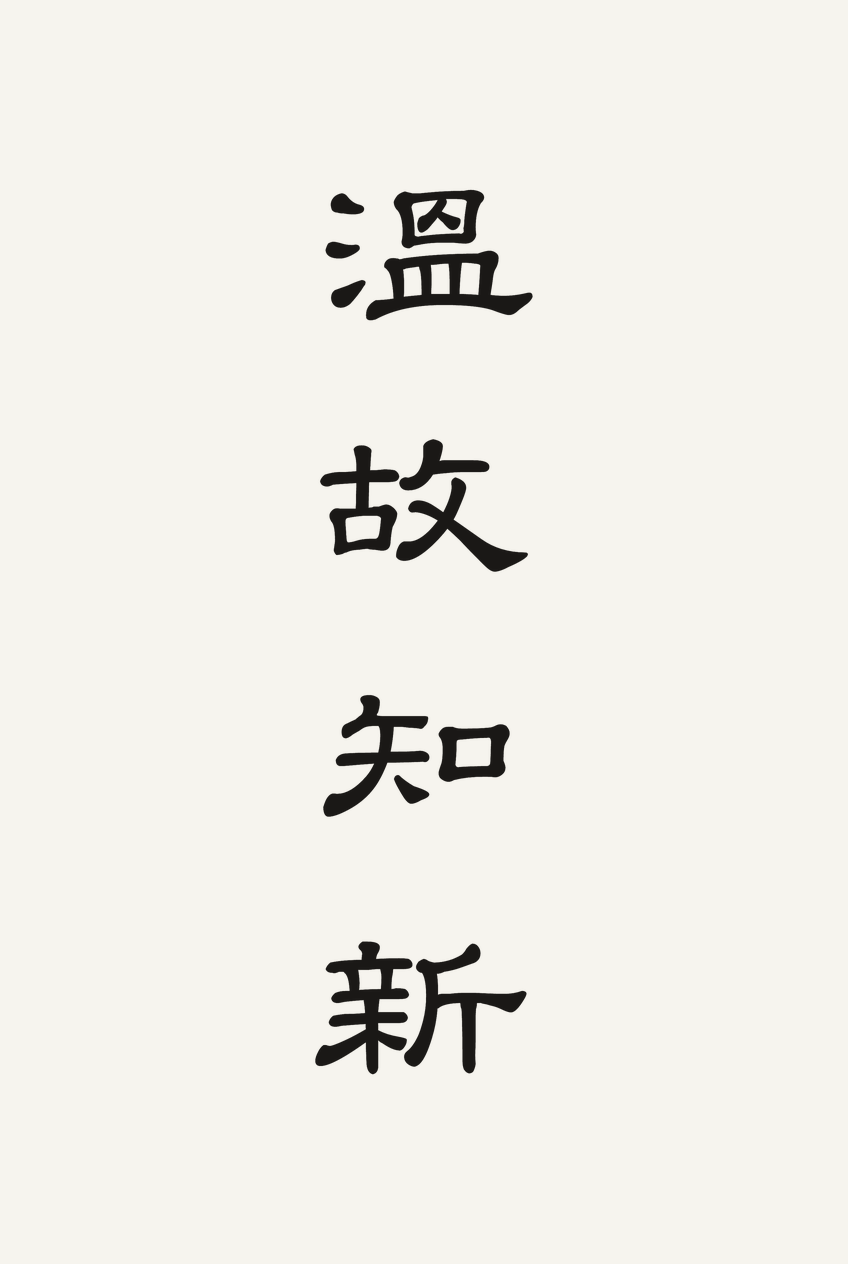
温故知新 · Wēn Gù Zhī Xīn
Warm the Old; Know the New
Series: Auspicious Idioms · Design #27
Style: four characters, vertical column · clerical script (lishu, traditional form 溫故知新) · medium
Form: 文字
The Name
Warm the old, and know the new. Confucius's teaching method in four characters, and his epistemology too: the new is not seized from the future — it is coaxed out of what you already hold, revisited at the right temperature. 溫 is the operative verb: not review, not reread — warm. Knowledge goes cold; the teacher's craft is re-heating it until it gives off something it never showed the first time.
温热旧知,从而知新。孔子的教学法四字写尽,也是他的认识论:新东西不是从未来抢来的——是从你已持有的东西里焐出来的,在恰当的温度里重访。溫是关键字:不是复习,不是重读——是温。知识会冷;为师的手艺就是把它重新加热,直到它散出第一次从未显过的东西。
Source & Provenance
Analects 2.11 (Weizheng), original text: 溫故而知新,可以為師矣 — "warm the old and know the new: such a one may be a teacher." The four-character compound is the scripture's own text — source and phrase are one document. Inking note: this design adapts the classic line construction of the traditional motif and re-inks it as tattoo linework.
《论语·为政》2.11 原文:溫故而知新,可以為師矣——「温故而知新,就可以做老师了。」四字复合就是经文自身——出处与成语是同一份文献。墨线转写:本设计以传统母题的经典线条造型为底,转写为纹身墨线。
Design Inspiration
Every form decision points to a recorded source, element by element. ① Four characters, one vertical column — the old (故) warmed below the water-radical of 溫, the new (新) standing fresh at the bottom. ② Clerical script, traditional form 溫故知新 — 溫's water-radical carries the temperature; 新's axe-and-tree (斤+木) keeps knowledge sharpened. ③ Medium scale — 12–14 cm. ④ Black ink only — a scholar's ink is the only fire this word needs.
本设计的每一处形制决定都有出处可查,逐条对账。① 四字竖列——故(故)在「溫」的水旁之下被加热,新(新)在最下方fresh立着。② 隶书、繁形「溫故知新」——「溫」的水旁带着温度;「新」的斤+木让知识保持锋利。③ 中尺寸——12–14 厘米。④ 只用墨——这个字需要的火,只有书生的墨。
The Story
Confucius says it casually, the way the best lines in the Analects arrive: someone asked what qualifies a person to teach, and the answer was not "learn more." It was 溫故而知新 — go back to what you already learned, at a different age, with different scars, and find it making new claims. A text read at twenty and forty is not the same text; the reader changed, so the knowledge did. The teacher is simply someone whose old material keeps yielding — publicly, on demand.
The modern reading is stronger than nostalgia. Rereading is not repetition; it is differential diagnosis of yourself. The tattoo suits the returner: the musician who goes back to scales, the coder who rereads the classic paper, the one who revisits the old wound not to relive it but to know what it produced. 故 is not behind you; it is fuel standing by.
孔子说得很随口,《论语》最好的句子都这么到货:有人问怎样才够格教书,答案不是「多学」。是溫故而知新——回到你已经学过的东西那里,换一个年纪、带着不同的伤,发现它提出了新的主张。二十岁读的书和四十岁读的不是同一本;读者变了,知识跟着变。所谓老师,只是那种旧材料不断产出的人——当众、随叫随到。
现代读法比怀旧更有力。重读不是重复;是对你自己的鉴别诊断。这个纹身适合回头的人:回去练音阶的乐手、重读经典论文的程序员、重访旧伤——不是为了重历,而是为了知道它产出过什么——的人。故不在你身后;故是待命的燃料。
What It Means
For the ones mid-career who suspect their best material is behind them — it isn't; it just hasn't been re-warmed. Also for anyone returning to the same page, the same room, the same question, at a different self.
给那些怀疑自己最好的素材已在身后的人——没有;只是还没重新加热。也给每一个回到同一页、同一个房间、同一个问题的人——只是换了一个自己。
Where It Sits
Four characters, one plane: inner forearm best, spine, outer thigh. 12–14 cm legible; below 9 cm the 溫 and 新 densities clog.
四字,一个平面:小臂内侧最佳,脊柱、大腿外侧次之。12–14 厘米可读;低于 9 厘米「溫」「新」的密度会糊。
Before You Ink
Four characters are the whole design. ② Traditional form 溫故知新. ③ Clerical script, level weight. ④ Minimum 9 cm for the denser glyphs. ⑤ Warm, not wallow. The doctrine produces 新 — something new must come out of the revisiting, or it is only a shrine. Check the output quarterly.
四个字就是全部设计。 ② 繁形「溫故知新」。 ③ 隶书、体量平正。 ④ 9 厘米起,密字才立得住。⑤ 温故,不是困在故里。 义理的产出是「新」——重访必须长出新东西,否则那只是一座神龛。每季度验收一次产出。
Every character on this card was selected and checked stroke by stroke by a native reader of Chinese.