狌狌 · Xīng Xīng
The One Who Knows the Past
Series: Mythical Beasts & Sacred Animals · Design #36
Style: White-eared ape creature set between twin peaks · bold brushwork · vertical composition · scalable 12–16 cm
Form: 图案
The Name
*xīng xīng* — the ape-like beast of Mount Zhaoyao, white-eared, walking sometimes on all fours, sometimes upright like a man. The *Shanhaijing* opens its entire bestiary with this creature. Later tradition gave it the gentlest of all mythical powers: it knows the past. Not the future — the past. It remembers everything that has happened, and that is its whole magic.
狌狌(xīng xīng)——招摇山上的猿形异兽,白耳,时而四足伏行,时而像人一样直立行走。《山海经》开卷记的第一只异兽就是它。后世传统给了它一切神话能力里最温柔的一种:知往。不是知来——是知往。它记得所有发生过的事,而这,就是它全部的法术。
Source & Provenance
The *Shanhaijing*, *Nanshan Jing* chapter (compiled c. 4th–2nd century BC), at Mount Zhaoyao: 「有兽焉,其状如禺而白耳,伏行人走,其名曰狌狌,食之善走。」 A second record, *Hainei Nan Jing*: 「狌狌知人名,其为兽如豕而人面,在舜葬西。」 — the xingxing knows men's names. The *Huainanzi* adds: 「狌狌知往而不知来」 — it knows the past but not the future. Historical form reference: the *Shanhaijing* textual record; classical bestiary woodcuts of the ape-beast between hills. Inking note: this design adapts the classic line construction of the traditional motif and re-inks it as tattoo linework.
《山海经·南山经》(约成书于前 4—前 2 世纪)招摇之山条:「有兽焉,其状如禺而白耳,伏行人走,其名曰狌狌,食之善走。」《海内南经》另载:「狌狌知人名,其为兽如豕而人面,在舜葬西。」《淮南子》补记:「狌狌知往而不知来。」形制参考:《山海经》文本记载;古典图谱中山形之间的猿兽木刻。墨线转写:本设计以传统母题的经典线条造型为底,转写为纹身墨线。
Design Inspiration
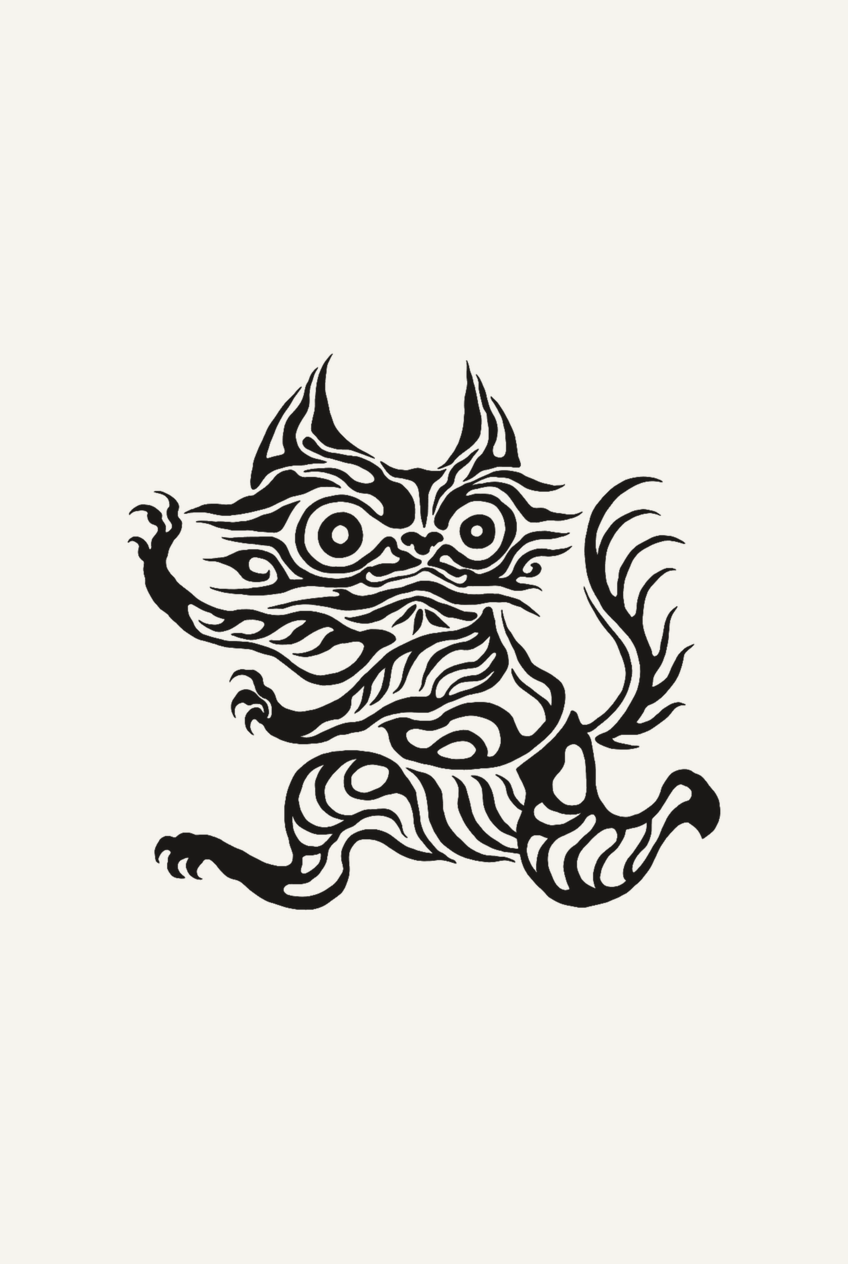
Every form decision on this design points to a recorded source, element by element. ① The ape form — 其状如禺, the simian body drawn with a walker's shoulders, halfway between forest and person. ② The white ears — 白耳, kept as clean paper-negative shapes inside the ink, the design's signature detail. ③ The twin peaks — the classical woodcut convention of setting the beast between hills, grounding it in its mountain home. ④ The walking gait — 伏行人走, one knuckle down, one hand rising — the exact ambiguity the text records.
本版每一处形制决定都有出处可查,逐条对账。① 猿形——「其状如禺」,猿的身躯配上行者的肩线,处在森林与人之间。② 白耳——「白耳」,以纸色负形留在墨中,是这件设计的签名细节。③ 双山——古典图谱把异兽置于山间的惯例,让它落在故山之中。④ 步态——「伏行人走」,一指着地、一手抬起——正是经文记录的那个含糊时刻。
The Story
The very first beast in the *Shanhaijing* — the opening page of China's oldest bestiary — is not a dragon or a phoenix. It is a shy, white-eared ape on a mountain by the western sea, and all it can do is walk like a man and remember. Later texts give it the sad, beautiful limitation in full: 狌狌知往而不知来 — the xingxing knows the past, but not what is coming.
Sit with what that power actually is. It sounds small next to flying and fire-breathing, until you notice that knowing the past is the one magical ability humans already have, and the only one we exercise constantly and badly. The xingxing is memory perfected: it knows men's names, it recalls every kindness and every injury, it cannot be told a story twice. Ancient readers saw in it the scholar's virtue and the griever's burden at once — an animal that cannot forget.
There is warmth in the sources too. The *Book of Rites* says it can talk. The *Huainanzi* lists it beside the magpie that knows the future — between them, the two halves of time. And the pairing quietly explains the beast's melancholy: to hold only the past is to be gentle with everyone's history and defenceless against tomorrow. People who carry heavy memories will recognize the posture immediately.
As a tattoo, the xingxing belongs to the keepers of stories — the family historian, the one who remembers birthdays, debts, promises, who owes who an apology. It says: what came before matters, and someone should carry it. The two peaks it sits between read as then and now, and the white-eared walker between them is you.
《山海经》的第一只异兽——中国最古老图谱的开卷之页——不是龙,也不是凤。是西海之滨一座山上那只羞怯的白耳猿,它全部的本事,是像人一样走路,并且记得。后世文献把它那种既哀且美的局限写全了:狌狌知往而不知来——知道过去,不知道将要来的。
细想这种能力究竟是什么。与飞天喷火相比它听上去很小——直到你发现,「知道过去」本就是人类唯一已经拥有的魔法,也是我们使用得最频繁、却用得最糟的一种。狌狌是记忆的完美形态:它知道人的名字,记得每一次善意与每一次伤害,任何故事听第二遍都会说「这个我听过」。古代读者在它身上同时看到了学者的美德与哀悼者的重负——一只不能遗忘的动物。
典籍里也有温暖的段落。《礼记》说它能言。《淮南子》把它与知来的喜鹊并提——两者合起来,是时间的两半。而这样的并置悄悄解释了异兽的忧郁:只握有过去,意味着对所有人的历史温柔,对明天毫无防备。背负沉重记忆的人,会立刻认出这个姿态。
作为纹身,狌狌属于故事的保管者——家里的记录者,记得所有生日、旧账、承诺、谁欠谁一句道歉的那个人。它说的是:先来之事重要,总得有人背着它。它栖居的双山可以读作「从前」与「如今」,走在两山之间的那只白耳行者,是你。
What It Means
Memory as a form of devotion: the one who keeps what happened from dissolving. For storytellers, family historians, and anyone whose love looks a lot like remembering.
记忆作为一种守护:让发生过的事免于消散的那个人。适合讲故事的人、家族的记录者,以及一切「爱的方式很像记得」的人。
Where It Sits
The vertical twin-peak frame suits 12–16 cm on the inner forearm or the calf, peaks framing the walker between them. At 10–12 cm it also reads cleanly on the upper arm. The composition is self-contained — it does not need to wrap — so flat placements (thigh, back-of-shoulder) work equally well.
竖向双山画框适合 12–16 厘米,落在小臂内侧或小腿,双山夹住中间的行者。10–12 厘米时在大臂上也清晰可读。构图自足、无需环绕,平面位置(大腿、肩后)同样成立。
Before You Ink
The white ears are non-negotiable — 白耳 is the canonical marker; without them it is just a monkey. They should be kept as paper-negative shapes, not grey-filled. ② The gait must stay ambiguous — one knuckle down, one hand rising; a fully upright pose loses the 伏行人走 detail. ③ Ink-only by design: the classical blue-green of the hills is an at-the-needle option; the stencil is pure linework. ④ Minimum 10 cm — the ear-shapes vanish below that. ⑤ Inner-forearm placement sees the most sun of the common spots; expect slightly earlier touch-ups there.
白耳不可省——「白耳」是经文的识别标记;没有它就只是只猴子。白耳应以纸色负形保留,不要填灰。② 步态必须保持含糊——一指着地、一手抬起;完全直立的姿势会丢掉「伏行人走」的细节。③ 只宜墨线:山体古典的青绿色是落针可选项;本转印稿为纯线描。④ 不小于 10 厘米——再小白耳就看不见了。⑤ 小臂内侧是常见位置中日晒最多的;补色周期会略早。
Every character on this card was selected and checked stroke by stroke by a native reader of Chinese.