诸怀 · Zhū Huái
One Water, Two Voices
Series: Mythical Beasts & Sacred Animals · Design #31
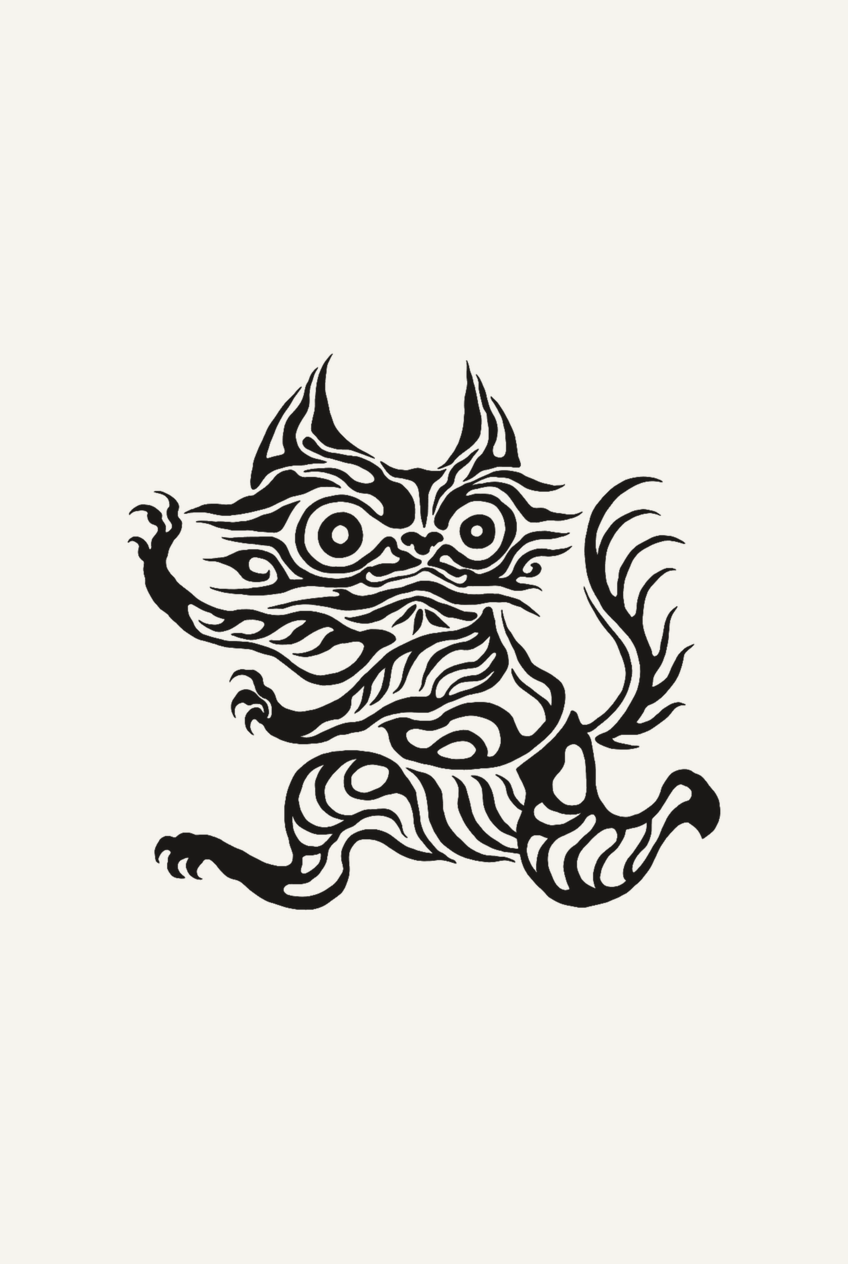
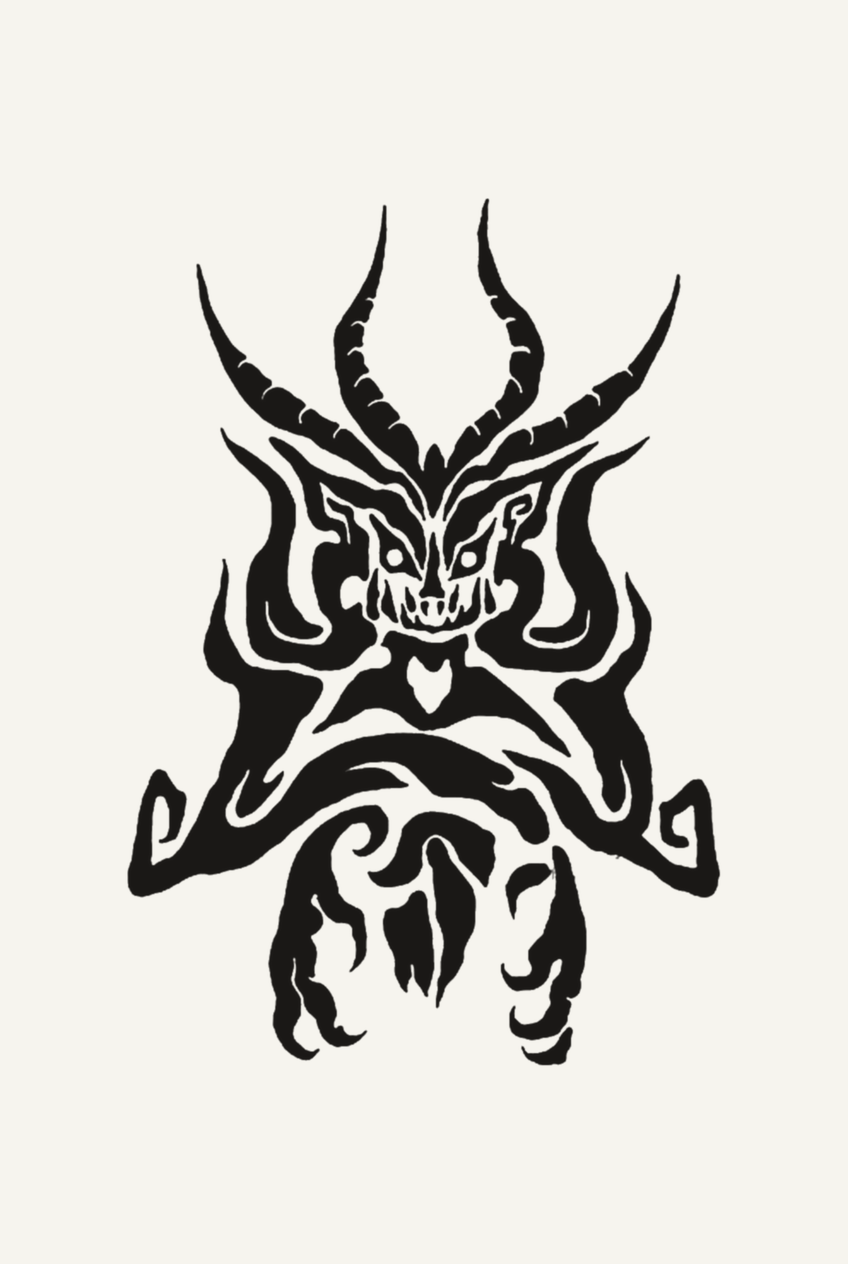
Style: Front-facing totem in vertical format: four horns radiating from the crown, human eyes above a grinning jaw, boar ears, a coiled ox-body with raking claws below, flame-hooks flanking both sides · black-grey · symmetric composition · scalable 14–18 cm
Form: 图案
The Name
*zhū huái* — the four-horned, human-eyed ox of North Yue Mountain, whose cry sounds like wild geese. The record gives it one spring: 诸怀之水 — and in that same water swims a dog-headed fish whose cry sounds like a human infant, which cures madness. Read it twice to feel the symmetry: at the source, a voice that kills; in the water, a voice that heals. One water, two voices — and the beast's name on the mountain where both begin.
诸怀(zhū huái)——北岳之山四角人目的牛形兽,叫声像雁唳。记载给它一道泉:诸怀之水——同一道水里游着一种犬首之鱼,啼声如婴儿,吃了能治癫狂。读两遍才能感到那份对称:源头处,一个杀人的声音;水里,一个救人的声音。一道水,两种声音——而兽的名字,就落在这一切开始的山上。
Source & Provenance
The *Shanhaijing*, *Bei Shan Jing* chapter (compiled c. 4th–2nd century BC), North Yue Mountain entry: 「有兽焉,其状如牛,而四角、人目、彘耳,其名曰诸怀,其音如鸣雁,是食人。诸怀之水出焉,而西流注于嚻水,其中多鮨鱼,鱼身而犬首,其音如婴儿,食之已狂。」 — ox-shaped with four horns, human eyes and boar ears; its cry is like geese calling; it eats people. Its own spring flows west, and in it lives the yu-fish — dog-headed, infant-voiced — whose flesh cures madness. The text sets the cure downstream of the predator and names the water after the predator. Inking note: this design adapts the recorded body-plan and re-inks it as tattoo linework.
《山海经·北山经》(约成书于前 4—前 2 世纪)北岳之山条:「有兽焉,其状如牛,而四角、人目、彘耳,其名曰诸怀,其音如鸣雁,是食人。诸怀之水出焉,而西流注于嚻水,其中多鮨鱼,鱼身而犬首,其音如婴儿,食之已狂。」牛形而四角、人目、彘耳;叫声如雁唳;食人。它名下的泉水西流,水中游着鮨鱼——犬首、婴儿声——其肉能治癫狂。经文把解药放在捕食者的下游,又用捕食者的名字命名这道水。墨线转写:本设计以经文所记的身体蓝图,转写为纹身墨线。
Design Inspiration
Every form decision on this design points to a recorded source, element by element. ① The four radiating horns — 四角, the recorded horns drawn in full spread: two curving inward, two flaring out, the design's crown and its first warning. ② The human eyes — 人目, the recorded eyes rendered as the piece's still center: it looks at you with the one feature it took from you, and the front-facing format forces the exchange. ③ The grinning jaw and boar ears — 其音如鸣雁, the cry drawn as an open grin (a voice that beautiful should not belong here) flanked by the boar ears that hear you coming. ④ The coiled ox-body with flame-hooks — the recorded bulk coiled beneath the face like the water coiling at its feet, the flanking flame-hooks reading as the current: everything in the frame flowing from the mountain down toward the cure.
本版每一处形制决定都有出处可查,逐条对账。① 放射的四角——「四角」,所记的角画成全开:两支内卷,两支外张,全图的冠冕,也是第一道警告。② 人目——「人目」,所记的眼睛画成全图安静的圆心:它用从你那里拿走的唯一部件看着你,而正面构图逼你完成这场对视。③ 咧口与彘耳——「其音如鸣雁」,叫声画成大张的咧口(这么好听的声音不该长在这里),两侧的彘耳听着你的来路。④ 盘曲的牛躯与焰钩——所记的庞躯盘在脸的下方,正如那道水盘在山的脚下,两侧焰钩读作水流:画面里的一切,都从山上向着解药流去。
The Story
The Shanhaijing has many man-eaters, but only one whose name is on the water that cures the madness of meeting it. Sit with the geography the text implies: a mountain; a beast at the top, singing like geese — a beautiful sound, the sound of autumn travel and homecoming, and the last thing its victims expected; a spring flowing west from its feet; and in that water, a dog-headed fish that cries like an infant, and eating it ends madness. The predator and the cure share one watershed. The classic does not explain this. It does not warn you away from the water, either. The arrangement is presented as simply as rainfall: what the mountain breeds, the mountain breeds together.
This is the entry's real teaching, and it is older than the beast: the poison and the antidote grow in the same ground, often under the same name. Traditional medicine codified it — 以毒攻毒 — but the Zhuhai entry had already drawn the map: do not search for a clean cure downstream of a clean danger. There is no such river. The healing fish swims in the killer's water, and the killer's water is the only water there is.
So what does it mean to wear it? This is a design for people who found their cure uncomfortably close to their wound — in the same family, the same trade, the same year, the same name. Wearing Zhuhai is not a warning to avoid the water. It is a map, worn: the source is up there, the cure is down here, and both are yours. 同源之水,择声而饮。
《山海经》有许多食人兽,但只有一只,治「遇见它之癫狂」的解药,流在它名字底下那道水里。把经文暗示的地理摆平了看:一座山;山顶一头兽,唱得像雁——好听的声音,秋天远行与归乡的声音,也是它的牺牲者最没想到的声音;一道泉从它脚下西流;水里游着犬首婴儿声的鱼,吃了它,癫狂终止。捕食者与解药共享一个流域。经文不解释。它也没让你躲开那道水。这份安排被陈述得像降雨一样平常:这座山生养的东西,是一起生养的。
这才是条目真正的教导,而且比这只兽更古老:毒与解药长在同一片土里,常常顶着同一个名字。传统医学把它写成了法度——以毒攻毒——但诸怀这条记载早已画好了地图:别去干净危险的下游找干净的解药。没有那条河。救人的鱼游在杀手的道水里,而杀手的道水,是那里唯一的水。
所以纹它,纹的是什么?这是给「发现解药离伤口近得让人不安」的人的设计——同一个家,同一个行当,同一年,同一个名字。纹诸怀不是警告你躲开水。是一张穿在身上的地图:源头在上面,解药在下面,两样都是你的。同源之水,择声而饮。
What It Means
The face of the predator and, downstream, the voice of the cure — one watershed, worn whole. Not a charm against madness: a map of where both the madness and its medicine begin.
捕食者的脸,与下游处解药的声音——一个流域,整幅穿在身上。不是避狂的护符:是一张地图,标出癫狂与它的药从何处开始。
Where It Sits
Built vertical and frontal: 14–18 cm on the spine or centered chest, the horns running up the body line; a 12 cm variant sits on the calf or outer arm. The human eyes are the design's center — keep them level; a tilted gaze reads as mockery instead of encounter.
天生的竖幅正面构图:14—18 厘米收脊柱或胸口正中,角顺身体线条向上;12 厘米变体收小腿或臂外侧。人目是全图的圆心——务必放平;斜了的目光会读成嘲弄,而不是相遇。
Before You Ink
This design belongs to ink only. The horn spread needs hard symmetrical line — black keeps the totem liturgical; greyscale makes it folk-festival. Minimum size 12 cm: below that the four horns fuse and the eyes lose their stillness. Keep it off the hip side — flexion and friction crack the central axis first, and the axis is the whole frontality.
此图只宜墨线。角的开展需要硬朗对称的线——黑让图腾保持仪式感,灰阶会把它弄成庙会货。最小尺寸 12 厘米:再小,四角黏连,人目失静。避开胯侧——屈曲与摩擦最先皲裂中轴,而中轴就是整幅正面性。
Every character on this card was selected and checked stroke by stroke by a native reader of Chinese.